[English] 日本語
Yorodumi Papers
- Database of articles cited by EMDB/PDB/SASBDB data -

+
Search query

Keywords
Structure methods
Author
Journal
IF

-
Structure paper

TitleLenacapavir prevents production of infectious HIV-1 by abrogating immature virus assembly.
Journal, issue, pagesbioRxiv, Year 2026
Publish dateMar 3, 2026
AuthorsClifton L Ricaña / Savannah G Brancato / Carolyn M Highland / Fatemeh Ekbataniamiri / Krisztina Ambrus / Juan S Rey / Mia Faerch / Bruce E Torbett / Juan R Perilla / Robert A Dick /
PubMed AbstractThe HIV-1 capsid effector Lenacapavir (LEN) acts by disrupting the early (reverse transcription and nuclear entry) and late (assembly and maturation) stages of the viral lifecycle. The early stage ...The HIV-1 capsid effector Lenacapavir (LEN) acts by disrupting the early (reverse transcription and nuclear entry) and late (assembly and maturation) stages of the viral lifecycle. The early stage requires an intact Capsid consisting of a lattice of capsid protein (CA) hexamers and pentamers. Phenylalanine-Glycine (FG) containing nuclear pore proteins interact with Capsid hexamers at their FG pockets, facilitating nuclear entry. Disruption of Capsid lattice stability, or competitive binding to the FG pocket, by LEN blocks infection. Here, we provide insight into the effects of LEN on the late stage. Using a combination of cryo-EM structure determination, assembly, and viral assays, we determined that treatment of producer cells with LEN abrogates the production of infectious virus via multiple mechanisms. Previous studies have shown that HIV-1 produced from LEN treated cells have improperly formed Capsids. However, how LEN interacts with the CA domain of the Gag polyprotein during assembly, prior to maturation, is unclear. Using a viral protease (PR) defective HIV-1 clone, which traps the Gag lattice in an immature state, we found that LEN dramatically remodulates the CA domain. The resulting CA layer was mature-like despite the absence of PR cleavage. We dubbed this unnatural state as "premature" lattice. Proper immature and mature lattice formation requires inositol hexakisphosphate (IP6), but our cryo-EM work revealed a lack of IP6 in the premature lattice. These findings provide insight into the mechanisms by which LEN prevents infectious HIV-1 production.
External linksbioRxiv / PubMed:41867786 / PubMed Central
MethodsEM (single particle)
Resolution3.5 Å
Structure data

EMDB-48430, PDB-9mnm:
SPA of purified HIV-1 CA protein in vitro assembled with IP6 (mature morphology). 500 uM LEN was added post assembly.
Method: EM (single particle) / Resolution: 3.5 Å

Chemicals

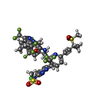
ChemComp-QNG:
N-[(1S)-1-(3-{4-chloro-3-[(methylsulfonyl)amino]-1-(2,2,2-trifluoroethyl)-1H-indazol-7-yl}-6-[3-methyl-3-(methylsulfonyl)but-1-yn-1-yl]pyridin-2-yl)-2-(3,5-difluorophenyl)ethyl]-2-[(3bS,4aR)-5,5-difluoro-3-(trifluoromethyl)-3b,4,4a,5-tetrahydro-1H-cyclopropa[3,4]cyclopenta[1,2-c]pyrazol-1-yl]acetamide / medication, antiretroviral*YM

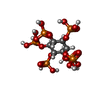
ChemComp-IHP:
INOSITOL HEXAKISPHOSPHATE

Source
  • human immunodeficiency virus type 1 bh10

KeywordsVIRUS LIKE PARTICLE / HIV / Mature / VLP / Lenacapavir

+
About Yorodumi Papers

-
News

-
Feb 9, 2022. New format data for meta-information of EMDB entries

New format data for meta-information of EMDB entries

  • Version 3 of the EMDB header file is now the official format.
  • The previous official version 1.9 will be removed from the archive.

Related info.:EMDB header

External links:wwPDB to switch to version 3 of the EMDB data model

-
Aug 12, 2020. Covid-19 info

Covid-19 info

URL: https://pdbj.org/emnavi/covid19.php

New page: Covid-19 featured information page in EM Navigator.

Related info.:Covid-19 info / Mar 5, 2020. Novel coronavirus structure data

+
Mar 5, 2020. Novel coronavirus structure data

Novel coronavirus structure data

Related info.:Yorodumi Speices / Aug 12, 2020. Covid-19 info

External links:COVID-19 featured content - PDBj / Molecule of the Month (242):Coronavirus Proteases

+
Jan 31, 2019. EMDB accession codes are about to change! (news from PDBe EMDB page)

EMDB accession codes are about to change! (news from PDBe EMDB page)

  • The allocation of 4 digits for EMDB accession codes will soon come to an end. Whilst these codes will remain in use, new EMDB accession codes will include an additional digit and will expand incrementally as the available range of codes is exhausted. The current 4-digit format prefixed with “EMD-” (i.e. EMD-XXXX) will advance to a 5-digit format (i.e. EMD-XXXXX), and so on. It is currently estimated that the 4-digit codes will be depleted around Spring 2019, at which point the 5-digit format will come into force.
  • The EM Navigator/Yorodumi systems omit the EMD- prefix.

Related info.:Q: What is EMD? / ID/Accession-code notation in Yorodumi/EM Navigator

External links:EMDB Accession Codes are Changing Soon! / Contact to PDBj

+
Jul 12, 2017. Major update of PDB

Major update of PDB

  • wwPDB released updated PDB data conforming to the new PDBx/mmCIF dictionary.
  • This is a major update changing the version number from 4 to 5, and with Remediation, in which all the entries are updated.
  • In this update, many items about electron microscopy experimental information are reorganized (e.g. em_software).
  • Now, EM Navigator and Yorodumi are based on the updated data.

External links:wwPDB Remediation / Enriched Model Files Conforming to OneDep Data Standards Now Available in the PDB FTP Archive

-
Yorodumi Papers

Database of articles cited by EMDB/PDB/SASBDB data

  • Database of articles cited by EMDB, PDB, and SASBDB entries
  • Using PubMed data

Related info.:EMDB / PDB / SASBDB / Yorodumi / EMN Papers / Changes in new EM Navigator and Yorodumi

Read more