 Movie
Movie Controller
 Structure viewers
 About Yorodumi Papers


+Search query
-Structure paper
| Title | Cryo-EM structures of engineered Shiga toxin-based immunogens capable of eliciting neutralizing antibodies with therapeutic potential against hemolytic uremic syndrome. |
|---|---|
| Journal, issue, pages | Protein Sci, Vol. 34, Issue 6, Page e70178, Year 2025 |
| Publish date | May 24, 2025 |
 Authors Authors | Alejandro Ezequiel Cristófalo / Arvind Sharma / María Laura Cerutti / Kedar Sharma / Roberto Melero / Romina Pardo / Fernando Alberto Goldbaum / Mario Borgnia / Vanesa Zylberman / Lisandro Horacio Otero /    |
| PubMed Abstract | Shiga toxin-producing Escherichia coli-associated hemolytic uremic syndrome (STEC-HUS) is a serious disease that causes renal failure predominantly in children. Despite its significant impact, there ...Shiga toxin-producing Escherichia coli-associated hemolytic uremic syndrome (STEC-HUS) is a serious disease that causes renal failure predominantly in children. Despite its significant impact, there are currently no licensed vaccines or effective therapies available. The B subunits of Shiga toxins 1 and 2 (Stx1B and Stx2B) are suitable targets for developing neutralizing antibodies, but their pentameric assembly is unstable when isolated from the whole toxin. Taking advantage of the oligomeric symmetry shared between Stx1B and Stx2B with the lumazine synthase from Brucella spp. (BLS), we have previously engineered the chimeric toxoids BLS-Stx1B and BLS-Stx2B as immunogens to generate therapeutic equine polyclonal antibodies. The resulting product (INM004) has successfully passed Phases 1 and 2 clinical trials, and a Phase 3 has been launched in Argentina and seven European countries. In this work, we present the cryo-electron microscopy structures of BLS-Stx1B and BLS-Stx2B, which confirm that these engineered immunogens effectively stabilize the StxB pentamers. Moreover, our results reveal that both chimeric constructs present high flexibility at their extremes, corresponding to motions of the StxBs with respect to the BLS core. Additionally, we present structural evidence of the interaction between the chimeras and polyclonal Fab (pFab) fragments derived from INM004, demonstrating that the elicited neutralizing antibodies block most of the interaction surface of the toxins with their cellular receptors. These findings further validate this promising antibody-based therapy for mitigating STEC-HUS and demonstrate that the BLS-Stx1B and BLS-Stx2B chimeras are potential candidates for developing a human vaccine. |
 External links External links | Protein Sci / PubMed:40411437 / PubMed Central |
| Methods | EM (single particle) |
| Resolution | 2.37 - 8.4 Å |
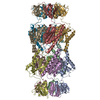
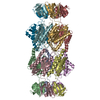
| Structure data | EMDB-42072, PDB-8uav: EMDB-42073, PDB-8uaw:  EMDB-48123: Cryo-EM Map of Brucella Abortus Lumazine Synthase (BLS) Engineered with Shiga Toxin I subunit B (Stx1B) Complexed with Equine Polyclonal Fab Fragments (Complex 1)  EMDB-48124: Cryo-EM Map of Brucella Abortus Lumazine Synthase (BLS) Engineered with Shiga Toxin I subunit B (Stx1B) Complexed with Equine Polyclonal Fab Fragments (Complex 2)  EMDB-48125: Cryo-EM Map of Brucella Abortus Lumazine Synthase (BLS) Engineered with Shiga Toxin I subunit B (Stx1B) Complexed with Equine Polyclonal Fab Fragments (Complex 3)  EMDB-48126: Cryo-EM Map of Brucella Abortus Lumazine Synthase (BLS) Engineered with Shiga Toxin II subunit B (Stx2B) Complexed with Equine Polyclonal Fab Fragments (Complex 1)  EMDB-48127: Cryo-EM Map of Brucella Abortus Lumazine Synthase (BLS) Engineered with Shiga Toxin II subunit B (Stx2B) Complexed with Equine Polyclonal Fab Fragments (Complex 2)  EMDB-48128: Cryo-EM Map of Brucella Abortus Lumazine Synthase (BLS) Engineered with Shiga Toxin II subunit B (Stx2B) Complexed with Equine Polyclonal Fab Fragments (Complex 3)  EMDB-48129: Cryo-EM Map of Brucella Abortus Lumazine Synthase (BLS) Engineered with Shiga Toxin II subunit B (Stx2B) Complexed with Equine Polyclonal Fab Fragments (Complex 4)  EMDB-48130: Cryo-EM Map of Brucella Abortus Lumazine Synthase (BLS) Engineered with Shiga Toxin II subunit B (Stx2B) Complexed with Equine Polyclonal Fab Fragments (Complex 5) |
| Source |
|
 Keywords Keywords | TOXIN / CHIMERA / SHIGA / IMMUNOGEN |

 escherichia coli o157:h7 (bacteria)