 Movie
Movie Controller
 Structure viewers
 About Yorodumi Papers


+Search query
-Structure paper
| Title | Structure of a mutated photosystem II complex reveals changes to the hydrogen-bonding network that affect proton egress during O-O bond formation. |
|---|---|
| Journal, issue, pages | J Biol Chem, Vol. 301, Issue 3, Page 108272, Year 2025 |
| Publish date | Feb 6, 2025 |
 Authors Authors | David A Flesher / Jieun Shin / Richard J Debus / Gary W Brudvig /  |
| PubMed Abstract | Photosystem II (PSII) is the water-splitting enzyme of oxygenic photosynthesis. Using light energy, PSII catalytically oxidizes two water molecules to fuel downstream metabolism, forming an O-O bond ...Photosystem II (PSII) is the water-splitting enzyme of oxygenic photosynthesis. Using light energy, PSII catalytically oxidizes two water molecules to fuel downstream metabolism, forming an O-O bond and releasing O as a byproduct. The reaction mechanism requires the strategic removal of four protons via conserved hydrogen-bonding networks, but these pathways remain poorly understood. Site-directed mutagenesis has been used to study these pathways and the role of specific side chains, such as Lys317 of the D2 subunit. Previous studies showed that the D2-Lys317Ala substitution, which abolishes the flexible hydrogen-bonding -NH group, resulted in delayed O release kinetics and diminished catalytic turnover, suggesting Lys317 has a crucial role in facilitating proton egress. Here, we investigated this proton egress pathway by determining the cryo-EM structure of PSII containing the D2-Lys317Ala substitution at a resolution of 1.97 Å. We observed that four new water molecules fill the space previously occupied by Lys317, but these waters lack specific water-protein interactions, leading to heterogeneity and suboptimal hydrogen bonding. We hypothesize that these waters negatively contribute to the existing hydrogen-bonding network and increase the entropic barrier for proton transfer. Additionally, we observed that a conserved chloride ion (Cl1), which is associated with Lys317, is unexpectedly maintained in D2-Lys317Ala PSII. However, unlike in wild-type, Cl1 has no measured effect on oxygen-evolution rates in D2-Lys317Ala PSII. This suggests that the role of Cl1 is dependent on the Lys317 amino group. These findings provide new insight into proton egress through the Cl1 hydrogen-bonding channel. |
 External links External links | J Biol Chem / PubMed:39922494 / PubMed Central |
| Methods | EM (single particle) |
| Resolution | 1.97 Å |
| Structure data | EMDB-48046, PDB-9eh5: |
| Chemicals | 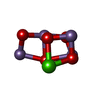 ChemComp-OEX:  ChemComp-FE2:  ChemComp-CL:  ChemComp-CLA:  ChemComp-PHO:  ChemComp-BCR:  ChemComp-LMG:  ChemComp-PL9:  ChemComp-SQD:  ChemComp-LMT:  ChemComp-BCT:  ChemComp-LHG:  ChemComp-DGD:  ChemComp-HEM:  ChemComp-RRX:  ChemComp-CA:  ChemComp-HOH: |
| Source |
|
 Keywords Keywords | PHOTOSYNTHESIS / photosystem II / oxygen-evolving complex / transition metals / metalloenzyme / mutagenesis / water channel / hydrogen-bond network |


 synechocystis sp. pcc 6803 (bacteria)