[English] 日本語
Yorodumi Papers
- Database of articles cited by EMDB/PDB/SASBDB data -

+
Search query

Keywords
Structure methods
Author
Journal
IF

-
Structure paper

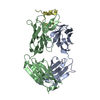
TitleStructures of respiratory syncytial virus G bound to broadly reactive antibodies provide insights into vaccine design.
Journal, issue, pagesSci Rep, Vol. 15, Issue 1, Page 8666, Year 2025
Publish dateMar 13, 2025
AuthorsMaria G Juarez / Sara M O'Rourke / John V Dzimianski / Delia Gagnon / Gabriel Penunuri / Vitor H B Serrão / Russell B Corbett-Detig / Lawrence M Kauvar / Rebecca M DuBois /
PubMed AbstractRespiratory syncytial virus (RSV) is a leading cause of severe lower respiratory tract disease in infants and older adults. The attachment glycoprotein (RSV G) binds to the chemokine receptor CX3CR1 ...Respiratory syncytial virus (RSV) is a leading cause of severe lower respiratory tract disease in infants and older adults. The attachment glycoprotein (RSV G) binds to the chemokine receptor CX3CR1 to promote viral entry and modulate host immunity. Antibodies against RSV G are a known correlate of protection. Previously, several broadly reactive, high-affinity anti-RSV G human monoclonal antibodies were isolated from RSV-exposed individuals and were shown to be protective in vitro and in vivo. Here, we determined the structures of three of these antibodies in complex with RSV G and defined distinct conformational epitopes comprised of highly conserved RSV G residues. Binding competition and structural studies demonstrated that this highly conserved region displays two non-overlapping antigenic sites. Analyses of anti-RSV G antibody sequences reveal that antigenic site flexibility may promote the elicitation of diverse antibody germlines. Together, these findings provide a foundation for next-generation RSV prophylactics, and they expand concepts in vaccine design for the elicitation of germline lineage-diverse, broadly reactive, high-affinity antibodies.
External linksSci Rep / PubMed:40082629 / PubMed Central
MethodsEM (single particle) / X-ray diffraction
Resolution1.74 - 7.29 Å
Structure data

EMDB-47153: Single particle cryoelectron microscopy of respiratory syncytial virus G ectodomain in complex with Fabs 2D10 and 3D3
Method: EM (single particle) / Resolution: 7.29 Å

PDB-9cqa:
Structure of antibody 1G1 bound to the central conserved region of RSV G
Method: X-RAY DIFFRACTION / Resolution: 1.74 Å

PDB-9cqb:
Antibody 1G8 bound to the central conserved domain of RSV G
Method: X-RAY DIFFRACTION / Resolution: 2.5 Å

PDB-9cqd:
Antibody 2B11 bound to the central conserved domain of RSV G
Method: X-RAY DIFFRACTION / Resolution: 3.1 Å

Chemicals

ChemComp-SO4:
SULFATE ION

ChemComp-HOH:
WATER

Source
  • Respiratory syncytial virus
  • homo sapiens (human)
  • respiratory syncytial virus a2
KeywordsVIRAL PROTEIN/IMMUNE SYSTEM / antibody / respiratory syncytial virus / G glycoprotein / VIRAL PROTEIN / VIRAL PROTEIN-IMMUNE SYSTEM complex

+
About Yorodumi Papers

-
News

-
Feb 9, 2022. New format data for meta-information of EMDB entries

New format data for meta-information of EMDB entries

  • Version 3 of the EMDB header file is now the official format.
  • The previous official version 1.9 will be removed from the archive.

Related info.:EMDB header

External links:wwPDB to switch to version 3 of the EMDB data model

-
Aug 12, 2020. Covid-19 info

Covid-19 info

URL: https://pdbj.org/emnavi/covid19.php

New page: Covid-19 featured information page in EM Navigator.

Related info.:Covid-19 info / Mar 5, 2020. Novel coronavirus structure data

+
Mar 5, 2020. Novel coronavirus structure data

Novel coronavirus structure data

Related info.:Yorodumi Speices / Aug 12, 2020. Covid-19 info

External links:COVID-19 featured content - PDBj / Molecule of the Month (242):Coronavirus Proteases

+
Jan 31, 2019. EMDB accession codes are about to change! (news from PDBe EMDB page)

EMDB accession codes are about to change! (news from PDBe EMDB page)

  • The allocation of 4 digits for EMDB accession codes will soon come to an end. Whilst these codes will remain in use, new EMDB accession codes will include an additional digit and will expand incrementally as the available range of codes is exhausted. The current 4-digit format prefixed with “EMD-” (i.e. EMD-XXXX) will advance to a 5-digit format (i.e. EMD-XXXXX), and so on. It is currently estimated that the 4-digit codes will be depleted around Spring 2019, at which point the 5-digit format will come into force.
  • The EM Navigator/Yorodumi systems omit the EMD- prefix.

Related info.:Q: What is EMD? / ID/Accession-code notation in Yorodumi/EM Navigator

External links:EMDB Accession Codes are Changing Soon! / Contact to PDBj

+
Jul 12, 2017. Major update of PDB

Major update of PDB

  • wwPDB released updated PDB data conforming to the new PDBx/mmCIF dictionary.
  • This is a major update changing the version number from 4 to 5, and with Remediation, in which all the entries are updated.
  • In this update, many items about electron microscopy experimental information are reorganized (e.g. em_software).
  • Now, EM Navigator and Yorodumi are based on the updated data.

External links:wwPDB Remediation / Enriched Model Files Conforming to OneDep Data Standards Now Available in the PDB FTP Archive

-
Yorodumi Papers

Database of articles cited by EMDB/PDB/SASBDB data

  • Database of articles cited by EMDB, PDB, and SASBDB entries
  • Using PubMed data

Related info.:EMDB / PDB / SASBDB / Yorodumi / EMN Papers / Changes in new EM Navigator and Yorodumi

Read more