 Movie
Movie Controller
 Structure viewers
 About Yorodumi Papers


+Search query
-Structure paper
| Title | The structure of basal body inner junctions from Tetrahymena revealed by electron cryo-tomography. |
|---|---|
| Journal, issue, pages | EMBO J, Vol. 44, Issue 7, Page 1975-2001, Year 2025 |
| Publish date | Feb 24, 2025 |
 Authors Authors | Sam Li / Jose-Jesus Fernandez / Marisa D Ruehle / Rachel A Howard-Till / Amy Fabritius / Chad G Pearson / David A Agard / Mark E Winey /   |
| PubMed Abstract | The cilium is a microtubule-based eukaryotic organelle critical for many cellular functions. Its assembly initiates at a basal body and continues as an axoneme that projects out of the cell to form a ...The cilium is a microtubule-based eukaryotic organelle critical for many cellular functions. Its assembly initiates at a basal body and continues as an axoneme that projects out of the cell to form a functional cilium. This assembly process is tightly regulated. However, our knowledge of the molecular architecture and the mechanism of assembly is limited. By applying cryo-electron tomography, we obtained structures of the inner junction in three regions of the cilium from Tetrahymena: the proximal, the central core of the basal body, and the axoneme. We identified several protein components in the basal body. While a few proteins are distributed throughout the entire length of the organelle, many are restricted to specific regions, forming intricate local interaction networks in the inner junction and bolstering local structural stability. By examining the inner junction in a POC1 knockout mutant, we found the triplet microtubule was destabilized, resulting in a defective structure. Surprisingly, several axoneme-specific components were found to "infiltrate" into the mutant basal body. Our findings provide molecular insight into cilium assembly at the inner junctions, underscoring its precise spatial regulation. |
 External links External links | EMBO J / PubMed:39994484 / PubMed Central |
| Methods | EM (subtomogram averaging) |
| Resolution | 5.89 - 10.1 Å |
| Structure data |  EMDB-46437: A 16-nm repeat of A-B Inner junction of TMT from the proximal region of basal body, wild-type  EMDB-46438: A 16-nm repeat of B-C Inner junction of TMT from the proximal region of basal body, wild-type  EMDB-46439: A 48-nm repeat of A-B inner junction of TMT from central core region of basal body, wild-type  EMDB-46440: A 16-nm repeat of A-B inner junction of TMT from the central core region of basal body, wild-type  EMDB-46441: A 16-nm repeat of A-B inner junction of DMT from axoneme, wild-type  EMDB-46442: A 16-nm repeat of A-B inner junction of TMT from the central core region of basal body, a subset of data from POC1 knockout mutant  EMDB-46443: A 48-nm repeat of A-B inner junction of TMT from the central core region of basal body, a subset of data from POC1 knockout mutant |
| Source |
|

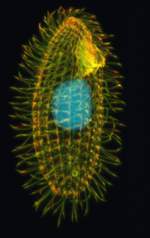 Tetrahymena thermophila (eukaryote)