[English] 日本語
Yorodumi Papers
- Database of articles cited by EMDB/PDB/SASBDB data -

+
Search query

Keywords
Structure methods
Author
Journal
IF

-
Structure paper

TitleHigh-throughput synthesis and specificity characterization of natively paired influenza hemagglutinin antibodies with oPool display.
Journal, issue, pagesSci Transl Med, Vol. 17, Issue 814, Page eadt4147, Year 2025
Publish dateSep 3, 2025
AuthorsWenhao O Ouyang / Huibin Lv / Wenkan Liu / Ruipeng Lei / Zongjun Mou / Tossapol Pholcharee / Logan Talmage / Meixuan Tong / Wei Ji / Yiquan Wang / Katrine E Dailey / Akshita B Gopal / Danbi Choi / Madison R Ardagh / Lucia A Rodriguez / Jenna J Guthmiller / Xinghong Dai / Nicholas C Wu /
PubMed AbstractAntibody discovery is crucial for developing therapeutics and vaccines and for understanding adaptive immunity. However, the lack of approaches to synthesize antibodies with defined sequences in a ...Antibody discovery is crucial for developing therapeutics and vaccines and for understanding adaptive immunity. However, the lack of approaches to synthesize antibodies with defined sequences in a high-throughput manner represents a major bottleneck in antibody discovery. Here, we present oPool display, a high-throughput cell-free platform that combined oligo pool synthesis and mRNA display to rapidly construct and characterize hundreds to thousands of natively paired antibodies in parallel. As a proof of concept, we applied oPool display to probe the binding specificity of more than 300 uncommon influenza hemagglutinin-specific antibodies against nine hemagglutinin variants through 16 screens. More than 5000 binding tests were performed in 3 to 5 days of hands-on time with further scaling potential. Follow-up structural and functional analysis of two antibodies revealed the versatility of the human immunoglobulin gene segment D3-3 () in recognizing the hemagglutinin stem. Overall, this study established an experimental platform that not only accelerates antibody characterization but also enables unbiased discovery of recurring molecular signatures among antibodies with the same specificity.
External linksSci Transl Med / PubMed:40901925 / PubMed Central
MethodsEM (single particle)
Resolution2.82 - 2.9 Å
Structure data

EMDB-45930, PDB-9cu7:
Structure of 16.ND.92 Fab in complex with A/Solomon Islands/3/2006(H1N1) influenza virus Hemagglutinin
Method: EM (single particle) / Resolution: 2.82 Å

EMDB-46727, PDB-9dbx:
Structure of AG11-2F01 Fab in complex with A/Solomon Islands/3/2006 (H1N1) influenza virus hemagglutinin
Method: EM (single particle) / Resolution: 2.9 Å

Chemicals

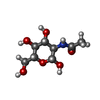
ChemComp-NAG:
2-acetamido-2-deoxy-beta-D-glucopyranose

Source
  • homo sapiens (human)
  • influenza a virus (a/solomon islands/3/2006(h1n1))
  • influenza a virus
KeywordsVIRAL PROTEIN/IMMUNE SYSTEM / Antibody / Influenza / Hemagglutinin / VIRAL PROTEIN-IMMUNE SYSTEM complex / antibody-antigen complex

+
About Yorodumi Papers

-
News

-
Feb 9, 2022. New format data for meta-information of EMDB entries

New format data for meta-information of EMDB entries

  • Version 3 of the EMDB header file is now the official format.
  • The previous official version 1.9 will be removed from the archive.

Related info.:EMDB header

External links:wwPDB to switch to version 3 of the EMDB data model

-
Aug 12, 2020. Covid-19 info

Covid-19 info

URL: https://pdbj.org/emnavi/covid19.php

New page: Covid-19 featured information page in EM Navigator.

Related info.:Covid-19 info / Mar 5, 2020. Novel coronavirus structure data

+
Mar 5, 2020. Novel coronavirus structure data

Novel coronavirus structure data

Related info.:Yorodumi Speices / Aug 12, 2020. Covid-19 info

External links:COVID-19 featured content - PDBj / Molecule of the Month (242):Coronavirus Proteases

+
Jan 31, 2019. EMDB accession codes are about to change! (news from PDBe EMDB page)

EMDB accession codes are about to change! (news from PDBe EMDB page)

  • The allocation of 4 digits for EMDB accession codes will soon come to an end. Whilst these codes will remain in use, new EMDB accession codes will include an additional digit and will expand incrementally as the available range of codes is exhausted. The current 4-digit format prefixed with “EMD-” (i.e. EMD-XXXX) will advance to a 5-digit format (i.e. EMD-XXXXX), and so on. It is currently estimated that the 4-digit codes will be depleted around Spring 2019, at which point the 5-digit format will come into force.
  • The EM Navigator/Yorodumi systems omit the EMD- prefix.

Related info.:Q: What is EMD? / ID/Accession-code notation in Yorodumi/EM Navigator

External links:EMDB Accession Codes are Changing Soon! / Contact to PDBj

+
Jul 12, 2017. Major update of PDB

Major update of PDB

  • wwPDB released updated PDB data conforming to the new PDBx/mmCIF dictionary.
  • This is a major update changing the version number from 4 to 5, and with Remediation, in which all the entries are updated.
  • In this update, many items about electron microscopy experimental information are reorganized (e.g. em_software).
  • Now, EM Navigator and Yorodumi are based on the updated data.

External links:wwPDB Remediation / Enriched Model Files Conforming to OneDep Data Standards Now Available in the PDB FTP Archive

-
Yorodumi Papers

Database of articles cited by EMDB/PDB/SASBDB data

  • Database of articles cited by EMDB, PDB, and SASBDB entries
  • Using PubMed data

Related info.:EMDB / PDB / SASBDB / Yorodumi / EMN Papers / Changes in new EM Navigator and Yorodumi

Read more