 Movie
Movie Controller
 Structure viewers
 About Yorodumi Papers


+Search query
-Structure paper
| Title | A cocktail of human mAbs targeting the henipavirus fusion and receptor binding proteins provides cross-species neutralization. |
|---|---|
| Journal, issue, pages | Sci Transl Med, Vol. 18, Issue 853, Page eadw8573, Year 2026 |
| Publish date | Jun 10, 2026 |
 Authors Authors | Axel A Guzmán-Solís / Mohamed Ouizougun-Oubari / Olivier Escaffre / Brendan B Larsen / Mary Lopez / Selina Locklear / Madhu Kumar / Terry L Juelich / Jennifer K Smith / Lihong Zhang / Griffin D Haas / Rachel Roenicke / Luca Brambilla / Kasopefoluwa Y Oguntuyo / Aum R Patel / Iden A Sapse / Thomas A Bowden / Domenico Tortorella / Jesse D Bloom / Alexander N Freiberg / Goran Bajic / James Andrew Duty / Benhur Lee /   |
| PubMed Abstract | The Nipah and Hendra viruses (NiV and HeV, respectively) are highly pathogenic, with case fatality rates of 40 to 75%, representing substantial public health threats. Although one monoclonal antibody ...The Nipah and Hendra viruses (NiV and HeV, respectively) are highly pathogenic, with case fatality rates of 40 to 75%, representing substantial public health threats. Although one monoclonal antibody (mAb), mAb102.4, has advanced through phase 1 clinical trials, there remains a critical need for approved therapeutic options against these henipaviruses (HNVs). Development of human mAbs has been constrained by limited access to convalescent patient samples. Here, we describe human mAbs derived from transgenic humanized mice that cross-neutralize extant NiV and HeV strains by binding to their fusion protein (F) or receptor binding protein (RBP). Deep mutational scanning and functional studies demonstrated that the anti-RBP mAb (8G3) targets the receptor binding site and requires multiple simultaneous mutations for escape. Sequence analysis of our anti-F mAbs identified a clonally expanded VH3-33 family with evidence of somatic hypermutation, yielding high-affinity antibodies. Cryo-electron microscopy revealed that our most potent F antibody (2A1) recognizes a conserved quaternary epitope spanning two protomers in trimeric prefusion NiV-F and stabilized, rather than displaced, a key glycan shield, distinguishing it from previously described antibodies targeting this region. The 8G3 and 2A1 mAbs exhibited additive neutralization when combined and provided complete protection against lethal NiV challenge in hamsters when administered individually or as a cocktail, even when treatment was delayed. Using a pseudovirus system, we show that this dual-targeting approach was resilient against a suite of escape mutants compared with monotherapy. Our findings establish a candidate therapeutic strategy that minimizes development of resistance, providing a foundation for next-generation countermeasures against emerging HNVs. |
 External links External links | Sci Transl Med / PubMed:42268934 |
| Methods | EM (single particle) |
| Resolution | 3.03 Å |
| Structure data | EMDB-45622, PDB-9cin: |
| Chemicals | 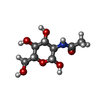 ChemComp-NAG: |
| Source |
|
 Keywords Keywords | VIRAL PROTEIN/IMMUNE SYSTEM / Fusion complex antibody / VIRAL PROTEIN / VIRAL PROTEIN-IMMUNE SYSTEM complex |


 henipavirus nipahense
 mus musculus (house mouse)