 Movie
Movie Controller
 Structure viewers
 About Yorodumi Papers


+Search query
-Structure paper
| Title | PilY1 regulates the dynamic architecture of the type IV pilus machine in Pseudomonas aeruginosa. |
|---|---|
| Journal, issue, pages | Nat Commun, Vol. 15, Issue 1, Page 9382, Year 2024 |
| Publish date | Oct 30, 2024 |
 Authors Authors | Shuaiqi Guo / Yunjie Chang / Yves V Brun / P Lynne Howell / Lori L Burrows / Jun Liu /    |
| PubMed Abstract | Type IV pili (T4P) produced by the pathogen Pseudomonas aeruginosa play a pivotal role in adhesion, surface motility, biofilm formation, and infection in humans. Despite the significance of T4P as a ...Type IV pili (T4P) produced by the pathogen Pseudomonas aeruginosa play a pivotal role in adhesion, surface motility, biofilm formation, and infection in humans. Despite the significance of T4P as a potential therapeutic target, key details of their dynamic assembly and underlying molecular mechanisms of pilus extension and retraction remain elusive, primarily due to challenges in isolating intact T4P machines from the bacterial cell envelope. Here, we combine cryo-electron tomography with subtomogram averaging and integrative modelling to resolve in-situ architectural details of the dynamic T4P machine in P. aeruginosa cells. The T4P machine forms 7-fold symmetric cage-like structures anchored in the cell envelope, providing a molecular framework for the rapid exchange of major pilin subunits during pilus extension and retraction. Our data suggest that the T4P adhesin PilY1 forms a champagne-cork-shaped structure, effectively blocking the secretin channel in the outer membrane whereas the minor-pilin complex in the periplasm appears to contact PilY1 via the central pore of the secretin gate. These findings point to a hypothetical model where the interplay between the secretin protein PilQ and the PilY1-minor-pilin priming complex is important for optimizing conformations of the T4P machine in P. aeruginosa, suggesting a gate-keeping mechanism that regulates pilus dynamics. |
 External links External links | Nat Commun / PubMed:39477930 / PubMed Central |
| Methods | EM (subtomogram averaging) |
| Resolution | 27.7 - 38.6 Å |
| Structure data |  EMDB-43410: Pseudomonas aeruginosa Type IV Pilus Machine, Delta-PilB, upper and mide cages  EMDB-43418: Pseudomonas aeruginosa Type IV Pilus Machine, PilT deletion mutant, Inner-membrane Region  EMDB-43426: Pseudomonas aeruginosa Type IV Pilus Machine, PilT deletion mutant  EMDB-43432: Pseudomonas aeruginosa Type IV Pilus Machine, PilY1 deletion mutant  EMDB-43433: Pseudomonas aeruginosa Type IV Pilus Machine, TsaP deletion mutant  EMDB-43434: Pseudomonas aeruginosa Type IV Pilus Machine, PilB deletion mutant, inner-membrane region |
| Source |
|

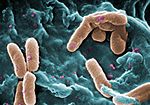 Pseudomonas aeruginosa (bacteria)