 Movie
Movie Controller
 Structure viewers
 About Yorodumi Papers


+Search query
-Structure paper
| Title | Hybrid immunity to SARS-CoV-2 arises from serological recall of IgG antibodies distinctly imprinted by infection or vaccination. |
|---|---|
| Journal, issue, pages | Cell Rep Med, Vol. 5, Issue 8, Page 101668, Year 2024 |
| Publish date | Aug 20, 2024 |
 Authors Authors | William N Voss / Michael A Mallory / Patrick O Byrne / Jeffrey M Marchioni / Sean A Knudson / John M Powers / Sarah R Leist / Bernadeta Dadonaite / Douglas R Townsend / Jessica Kain / Yimin Huang / Ed Satterwhite / Izabella N Castillo / Melissa Mattocks / Chelsea Paresi / Jennifer E Munt / Trevor Scobey / Allison Seeger / Lakshmanane Premkumar / Jesse D Bloom / George Georgiou / Jason S McLellan / Ralph S Baric / Jason J Lavinder / Gregory C Ippolito /  |
| PubMed Abstract | We describe the molecular-level composition of polyclonal immunoglobulin G (IgG) anti-spike antibodies from ancestral severe acute respiratory syndrome coronavirus 2 (SARS-CoV-2) infection, ...We describe the molecular-level composition of polyclonal immunoglobulin G (IgG) anti-spike antibodies from ancestral severe acute respiratory syndrome coronavirus 2 (SARS-CoV-2) infection, vaccination, or their combination ("hybrid immunity") at monoclonal resolution. Infection primarily triggers S2/N-terminal domain (NTD)-reactive antibodies, whereas vaccination mainly induces anti-receptor-binding domain (RBD) antibodies. This imprint persists after secondary exposures wherein >60% of ensuing hybrid immunity derives from the original IgG pool. Monoclonal constituents of the original IgG pool can increase breadth, affinity, and prevalence upon secondary exposures, as exemplified by the plasma antibody SC27. Following a breakthrough infection, vaccine-induced SC27 gained neutralization breadth and potency against SARS-CoV-2 variants and zoonotic viruses (half-maximal inhibitory concentration [IC] ∼0.1-1.75 nM) and increased its binding affinity to the protective RBD class 1/4 epitope (dissociation constant [K] < 5 pM). According to polyclonal escape analysis, SC27-like binding patterns are common in SARS-CoV-2 hybrid immunity. Our findings provide a detailed molecular definition of immunological imprinting and show that vaccination can produce class 1/4 (SC27-like) IgG antibodies circulating in the blood. |
 External links External links | Cell Rep Med / PubMed:39094579 / PubMed Central |
| Methods | EM (single particle) |
| Resolution | 2.6 - 3.1 Å |
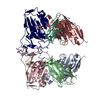
| Structure data |  EMDB-43250: SARS-CoV-2 spike omicron (BA.1) ectodomain trimer in complex with SC27 Fab, global refinement EMDB-43260, PDB-8vif:  EMDB-43261: SARS-CoV-2 spike omicron (BA.1) ectodomain dimer-of-trimers in complex with SC27 Fab, global refinement EMDB-43315, PDB-8vke: |
| Chemicals | 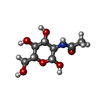 ChemComp-NAG: |
| Source |
|
 Keywords Keywords | VIRAL PROTEIN/IMMUNE SYSTEM / SARS-CoV-2 / coronavirus / S / spike / BA.1 / omicron / RBD / COVID-19 / antibody / SC27 / Fab / virus / viral protein / VIRAL PROTEIN-IMMUNE SYSTEM complex |


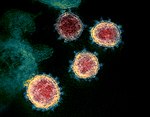 severe acute respiratory syndrome coronavirus 2
 homo sapiens (human)