[English] 日本語
Yorodumi Papers
- Database of articles cited by EMDB/PDB/SASBDB data -

+
Search query

Keywords
Structure methods
Author
Journal
IF

-
Structure paper

TitleStructural insights into the assembly and energy transfer of haptophyte photosystem I-light-harvesting supercomplex.
Journal, issue, pagesProc Natl Acad Sci U S A, Vol. 121, Issue 50, Page e2413678121, Year 2024
Publish dateDec 10, 2024
AuthorsFei-Yu He / Long-Sheng Zhao / Xin-Xiao Qu / Kang Li / Jian-Ping Guo / Fang Zhao / Ning Wang / Bing-Yue Qin / Xiu-Lan Chen / Jun Gao / Lu-Ning Liu / Yu-Zhong Zhang /
PubMed AbstractHaptophyta represents a major taxonomic group, with plastids derived from the primary plastids of red algae. Here, we elucidated the cryoelectron microscopy structure of the photosystem I-light- ...Haptophyta represents a major taxonomic group, with plastids derived from the primary plastids of red algae. Here, we elucidated the cryoelectron microscopy structure of the photosystem I-light-harvesting complex I (PSI-LHCI) supercomplex from the haptophyte . The PSI core comprises 12 subunits, which have evolved differently from red algae and cryptophytes by losing the PsaO subunit while incorporating the PsaK subunit, which is absent in diatoms and dinoflagellates. The PSI core is encircled by 22 fucoxanthin-chlorophyll /-binding light-harvesting antenna proteins (iFCPIs) that form a trilayered antenna arrangement. Moreover, a pigment-binding subunit, L, which has not been identified in any other previously characterized PSI-LHCI supercomplexes, was determined in PSI-iFCPI, presumably facilitating the interactions and energy transfer between peripheral iFCPIs and the PSI core. Calculation of excitation energy transfer rates by computational simulations revealed that the intricate pigment network formed within PSI-iFCPI ensures efficient transfer of excitation energy. Overall, our study provides a solid structural foundation for understanding the light-harvesting and energy transfer mechanisms in haptophyte PSI-iFCPI and provides insights into the evolution and structural variations of red-lineage PSI-LHCIs.
External linksProc Natl Acad Sci U S A / PubMed:39642204 / PubMed Central
MethodsEM (single particle)
Resolution2.74 Å
Structure data

EMDB-39717, PDB-8z11:
Cryo-EM structure of haptophyte photosystem I
Method: EM (single particle) / Resolution: 2.74 Å

Chemicals

ChemComp-CLA:
CHLOROPHYLL A

ChemComp-KC2:
Chlorophyll c2

ChemComp-DD6:
(3S,3'R,5R,6S,7cis)-7',8'-didehydro-5,6-dihydro-5,6-epoxy-beta,beta-carotene-3,3'-diol

ChemComp-LHG:
1,2-DIPALMITOYL-PHOSPHATIDYL-GLYCEROLE / phospholipid*YM

ChemComp-LMG:
1,2-DISTEAROYL-MONOGALACTOSYL-DIGLYCERIDE

ChemComp-A86:
(3S,3'S,5R,5'R,6S,6'R,8'R)-3,5'-dihydroxy-8-oxo-6',7'-didehydro-5,5',6,6',7,8-hexahydro-5,6-epoxy-beta,beta-caroten-3'-

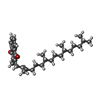
ChemComp-LMU:
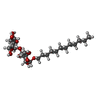
DODECYL-ALPHA-D-MALTOSIDE / detergent*YM

ChemComp-SQD:
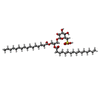
1,2-DI-O-ACYL-3-O-[6-DEOXY-6-SULFO-ALPHA-D-GLUCOPYRANOSYL]-SN-GLYCEROL

ChemComp-DGD:
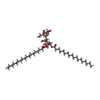
DIGALACTOSYL DIACYL GLYCEROL (DGDG)

ChemComp-BCR:
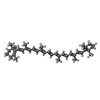
BETA-CAROTENE

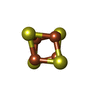
ChemComp-SF4:
IRON/SULFUR CLUSTER

ChemComp-PQN:
PHYLLOQUINONE

Source
  • isochrysis galbana (eukaryote)
KeywordsPHOTOSYNTHESIS / Haptophyte / Photosystem I / evolution

+
About Yorodumi Papers

-
News

-
Feb 9, 2022. New format data for meta-information of EMDB entries

New format data for meta-information of EMDB entries

  • Version 3 of the EMDB header file is now the official format.
  • The previous official version 1.9 will be removed from the archive.

Related info.:EMDB header

External links:wwPDB to switch to version 3 of the EMDB data model

-
Aug 12, 2020. Covid-19 info

Covid-19 info

URL: https://pdbj.org/emnavi/covid19.php

New page: Covid-19 featured information page in EM Navigator.

Related info.:Covid-19 info / Mar 5, 2020. Novel coronavirus structure data

+
Mar 5, 2020. Novel coronavirus structure data

Novel coronavirus structure data

Related info.:Yorodumi Speices / Aug 12, 2020. Covid-19 info

External links:COVID-19 featured content - PDBj / Molecule of the Month (242):Coronavirus Proteases

+
Jan 31, 2019. EMDB accession codes are about to change! (news from PDBe EMDB page)

EMDB accession codes are about to change! (news from PDBe EMDB page)

  • The allocation of 4 digits for EMDB accession codes will soon come to an end. Whilst these codes will remain in use, new EMDB accession codes will include an additional digit and will expand incrementally as the available range of codes is exhausted. The current 4-digit format prefixed with “EMD-” (i.e. EMD-XXXX) will advance to a 5-digit format (i.e. EMD-XXXXX), and so on. It is currently estimated that the 4-digit codes will be depleted around Spring 2019, at which point the 5-digit format will come into force.
  • The EM Navigator/Yorodumi systems omit the EMD- prefix.

Related info.:Q: What is EMD? / ID/Accession-code notation in Yorodumi/EM Navigator

External links:EMDB Accession Codes are Changing Soon! / Contact to PDBj

+
Jul 12, 2017. Major update of PDB

Major update of PDB

  • wwPDB released updated PDB data conforming to the new PDBx/mmCIF dictionary.
  • This is a major update changing the version number from 4 to 5, and with Remediation, in which all the entries are updated.
  • In this update, many items about electron microscopy experimental information are reorganized (e.g. em_software).
  • Now, EM Navigator and Yorodumi are based on the updated data.

External links:wwPDB Remediation / Enriched Model Files Conforming to OneDep Data Standards Now Available in the PDB FTP Archive

-
Yorodumi Papers

Database of articles cited by EMDB/PDB/SASBDB data

  • Database of articles cited by EMDB, PDB, and SASBDB entries
  • Using PubMed data

Related info.:EMDB / PDB / SASBDB / Yorodumi / EMN Papers / Changes in new EM Navigator and Yorodumi

Read more