[English] 日本語
Yorodumi Papers
- Database of articles cited by EMDB/PDB/SASBDB data -

+
Search query

Keywords
Structure methods
Author
Journal
IF

-
Structure paper

TitleStructural basis of neuropeptide Y signaling through Y and Y receptors.
Journal, issue, pagesMedComm (2020), Vol. 5, Issue 7, Page e565, Year 2024
Publish dateJun 15, 2024
AuthorsSiyuan Shen / Yue Deng / Chenglong Shen / Haidi Chen / Lin Cheng / Chao Wu / Chang Zhao / Zhiqian Yang / Hanlin Hou / Kexin Wang / Zhenhua Shao / Cheng Deng / Feng Ye / Wei Yan /
PubMed AbstractNeuropeptide Y (NPY), a 36-amino-acid peptide, functions as a neurotransmitter in both the central and peripheral nervous systems by activating the NPY receptor subfamily. Notably, NPY analogs ...Neuropeptide Y (NPY), a 36-amino-acid peptide, functions as a neurotransmitter in both the central and peripheral nervous systems by activating the NPY receptor subfamily. Notably, NPY analogs display varying selectivity and exert diverse physiological effects through their interactions with this receptor family. [Pro]-NPY and [Leu, Pro]-NPY, mainly acting on YR, reportedly increases blood pressure and postsynaptically potentiates the effect of other vasoactive substances above all, while N-terminal cleaved NPY variants in human body primary mediates angiogenesis and neurotransmitter release inhibition through YR. However, the recognition mechanisms of YR and YR with specific agonists remain elusive, thereby hindering subtype receptor-selective drug development. In this study, we report three cryo-electron microscopy (cryo-EM) structures of Gi2-coupled YR and YR in complexes with NPY, as well as YR bound to a selective agonist [Leu, Pro]-NPY. Combined with cell-based assays, our study not only reveals the conserved peptide-binding mode of NPY receptors but also identifies an additional sub-pocket that confers ligand selectivity. Moreover, our analysis of YR evolutionary dynamics suggests that this sub-pocket has undergone functional adaptive evolution across different species. Collectively, our findings shed light on the molecular underpinnings of neuropeptide recognition and receptor activation, and they present a promising avenue for the design of selective drugs targeting the NPY receptor family.
External linksMedComm (2020) / PubMed:38882210 / PubMed Central
MethodsEM (single particle)
Resolution3.2 - 3.3 Å
Structure data

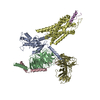
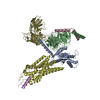
EMDB-36923, PDB-8k6m:
Structural complex of neuropeptide Y receptor 1
Method: EM (single particle) / Resolution: 3.3 Å

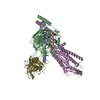
EMDB-36924, PDB-8k6n:
Structural complex of neuropeptide Y receptor 2
Method: EM (single particle) / Resolution: 3.2 Å

EMDB-36925, PDB-8k6o:
Structural complex of neuropeptide Y receptor 1
Method: EM (single particle) / Resolution: 3.3 Å

Source
  • homo sapiens (human)
  • mus musculus (house mouse)
KeywordsMEMBRANE PROTEIN / neuropeptide Y receptor 1 / complex / neuropeptide Y receptor 2

+
About Yorodumi Papers

-
News

-
Feb 9, 2022. New format data for meta-information of EMDB entries

New format data for meta-information of EMDB entries

  • Version 3 of the EMDB header file is now the official format.
  • The previous official version 1.9 will be removed from the archive.

Related info.:EMDB header

External links:wwPDB to switch to version 3 of the EMDB data model

-
Aug 12, 2020. Covid-19 info

Covid-19 info

URL: https://pdbj.org/emnavi/covid19.php

New page: Covid-19 featured information page in EM Navigator.

Related info.:Covid-19 info / Mar 5, 2020. Novel coronavirus structure data

+
Mar 5, 2020. Novel coronavirus structure data

Novel coronavirus structure data

Related info.:Yorodumi Speices / Aug 12, 2020. Covid-19 info

External links:COVID-19 featured content - PDBj / Molecule of the Month (242):Coronavirus Proteases

+
Jan 31, 2019. EMDB accession codes are about to change! (news from PDBe EMDB page)

EMDB accession codes are about to change! (news from PDBe EMDB page)

  • The allocation of 4 digits for EMDB accession codes will soon come to an end. Whilst these codes will remain in use, new EMDB accession codes will include an additional digit and will expand incrementally as the available range of codes is exhausted. The current 4-digit format prefixed with “EMD-” (i.e. EMD-XXXX) will advance to a 5-digit format (i.e. EMD-XXXXX), and so on. It is currently estimated that the 4-digit codes will be depleted around Spring 2019, at which point the 5-digit format will come into force.
  • The EM Navigator/Yorodumi systems omit the EMD- prefix.

Related info.:Q: What is EMD? / ID/Accession-code notation in Yorodumi/EM Navigator

External links:EMDB Accession Codes are Changing Soon! / Contact to PDBj

+
Jul 12, 2017. Major update of PDB

Major update of PDB

  • wwPDB released updated PDB data conforming to the new PDBx/mmCIF dictionary.
  • This is a major update changing the version number from 4 to 5, and with Remediation, in which all the entries are updated.
  • In this update, many items about electron microscopy experimental information are reorganized (e.g. em_software).
  • Now, EM Navigator and Yorodumi are based on the updated data.

External links:wwPDB Remediation / Enriched Model Files Conforming to OneDep Data Standards Now Available in the PDB FTP Archive

-
Yorodumi Papers

Database of articles cited by EMDB/PDB/SASBDB data

  • Database of articles cited by EMDB, PDB, and SASBDB entries
  • Using PubMed data

Related info.:EMDB / PDB / SASBDB / Yorodumi / EMN Papers / Changes in new EM Navigator and Yorodumi

Read more