 Movie
Movie Controller
 Structure viewers
 About Yorodumi Papers


+Search query
-Structure paper
| Title | Biochemical and structural analyses reveal that the tumor suppressor neurofibromin (NF1) forms a high-affinity dimer. |
|---|---|
| Journal, issue, pages | J Biol Chem, Vol. 295, Issue 4, Page 1105-1119, Year 2020 |
| Publish date | Jan 24, 2020 |
 Authors Authors | Mukul Sherekar / Sae-Won Han / Rodolfo Ghirlando / Simon Messing / Matthew Drew / Dana Rabara / Timothy Waybright / Puneet Juneja / Hugh O'Neill / Christopher B Stanley / Debsindhu Bhowmik / Arvind Ramanathan / Sriram Subramaniam / Dwight V Nissley / William Gillette / Frank McCormick / Dominic Esposito /    |
| PubMed Abstract | Neurofibromin is a tumor suppressor encoded by the gene, which is mutated in Rasopathy disease neurofibromatosis type I. Defects in lead to aberrant signaling through the RAS-mitogen-activated ...Neurofibromin is a tumor suppressor encoded by the gene, which is mutated in Rasopathy disease neurofibromatosis type I. Defects in lead to aberrant signaling through the RAS-mitogen-activated protein kinase pathway due to disruption of the neurofibromin GTPase-activating function on RAS family small GTPases. Very little is known about the function of most of the neurofibromin protein; to date, biochemical and structural data exist only for its GAP domain and a region containing a Sec-PH motif. To better understand the role of this large protein, here we carried out a series of biochemical and biophysical experiments, including size-exclusion chromatography-multiangle light scattering (SEC-MALS), small-angle X-ray and neutron scattering, and analytical ultracentrifugation, indicating that full-length neurofibromin forms a high-affinity dimer. We observed that neurofibromin dimerization also occurs in human cells and likely has biological and clinical implications. Analysis of purified full-length and truncated neurofibromin variants by negative-stain EM revealed the overall architecture of the dimer and predicted the potential interactions that contribute to the dimer interface. We could reconstitute structures resembling high-affinity full-length dimers by mixing N- and C-terminal protein domains The reconstituted neurofibromin was capable of GTPase activation , and co-expression of the two domains in human cells effectively recapitulated the activity of full-length neurofibromin. Taken together, these results suggest how neurofibromin dimers might form and be stabilized within the cell. |
 External links External links | J Biol Chem / PubMed:31836666 / PubMed Central |
| Methods | EM (single particle) |
| Resolution | 18.5 Å |
| Structure data | 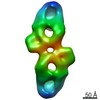 EMDB-20667: |
| Source |
|
 Homo sapiens (human)