[English] 日本語
Yorodumi Papers
- Database of articles cited by EMDB/PDB/SASBDB data -

+
Search query

Keywords
Structure methods
Author
Journal
IF

-
Structure paper

TitleCellular replisomes are powered by flex-fuel motors for unwinding DNA.
Journal, issue, pagesNat Commun, Vol. 17, Issue 1, Year 2026
Publish dateJun 29, 2026
AuthorsFahad Rashid / Sushil Pangeni / Chuan Liu / Harish Kumar / Gyeongtae Sun Moon / Qianyun Yan / Taekjip Ha / James M Berger /
PubMed AbstractDNA replication relies on hexameric, ring-shaped helicases to unwind parental DNA for supporting fork progression over tens of thousands of base pairs. Oddly, biochemical studies have suggested that, ...DNA replication relies on hexameric, ring-shaped helicases to unwind parental DNA for supporting fork progression over tens of thousands of base pairs. Oddly, biochemical studies have suggested that, on their own, replicative helicases are rather limited motors that struggle to couple rapid movement to nucleotide turnover (typically believed to be solely ATP). Here, single-molecule studies reveal that when properly loaded, the Escherichia coli (E. coli) replicative helicase, DnaB, is a tremendously fast single-stranded DNA translocase that moves up to three times more rapidly than the replisome (3 knt/s). Translocation is highly processive, resistant to pulling force/high salt, and can displace short, 3'-tailed DNA duplexes without apparent changes in speed. Surprisingly, we find that the loader for DnaB, DnaC, can use any rNTP or dATP for depositing DnaB onto ssDNA and that the helicase itself also must hydrolyze nucleotide for stable loading. DnaB translocation also turns out to be supported by any r/dNTP, a property shown to extend to the eukaryotic CMG replicative helicase. Overall, the DNA unwinding engines that support cellular replisomes are highly indiscriminate of their fuel source, a feature that may be of utility during times when cells encounter nucleotide pool stress but have committed to DNA synthesis.
External linksNat Commun / PubMed:42373613 / PubMed Central
MethodsEM (single particle)
Resolution3.5 Å
Structure data

EMDB-71404, PDB-9p9a:
DnaB complex binding with ssDNA and dTDP-AlFx
Method: EM (single particle) / Resolution: 3.5 Å

Chemicals

ChemComp-MG:
Unknown entry

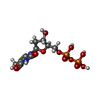
ChemComp-TYD:
THYMIDINE-5'-DIPHOSPHATE

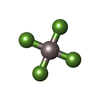
ChemComp-ALF:
TETRAFLUOROALUMINATE ION

Source
  • geobacillus stearothermophilus (bacteria)

  • synthetic construct (others)
KeywordsDNA BINDING PROTEIN / Helicase

+
About Yorodumi Papers

-
News

-
Feb 9, 2022. New format data for meta-information of EMDB entries

New format data for meta-information of EMDB entries

  • Version 3 of the EMDB header file is now the official format.
  • The previous official version 1.9 will be removed from the archive.

Related info.:EMDB header

External links:wwPDB to switch to version 3 of the EMDB data model

-
Aug 12, 2020. Covid-19 info

Covid-19 info

URL: https://pdbj.org/emnavi/covid19.php

New page: Covid-19 featured information page in EM Navigator.

Related info.:Covid-19 info / Mar 5, 2020. Novel coronavirus structure data

+
Mar 5, 2020. Novel coronavirus structure data

Novel coronavirus structure data

Related info.:Yorodumi Speices / Aug 12, 2020. Covid-19 info

External links:COVID-19 featured content - PDBj / Molecule of the Month (242):Coronavirus Proteases

+
Jan 31, 2019. EMDB accession codes are about to change! (news from PDBe EMDB page)

EMDB accession codes are about to change! (news from PDBe EMDB page)

  • The allocation of 4 digits for EMDB accession codes will soon come to an end. Whilst these codes will remain in use, new EMDB accession codes will include an additional digit and will expand incrementally as the available range of codes is exhausted. The current 4-digit format prefixed with “EMD-” (i.e. EMD-XXXX) will advance to a 5-digit format (i.e. EMD-XXXXX), and so on. It is currently estimated that the 4-digit codes will be depleted around Spring 2019, at which point the 5-digit format will come into force.
  • The EM Navigator/Yorodumi systems omit the EMD- prefix.

Related info.:Q: What is EMD? / ID/Accession-code notation in Yorodumi/EM Navigator

External links:EMDB Accession Codes are Changing Soon! / Contact to PDBj

+
Jul 12, 2017. Major update of PDB

Major update of PDB

  • wwPDB released updated PDB data conforming to the new PDBx/mmCIF dictionary.
  • This is a major update changing the version number from 4 to 5, and with Remediation, in which all the entries are updated.
  • In this update, many items about electron microscopy experimental information are reorganized (e.g. em_software).
  • Now, EM Navigator and Yorodumi are based on the updated data.

External links:wwPDB Remediation / Enriched Model Files Conforming to OneDep Data Standards Now Available in the PDB FTP Archive

-
Yorodumi Papers

Database of articles cited by EMDB/PDB/SASBDB data

  • Database of articles cited by EMDB, PDB, and SASBDB entries
  • Using PubMed data

Related info.:EMDB / PDB / SASBDB / Yorodumi / EMN Papers / Changes in new EM Navigator and Yorodumi

Read more