[English] 日本語
Yorodumi Papers
- Database of articles cited by EMDB/PDB/SASBDB data -

+
Search query

Keywords
Structure methods
Author
Journal
IF

-
Structure paper

TitleStructurally exclusive Teneurin complexes orchestrate divergent programs in early cortical development.
Journal, issue, pagesNat Commun, Vol. 17, Issue 1, Year 2026
Publish dateApr 16, 2026
AuthorsMiguel Berbeira-Santana / Claudia Peregrina / Kosuke Okuda / Jin Chuan Zhou / Maria Carrasquero-Ordaz / Amy V Roberts / Anne E Thomas / Evert Haanappel / Matthieu Chavent / Kamel El Omari / Lindsay A Baker / Daniel T Pederick / Els Pardon / Jan Steyaert / U Valentin Nägerl / Daniel Del Toro / Elena Seiradake /
PubMed AbstractCortical migration is a complex process in which neurons migrate along radial glial cells (RGC) to form functional layers. Teneurins (Ten1-4) play a role by interacting with Latrophilins (Lphn/ADGRL1- ...Cortical migration is a complex process in which neurons migrate along radial glial cells (RGC) to form functional layers. Teneurins (Ten1-4) play a role by interacting with Latrophilins (Lphn/ADGRL1-3). Teneurins are also known as cell adhesion molecules, but how homophilic and heterophilic Teneurin interactions are integrated is unknown. Here, single-particle-cryo-EM data of Ten2 shows that canonical Latrophilin-binding is sterically incompatible with Ten2-dimerisation, making these interactions exclusive. We engineered surface mutations that specifically disrupt Ten2-Ten2 or Ten2-Latrophilin interactions. These are transferrable to Ten4, suggesting conserved binding mechanisms. Proteomics, in-vivo-gene-editing and super-resolution-microscopy show that Ten4 is expressed along RGC fibres and that migrating neurons switch from low-to-high Ten4-expression. Ten4 expression is highest in the cortical plate where Ten4-Ten4 interactions reduce RGC-attachment. In the intermediate zone, Ten4-Latrophilin interactions are required to promote neuron-RGC association. The results show how Ten4 orchestrates different stages of cortical migration by using a structural/functional switch between high-affinity Lphn interactions and low-affinity homophilic interactions, underpinning the integration of distinct migration programmes.
External linksNat Commun / PubMed:41991904 / PubMed Central
MethodsEM (single particle)
Resolution2.55 - 3.48 Å
Structure data

EMDB-50975, PDB-9g2f:
Mouse Teneurin2 dimer variant A1B1
Method: EM (single particle) / Resolution: 2.8 Å

EMDB-50976, PDB-9g2h:
Mouse Teneurin2 dimer variant A1B0
Method: EM (single particle) / Resolution: 2.55 Å

EMDB-51021, PDB-9g41:
Mouse Teneurin2 dimer variant A0B1
Method: EM (single particle) / Resolution: 3.48 Å

EMDB-51022, PDB-9g42:
Mouse Teneurin2 dimer variant A0B0
Method: EM (single particle) / Resolution: 2.82 Å

Chemicals

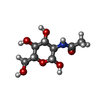
ChemComp-NAG:
2-acetamido-2-deoxy-beta-D-glucopyranose

Source
  • mus musculus (house mouse)
KeywordsCELL ADHESION / cell adhesion molecule / complex / homodimer

+
About Yorodumi Papers

-
News

-
Feb 9, 2022. New format data for meta-information of EMDB entries

New format data for meta-information of EMDB entries

  • Version 3 of the EMDB header file is now the official format.
  • The previous official version 1.9 will be removed from the archive.

Related info.:EMDB header

External links:wwPDB to switch to version 3 of the EMDB data model

-
Aug 12, 2020. Covid-19 info

Covid-19 info

URL: https://pdbj.org/emnavi/covid19.php

New page: Covid-19 featured information page in EM Navigator.

Related info.:Covid-19 info / Mar 5, 2020. Novel coronavirus structure data

+
Mar 5, 2020. Novel coronavirus structure data

Novel coronavirus structure data

Related info.:Yorodumi Speices / Aug 12, 2020. Covid-19 info

External links:COVID-19 featured content - PDBj / Molecule of the Month (242):Coronavirus Proteases

+
Jan 31, 2019. EMDB accession codes are about to change! (news from PDBe EMDB page)

EMDB accession codes are about to change! (news from PDBe EMDB page)

  • The allocation of 4 digits for EMDB accession codes will soon come to an end. Whilst these codes will remain in use, new EMDB accession codes will include an additional digit and will expand incrementally as the available range of codes is exhausted. The current 4-digit format prefixed with “EMD-” (i.e. EMD-XXXX) will advance to a 5-digit format (i.e. EMD-XXXXX), and so on. It is currently estimated that the 4-digit codes will be depleted around Spring 2019, at which point the 5-digit format will come into force.
  • The EM Navigator/Yorodumi systems omit the EMD- prefix.

Related info.:Q: What is EMD? / ID/Accession-code notation in Yorodumi/EM Navigator

External links:EMDB Accession Codes are Changing Soon! / Contact to PDBj

+
Jul 12, 2017. Major update of PDB

Major update of PDB

  • wwPDB released updated PDB data conforming to the new PDBx/mmCIF dictionary.
  • This is a major update changing the version number from 4 to 5, and with Remediation, in which all the entries are updated.
  • In this update, many items about electron microscopy experimental information are reorganized (e.g. em_software).
  • Now, EM Navigator and Yorodumi are based on the updated data.

External links:wwPDB Remediation / Enriched Model Files Conforming to OneDep Data Standards Now Available in the PDB FTP Archive

-
Yorodumi Papers

Database of articles cited by EMDB/PDB/SASBDB data

  • Database of articles cited by EMDB, PDB, and SASBDB entries
  • Using PubMed data

Related info.:EMDB / PDB / SASBDB / Yorodumi / EMN Papers / Changes in new EM Navigator and Yorodumi

Read more