[English] 日本語
Yorodumi Papers
- Database of articles cited by EMDB/PDB/SASBDB data -

+
Search query

Keywords
Structure methods
Author
Journal
IF

-
Structure paper

TitleA highly potent and broadly accessible bispecific nanobody for the treatment of ebola virus infections.
Journal, issue, pagesPLoS Pathog, Vol. 22, Issue 1, Page e1013878, Year 2026
Publish dateJan 27, 2026
AuthorsFan Bu / Gang Ye / Kimberly Morsheimer / Hailey Turner-Hubbard / Brett Eaton / Manu Anantpadma / Khaggeswar Bheemanapally / Chalet Tan / Robert Davey / Fang Li /
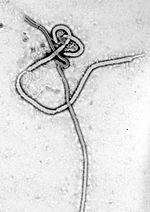
PubMed AbstractEbola virus (EBOV) causes recurring outbreaks, with a case fatality rate of about 40%. Currently approved vaccine and antibody therapies face major limitations, including only modest reductions in ...Ebola virus (EBOV) causes recurring outbreaks, with a case fatality rate of about 40%. Currently approved vaccine and antibody therapies face major limitations, including only modest reductions in mortality and restricted accessibility due to their reliance on injection-based delivery and cold-chain transport and storage. To address these challenges, we developed a bispecific nanobody, Nanosota-EB1/EB2-Fc, composed of two nanobodies (camelid-derived single-domain antibodies, Nanosota-EB1 and Nanosota-EB2) that target distinct epitopes on the EBOV glycoprotein (GP) and are fused to a human Fc domain. Through cooperative contributions from both nanobodies, this bispecific nanobody strongly inhibits GP function and effectively overcomes the virus's decoy mechanism. A single dose provided strong protection in EBOV-infected mice, including when administered at late stages of infection. It was also effective when administered intranasally, offering a needle-free delivery option. Furthermore, its high in vitro stability indicates that it can be deployed without refrigeration. Taken together, this novel bispecific nanobody represents a promising next-generation therapeutic for EBOV, combining high potency with broad accessibility.
External linksPLoS Pathog / PubMed:41592114 / PubMed Central
MethodsEM (single particle)
Resolution2.92 Å
Structure data

EMDB-71328, PDB-9p6x:
Structure of EBOV glycoprotein in complex with Nanosota-EB1 and EB2
Method: EM (single particle) / Resolution: 2.92 Å

Chemicals

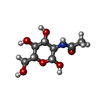
ChemComp-NAG:
2-acetamido-2-deoxy-beta-D-glucopyranose

Source
  • Ebola virus - Mayinga, Zaire, 1976
  • vicugna pacos (alpaca)
  • ebola virus
KeywordsVIRAL PROTEIN / EBOV / glycoprotein / nanobody

+
About Yorodumi Papers

-
News

-
Feb 9, 2022. New format data for meta-information of EMDB entries

New format data for meta-information of EMDB entries

  • Version 3 of the EMDB header file is now the official format.
  • The previous official version 1.9 will be removed from the archive.

Related info.:EMDB header

External links:wwPDB to switch to version 3 of the EMDB data model

-
Aug 12, 2020. Covid-19 info

Covid-19 info

URL: https://pdbj.org/emnavi/covid19.php

New page: Covid-19 featured information page in EM Navigator.

Related info.:Covid-19 info / Mar 5, 2020. Novel coronavirus structure data

+
Mar 5, 2020. Novel coronavirus structure data

Novel coronavirus structure data

Related info.:Yorodumi Speices / Aug 12, 2020. Covid-19 info

External links:COVID-19 featured content - PDBj / Molecule of the Month (242):Coronavirus Proteases

+
Jan 31, 2019. EMDB accession codes are about to change! (news from PDBe EMDB page)

EMDB accession codes are about to change! (news from PDBe EMDB page)

  • The allocation of 4 digits for EMDB accession codes will soon come to an end. Whilst these codes will remain in use, new EMDB accession codes will include an additional digit and will expand incrementally as the available range of codes is exhausted. The current 4-digit format prefixed with “EMD-” (i.e. EMD-XXXX) will advance to a 5-digit format (i.e. EMD-XXXXX), and so on. It is currently estimated that the 4-digit codes will be depleted around Spring 2019, at which point the 5-digit format will come into force.
  • The EM Navigator/Yorodumi systems omit the EMD- prefix.

Related info.:Q: What is EMD? / ID/Accession-code notation in Yorodumi/EM Navigator

External links:EMDB Accession Codes are Changing Soon! / Contact to PDBj

+
Jul 12, 2017. Major update of PDB

Major update of PDB

  • wwPDB released updated PDB data conforming to the new PDBx/mmCIF dictionary.
  • This is a major update changing the version number from 4 to 5, and with Remediation, in which all the entries are updated.
  • In this update, many items about electron microscopy experimental information are reorganized (e.g. em_software).
  • Now, EM Navigator and Yorodumi are based on the updated data.

External links:wwPDB Remediation / Enriched Model Files Conforming to OneDep Data Standards Now Available in the PDB FTP Archive

-
Yorodumi Papers

Database of articles cited by EMDB/PDB/SASBDB data

  • Database of articles cited by EMDB, PDB, and SASBDB entries
  • Using PubMed data

Related info.:EMDB / PDB / SASBDB / Yorodumi / EMN Papers / Changes in new EM Navigator and Yorodumi

Read more