[English] 日本語
Yorodumi Papers
- Database of articles cited by EMDB/PDB/SASBDB data -

+
Search query

Keywords
Structure methods
Author
Journal
IF

-
Structure paper

TitleA disulfide redox switch mechanism regulates glycoside hydrolase function.
Journal, issue, pagesNat Commun, Vol. 17, Issue 1, Page 45, Year 2026
Publish dateJan 5, 2026
AuthorsMarcele Pandeló Martins / Gustavo Henrique Martins / Felipe Jun Fuzita / João Paulo Menezes Spadeto / Renan Yuji Miyamoto / Felippe Mariano Colombari / Fabiane Stoffel / Luciano Graciani Dolce / Camila Ramos Dos Santos / Rodrigo Silva Araujo Streit / Antônio Carlos Borges / Rafael Henrique Galinari / Yoshihisa Yoshimi / Paul Dupree / Gabriela Felix Persinoti / Mariana Abrahão Bueno Morais / Mario Tyago Murakami /
PubMed AbstractDisulfide bonds are a key post-translational modification involved in protein folding, structural stability, and functional regulation. Here, we demonstrate that a glycoside hydrolase from the GH2 ...Disulfide bonds are a key post-translational modification involved in protein folding, structural stability, and functional regulation. Here, we demonstrate that a glycoside hydrolase from the GH2 family undergoes reversible redox regulation through an intramolecular disulfide bond. The enzyme is inactive in its oxidized state and becomes active when reduced through a fully reversible process. Under oxidative conditions, multiple crystallographic and cryo-EM structures revealed a pronounced structural disorder in the active site, most prominent in the regulatory and catalytic loops, which disrupts the substrate binding site and, remarkably, the configuration of the acidic catalytic residues. Conversely, a high-resolution cryo-EM structure of the active (reduced) state unveiled a well-ordered active site with catalytic residues properly positioned for a classical Koshland retaining mechanism. This reversible order-disorder process based on a disulfide switch provides a mechanism for redox-dependent control of glycoside hydrolase activity, with potential implications for carbohydrate metabolism, microbial adaptation and biotechnological applications.
External linksNat Commun / PubMed:41491304 / PubMed Central
MethodsEM (single particle) / X-ray diffraction
Resolution2 - 3.41 Å
Structure data

EMDB-49363: Cryo-EM map of the inactive conformation of a glycoside hydrolase (CapGH2b) from the GH2 family
Method: EM (single particle) / Resolution: 3.41 Å

EMDB-49364, PDB-9nfe:
Active conformation of a redox-regulated glycoside hydrolase (CapGH2b) from the GH2 family
Method: EM (single particle) / Resolution: 2.62 Å

PDB-9np8:
Crystal structure of the inactive conformation of a glycoside hydrolase (CapGH2b) from the GH2 family in the space group I213 at 2.05 A
Method: X-RAY DIFFRACTION / Resolution: 2 Å

PDB-9np9:
Crystal structure of the inactive conformation of a glycoside hydrolase (CapGH2b - E553Q Mutant) from the GH2 family in the space group I213 at 2.6 A
Method: X-RAY DIFFRACTION / Resolution: 2.6 Å

PDB-9npa:
Crystal structure of the inactive conformation of a glycoside hydrolase (CapGH2b) from the GH2 family in the space group I213 at 2.75 A
Method: X-RAY DIFFRACTION / Resolution: 2.75 Å

PDB-9npb:
Crystal structure of the inactive conformation of a glycoside hydrolase (CapGH2b) from the GH2 family in the space group R3 at 2.45 A
Method: X-RAY DIFFRACTION / Resolution: 2.45 Å

PDB-9npc:
Crystal structure of the inactive conformation of a glycoside hydrolase (CapGH2b) from the GH2 family in the space group I212121 at 2.65 A
Method: X-RAY DIFFRACTION / Resolution: 2.65 Å

PDB-9npd:
Crystal structure of the inactive conformation of a glycoside hydrolase (CapGH2b - E553Q Mutant) from the GH2 family in the space group P3121 at 3.05 A
Method: X-RAY DIFFRACTION / Resolution: 3.05 Å

PDB-9npe:
Crystal structure of the inactive conformation of a glycoside hydrolase (CapGH2b) from the GH2 family in the space group P1 at 2.40 A
Method: X-RAY DIFFRACTION / Resolution: 2.4 Å

PDB-9npf:
Crystal structure of the inactive conformation of a glycoside hydrolase (CapGH2b) from the GH2 family in the space group P1 at 2.15 A
Method: X-RAY DIFFRACTION / Resolution: 2.15 Å

PDB-9npl:
Crystal structure of the inactive conformation of a glycoside hydrolase (CapGH2b - E553Q Mutant) from the GH2 family in the space group P1 at 2.25 A
Method: X-RAY DIFFRACTION / Resolution: 2.25 Å

PDB-9npn:
Crystal structure of the inactive conformation of a glycoside hydrolase (CapGH2b - E465A Mutant) from the GH2 family in the space group P1 at 3.1 A
Method: X-RAY DIFFRACTION / Resolution: 3.1 Å

Chemicals

ChemComp-PO4:
PHOSPHATE ION

ChemComp-GOL:
GLYCEROL

ChemComp-HOH:
WATER

ChemComp-TAU:
2-AMINOETHANESULFONIC ACID

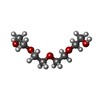
ChemComp-PEG:
DI(HYDROXYETHYL)ETHER

ChemComp-PG4:
TETRAETHYLENE GLYCOL / precipitant*YM

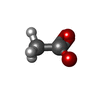
ChemComp-ACT:
ACETATE ION

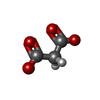
ChemComp-MLI:
MALONATE ION

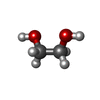
ChemComp-EDO:
1,2-ETHANEDIOL

Source
  • metagenome (others)
KeywordsHYDROLASE / redox-regulation / glycosyl hydrolase / mannosidase / redox-switch / metagenome / disulfide bond

+
About Yorodumi Papers

-
News

-
Feb 9, 2022. New format data for meta-information of EMDB entries

New format data for meta-information of EMDB entries

  • Version 3 of the EMDB header file is now the official format.
  • The previous official version 1.9 will be removed from the archive.

Related info.:EMDB header

External links:wwPDB to switch to version 3 of the EMDB data model

-
Aug 12, 2020. Covid-19 info

Covid-19 info

URL: https://pdbj.org/emnavi/covid19.php

New page: Covid-19 featured information page in EM Navigator.

Related info.:Covid-19 info / Mar 5, 2020. Novel coronavirus structure data

+
Mar 5, 2020. Novel coronavirus structure data

Novel coronavirus structure data

Related info.:Yorodumi Speices / Aug 12, 2020. Covid-19 info

External links:COVID-19 featured content - PDBj / Molecule of the Month (242):Coronavirus Proteases

+
Jan 31, 2019. EMDB accession codes are about to change! (news from PDBe EMDB page)

EMDB accession codes are about to change! (news from PDBe EMDB page)

  • The allocation of 4 digits for EMDB accession codes will soon come to an end. Whilst these codes will remain in use, new EMDB accession codes will include an additional digit and will expand incrementally as the available range of codes is exhausted. The current 4-digit format prefixed with “EMD-” (i.e. EMD-XXXX) will advance to a 5-digit format (i.e. EMD-XXXXX), and so on. It is currently estimated that the 4-digit codes will be depleted around Spring 2019, at which point the 5-digit format will come into force.
  • The EM Navigator/Yorodumi systems omit the EMD- prefix.

Related info.:Q: What is EMD? / ID/Accession-code notation in Yorodumi/EM Navigator

External links:EMDB Accession Codes are Changing Soon! / Contact to PDBj

+
Jul 12, 2017. Major update of PDB

Major update of PDB

  • wwPDB released updated PDB data conforming to the new PDBx/mmCIF dictionary.
  • This is a major update changing the version number from 4 to 5, and with Remediation, in which all the entries are updated.
  • In this update, many items about electron microscopy experimental information are reorganized (e.g. em_software).
  • Now, EM Navigator and Yorodumi are based on the updated data.

External links:wwPDB Remediation / Enriched Model Files Conforming to OneDep Data Standards Now Available in the PDB FTP Archive

-
Yorodumi Papers

Database of articles cited by EMDB/PDB/SASBDB data

  • Database of articles cited by EMDB, PDB, and SASBDB entries
  • Using PubMed data

Related info.:EMDB / PDB / SASBDB / Yorodumi / EMN Papers / Changes in new EM Navigator and Yorodumi

Read more