 Movie
Movie Controller
 Structure viewers
 About Yorodumi Papers


+Search query
-Structure paper
| Title | The cryo-EM structure of Photosystem I from Chromera velia with a bound superoxide dismutase heterodimer. |
|---|---|
| Journal, issue, pages | Nat Commun, Vol. 17, Issue 1, Page 913, Year 2025 |
| Publish date | Dec 21, 2025 |
 Authors Authors | Xukun Yuan / Martin Lukeš / Pu Qian / Quentin Charras / Tomáš Smrčka / Petr Man / Lucie Kovářová / Peter Koník / Emmanuel Heilmann / Ashraf Al-Amoudi / Roman Sobotka / Andreas Naschberger /    |
| PubMed Abstract | Photosystem I is a key component of the solar energy conversion machinery in oxygenic photosynthesis, and its core, where photochemistry occurs, is highly conserved. However, the coral-associated ...Photosystem I is a key component of the solar energy conversion machinery in oxygenic photosynthesis, and its core, where photochemistry occurs, is highly conserved. However, the coral-associated alga Chromera velia that is evolutionary linked to parasitic apicomplexans, exhibits Photosystem I with unusual features. These include the splitting of the central PsaA subunit and the binding of superoxide dismutases as regular subunits. The organization of such a unique Photosystem I was enigmatic. Here, we present the cryo-EM structure of Chromera velia Photosystem I at 1.84 Å resolution. Our work reveals a superoxide dismutase heterodimer bound to the stromal side of the core, stabilized by extensions of canonical subunits, a novel protein PsaV, and a reduced light-harvesting apparatus. We elucidate how the complex evolved to accommodate the superoxide dismutase, assemble the split PsaA, and integrate antenna proteins in a non-canonical orientation. Based on our data and prior physiological data, we propose that this specialized Photosystem I functions likely as an Mehler machine, redirecting electrons from Photosystem II back to water. This mechanism enables Chromera velia to manage redox imbalance and reduce photorespiration through localized oxygen consumption. |
 External links External links | Nat Commun / PubMed:41423677 / PubMed Central |
| Methods | EM (single particle) |
| Resolution | 1.84 - 2.17 Å |
| Structure data |  EMDB-52499: FCPe region focused map  EMDB-52501: SOD region focused map  EMDB-52507: PsaI Nterm region focused map  EMDB-52508: Consensus map of PSI complex from Chromera velia  EMDB-52514: FCPa region focused map  EMDB-52517: FCPe region focused map EMDB-52518, PDB-9hyu: |
| Chemicals |  ChemComp-FE: 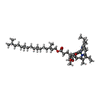 ChemComp-CLA: 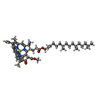 ChemComp-CL0: 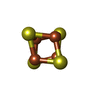 ChemComp-SF4: 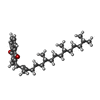 ChemComp-PQN:  ChemComp-XAT:  ChemComp-LMG:  ChemComp-DGD:  ChemComp-LMT:  ChemComp-BCR:  ChemComp-AV0: 
PDB-1l6d: Crystal Structure of a Ternary Complex of E.Coli HPPK(V83G/DEL84-89) with MGAMPCPP and 6-Hydroxymethyl-7,8-Dihydropterin at 1.40 Angstrom Resolution (Monoclinic Form)  ChemComp-SQD:  PDB-1i05:  ChemComp-HOH: |
| Source |
|
 Keywords Keywords | PHOTOSYNTHESIS / Photosystem I / PSI-FCP complex / Chrome velia / Cryo-EM. |


 chromera velia (eukaryote)