[English] 日本語
Yorodumi Papers
- Database of articles cited by EMDB/PDB/SASBDB data -

+
Search query

Keywords
Structure methods
Author
Journal
IF

-
Structure paper

TitleApplication of Weighted Interaction-Fingerprints for Rationalizing Neosubstrate Potency and Selectivity of Cereblon-Based Molecular Glues.
Journal, issue, pagesJ Med Chem, Vol. 68, Issue 19, Page 20657-20674, Year 2025
Publish dateOct 9, 2025
AuthorsGuilian Luchini / Shuang Liu / Hannah L Powers / Emily Cherney / Jinyi Zhu / Kristina Danga / Joel W Thompson / Lihong Shi / Barbra Pagarigan / Dong Donna Wei / Peter Park / Andrew P Degnan / Christoph W Zapf / Jennifer R Riggs / Scott Johnson / Thomas Cummins /
PubMed AbstractCullin-RING Ligase 4 Cereblon (CRL4) (CRBN) E3 ligase modulatory drugs (CELMoDs) make up a successful class of compounds targeting neosubstrates for proteasome-dependent degradation. Early ...Cullin-RING Ligase 4 Cereblon (CRL4) (CRBN) E3 ligase modulatory drugs (CELMoDs) make up a successful class of compounds targeting neosubstrates for proteasome-dependent degradation. Early immunomodulatory drugs (IMiDs) target Ikaros and Aiolos degradation. In addition, there are ongoing clinical trials targeting the degradation of biologically relevant proteins such as GSPT1, CK1α, and Helios with CRBN-based molecular glues. To date, most advanced preclinical and clinical CRBN-based molecular glues recruit their neosubstrates through canonical G-motifs, secondary protein features that are structurally similar but have significantly different amino acid sequence identities. Analogous to the development of kinase inhibitors, optimizing both neosubstrate recruitment and degradation selectivity is important to minimize potential off-target activity. Here, we describe a computational structure-based approach to analyze and predict putative ligand interactions important in the neosubstrate ternary complex. This approach provides valuable insights for enhanced designs toward the development of more selective and efficacious CRBN-based molecular glues.
External linksJ Med Chem / PubMed:40994183
MethodsEM (single particle) / X-ray diffraction
Resolution2.94 - 3.406 Å
Structure data

EMDB-72160, PDB-9q2d:
Cryo-EM structure of ternary complex Ikaros-ZF2:CC-885:CRBN:DDB1 (molecular glue degrader)
Method: EM (single particle) / Resolution: 2.94 Å

PDB-9q22:
Crystal structure of ternary complex Helios-ZF2:I-19:CRBN:DDB1
Method: X-RAY DIFFRACTION / Resolution: 3.406 Å

Chemicals

PDB-1cnp:
THE STRUCTURE OF CALCYCLIN REVEALS A NOVEL HOMODIMERIC FOLD FOR S100 CA2+-BINDING PROTEINS, NMR, 22 STRUCTURES

ChemComp-ZN:
Unknown entry

ChemComp-85C:
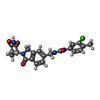
1-(3-chloro-4-methylphenyl)-3-({2-[(3S)-2,6-dioxopiperidin-3-yl]-1-oxo-2,3-dihydro-1H-isoindol-5-yl}methyl)urea

Source
  • homo sapiens (human)
KeywordsLIGASE / CEREBLON / DEGRADER / HELIOS / IKZF2 / DDB1 / MOCLECULAR GLUE / Ikaros / IKZF1 / molecular glue

+
About Yorodumi Papers

-
News

-
Feb 9, 2022. New format data for meta-information of EMDB entries

New format data for meta-information of EMDB entries

  • Version 3 of the EMDB header file is now the official format.
  • The previous official version 1.9 will be removed from the archive.

Related info.:EMDB header

External links:wwPDB to switch to version 3 of the EMDB data model

-
Aug 12, 2020. Covid-19 info

Covid-19 info

URL: https://pdbj.org/emnavi/covid19.php

New page: Covid-19 featured information page in EM Navigator.

Related info.:Covid-19 info / Mar 5, 2020. Novel coronavirus structure data

+
Mar 5, 2020. Novel coronavirus structure data

Novel coronavirus structure data

Related info.:Yorodumi Speices / Aug 12, 2020. Covid-19 info

External links:COVID-19 featured content - PDBj / Molecule of the Month (242):Coronavirus Proteases

+
Jan 31, 2019. EMDB accession codes are about to change! (news from PDBe EMDB page)

EMDB accession codes are about to change! (news from PDBe EMDB page)

  • The allocation of 4 digits for EMDB accession codes will soon come to an end. Whilst these codes will remain in use, new EMDB accession codes will include an additional digit and will expand incrementally as the available range of codes is exhausted. The current 4-digit format prefixed with “EMD-” (i.e. EMD-XXXX) will advance to a 5-digit format (i.e. EMD-XXXXX), and so on. It is currently estimated that the 4-digit codes will be depleted around Spring 2019, at which point the 5-digit format will come into force.
  • The EM Navigator/Yorodumi systems omit the EMD- prefix.

Related info.:Q: What is EMD? / ID/Accession-code notation in Yorodumi/EM Navigator

External links:EMDB Accession Codes are Changing Soon! / Contact to PDBj

+
Jul 12, 2017. Major update of PDB

Major update of PDB

  • wwPDB released updated PDB data conforming to the new PDBx/mmCIF dictionary.
  • This is a major update changing the version number from 4 to 5, and with Remediation, in which all the entries are updated.
  • In this update, many items about electron microscopy experimental information are reorganized (e.g. em_software).
  • Now, EM Navigator and Yorodumi are based on the updated data.

External links:wwPDB Remediation / Enriched Model Files Conforming to OneDep Data Standards Now Available in the PDB FTP Archive

-
Yorodumi Papers

Database of articles cited by EMDB/PDB/SASBDB data

  • Database of articles cited by EMDB, PDB, and SASBDB entries
  • Using PubMed data

Related info.:EMDB / PDB / SASBDB / Yorodumi / EMN Papers / Changes in new EM Navigator and Yorodumi

Read more