[English] 日本語
Yorodumi Papers
- Database of articles cited by EMDB/PDB/SASBDB data -

+
Search query

Keywords
Structure methods
Author
Journal
IF

-
Structure paper

TitleElucidating the structure and assembly mechanism of actinoporin pores in complex membrane environments.
Journal, issue, pagesSci Adv, Vol. 11, Issue 39, Page eadv0683, Year 2025
Publish dateSep 26, 2025
AuthorsRocío Arranz / César Santiago / Simonas Masiulis / Esperanza Rivera-de-Torre / Juan Palacios-Ortega / Diego Carlero / Diego Heras-Márquez / José G Gavilanes / Ernesto Arias-Palomo / Álvaro Martínez-Del-Pozo / Sara García-Linares / Jaime Martín-Benito /
PubMed AbstractPore-forming proteins exemplify the transformative potential of biological molecules. Produced as soluble monomers, they assemble into multimeric membrane-inserted complexes in response to specific ...Pore-forming proteins exemplify the transformative potential of biological molecules. Produced as soluble monomers, they assemble into multimeric membrane-inserted complexes in response to specific membrane environments. Actinoporins, a class of pore-forming proteins from sea anemones, target membranes to kill cells. Here, we report cryogenic electron microscopy structures of two actinoporins, fragaceatoxin C and sticholysin II, reconstituted in lipid membranes. The structures reveal an ordered arrangement of dozens of lipid molecules that form an integral part of the pore architecture. We also captured distinct oligomeric intermediates, arc-shaped assemblies with monomers in transitional conformations, representing key snapshots along the pore formation pathway. These data provide direct structural evidence for a stepwise mechanism in which monomers sequentially bind the membrane and undergo conformational changes that drive pore assembly and membrane disruption. Our findings reveal how these proteins reshape membranes and offer mechanistic insights into their cytolytic activity. This work broadens our understanding of pore-forming proteins, which are gaining increasing relevance in diverse biotechnological applications.
External linksSci Adv / PubMed:40991702 / PubMed Central
MethodsEM (single particle)
Resolution2.1 - 4.9 Å
Structure data

EMDB-51384, PDB-9gj8:
Structure of Sticholisin II in large unilamellar vesicles.
Method: EM (single particle) / Resolution: 2.1 Å

EMDB-51420, PDB-9gki:
Structure of 5mer pore intermediate of Sticholysin II (StnII) toxin in lipid nanodiscs
Method: EM (single particle) / Resolution: 3.8 Å

EMDB-51426, PDB-9gkl:
Structure of the octameric pore of Fragaceotxin C (FraC or DELTA-actitoxin-Afr1a) in large unilamellar vesicles.
Method: EM (single particle) / Resolution: 2.5 Å

EMDB-51431, PDB-9gko:
Structure of 6mer pore intermediate of Sticholysin II (StnII) toxin in lipid nanodiscs
Method: EM (single particle) / Resolution: 4.9 Å

EMDB-51432, PDB-9gkp:
Structure of fragacetoxin C in lipid nanodiscs
Method: EM (single particle) / Resolution: 2.5 Å

Chemicals

ChemComp-FO4:
sphingomyelin

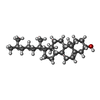
ChemComp-CLR:
CHOLESTEROL

ChemComp-HOH:
WATER

Source
  • stichodactyla helianthus (sea anemone)
  • actinia fragacea (sea anemone)
KeywordsMEMBRANE PROTEIN / sticholisin / nanodisc / toxin / actinoporin / LUVs

+
About Yorodumi Papers

-
News

-
Feb 9, 2022. New format data for meta-information of EMDB entries

New format data for meta-information of EMDB entries

  • Version 3 of the EMDB header file is now the official format.
  • The previous official version 1.9 will be removed from the archive.

Related info.:EMDB header

External links:wwPDB to switch to version 3 of the EMDB data model

-
Aug 12, 2020. Covid-19 info

Covid-19 info

URL: https://pdbj.org/emnavi/covid19.php

New page: Covid-19 featured information page in EM Navigator.

Related info.:Covid-19 info / Mar 5, 2020. Novel coronavirus structure data

+
Mar 5, 2020. Novel coronavirus structure data

Novel coronavirus structure data

Related info.:Yorodumi Speices / Aug 12, 2020. Covid-19 info

External links:COVID-19 featured content - PDBj / Molecule of the Month (242):Coronavirus Proteases

+
Jan 31, 2019. EMDB accession codes are about to change! (news from PDBe EMDB page)

EMDB accession codes are about to change! (news from PDBe EMDB page)

  • The allocation of 4 digits for EMDB accession codes will soon come to an end. Whilst these codes will remain in use, new EMDB accession codes will include an additional digit and will expand incrementally as the available range of codes is exhausted. The current 4-digit format prefixed with “EMD-” (i.e. EMD-XXXX) will advance to a 5-digit format (i.e. EMD-XXXXX), and so on. It is currently estimated that the 4-digit codes will be depleted around Spring 2019, at which point the 5-digit format will come into force.
  • The EM Navigator/Yorodumi systems omit the EMD- prefix.

Related info.:Q: What is EMD? / ID/Accession-code notation in Yorodumi/EM Navigator

External links:EMDB Accession Codes are Changing Soon! / Contact to PDBj

+
Jul 12, 2017. Major update of PDB

Major update of PDB

  • wwPDB released updated PDB data conforming to the new PDBx/mmCIF dictionary.
  • This is a major update changing the version number from 4 to 5, and with Remediation, in which all the entries are updated.
  • In this update, many items about electron microscopy experimental information are reorganized (e.g. em_software).
  • Now, EM Navigator and Yorodumi are based on the updated data.

External links:wwPDB Remediation / Enriched Model Files Conforming to OneDep Data Standards Now Available in the PDB FTP Archive

-
Yorodumi Papers

Database of articles cited by EMDB/PDB/SASBDB data

  • Database of articles cited by EMDB, PDB, and SASBDB entries
  • Using PubMed data

Related info.:EMDB / PDB / SASBDB / Yorodumi / EMN Papers / Changes in new EM Navigator and Yorodumi

Read more