 Movie
Movie Controller
 Structure viewers
 About Yorodumi Papers


+Search query
-Structure paper
| Title | Structures of a synthetic antibody selected against and bound to the C-terminal domain of Clostridium perfringens enterotoxin. |
|---|---|
| Journal, issue, pages | Protein Sci, Vol. 34, Issue 10, Page e70281, Year 2025 |
| Publish date | Sep 16, 2025 |
 Authors Authors | Chinemerem P Ogbu / Nicolas Manuel Goldbach / Martin Pacesa / Srajan Kapoor / Bruno E Correia / Alex J Vecchio /   |
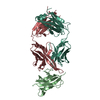
| PubMed Abstract | Clostridium perfringens enterotoxin (CpE) causes cytotoxic gastrointestinal disease in mammalian epithelium by binding membrane protein receptors called claudins. Claudins direct the formation of ...Clostridium perfringens enterotoxin (CpE) causes cytotoxic gastrointestinal disease in mammalian epithelium by binding membrane protein receptors called claudins. Claudins direct the formation of cell/cell tight junctions through oligomerization and govern the transport of molecules between individual cells. CpE binds claudins through its C-terminal domain (cCpE) and induces cytotoxicity through its N-terminal domain. The non-toxic cCpE is a useful tool to study claudins, tight junctions, and for translational applications, such as increasing the permeability of restrictive tissues like the blood-brain barrier or selective targeting of claudin overexpressing cancers. Conversely, there are no specialized molecular tools to study CpE or cCpE, or to modulate or inhibit their functions. We previously reported the development of synthetic antigen-binding fragments (sFabs) that bind cCpE, and low-resolution structures of them bound to claudin/cCpE complexes. Here, we determine high-resolution structures of sFab COP-2 bound to cCpE using X-ray crystallography and cryogenic electron microscopy. The structures and biophysical findings provide the mechanism of COP-2 binding to cCpE and the molecular determinants driving their interactions. These insights can advance the design of new antibody-based tools from our COP-2 scaffold to study or alter cCpE function and give rise to a "Trojan horse" strategy that exploits cCpE's tight junction barrier disrupting function to selectively deliver conjugated therapeutics through normally impermeable tissues. |
 External links External links | Protein Sci / PubMed:40944397 / PubMed Central |
| Methods | EM (single particle) / X-ray diffraction |
| Resolution | 2.5 - 2.95 Å |
| Structure data | EMDB-52864, PDB-9ihc:  PDB-9pzi: |
| Chemicals |  ChemComp-HOH: |
| Source |
|
 Keywords Keywords | TOXIN / clostridium / COP-2 / IMMUNE SYSTEM/TOXIN / ENTEROTOXIN / SYNTHETIC ANTIBODY / IMMUNE SYSTEM-TOXIN complex |


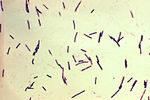 clostridium perfringens (bacteria)
 homo sapiens (human)