[English] 日本語
Yorodumi Papers
- Database of articles cited by EMDB/PDB/SASBDB data -

+
Search query

Keywords
Structure methods
Author
Journal
IF

-
Structure paper

TitleThe Discovery of RP-2119: A Potent, Selective, and Orally Bioavailable Polθ ATPase Inhibitor.
Journal, issue, pagesJ Med Chem, Vol. 68, Issue 18, Page 19726-19745, Year 2025
Publish dateSep 25, 2025
AuthorsPhilippe Mochirian / Robert Papp / Marie-Claude Mathieu / Gino B Ferraro / Evelyne Dietrich / Bingcan Liu / David Bendahan / Alexander L Perryman / Simon Surprenant / Sara Fournier / Bita Lotfollahzadeh Barzili / Alexanne Bonneau-Fortin / Shou Yun Yin / Marie-Eve Leclaire / Charmi Patel / Hugo Poirier / Sai Save / Yann Mathieu / Nicolas Morin / Claude Godbout / Helen E Burston / Karl E Zahn / Mohamed A Attia / Thomas Pinter / Francis Barabé / Paranjay Parikh / Chandresh Jagani / Gyunghoon Kang / Giovanna Scapin / Yael Mamane / Agnel Sfeir / Pavel Mader / Frank Sicheri / Michal Zimmermann / Anne Roulston / Stephen J Morris / W Cameron Black / Michel Gallant /
PubMed AbstractDNA polymerase theta (Polθ) plays a critical role in repairing DNA double-strand breaks through microhomology-mediated end joining (MMEJ) and has emerged as a key synthetic lethal drug target in ...DNA polymerase theta (Polθ) plays a critical role in repairing DNA double-strand breaks through microhomology-mediated end joining (MMEJ) and has emerged as a key synthetic lethal drug target in cancers with homologous recombination (HR) deficiencies. Its inhibition has shown a strong potential to synergize with PARP inhibitors, particularly in tumors with deleterious or mutations. Here, we describe the discovery and preclinical development of RP-2119, a selective, potent, and bioavailable Polθ ATPase inhibitor. Starting from a high-throughput ATPase screen combined with literature insights, key vectors for enhancing potency were identified by structural studies using single-particle cryo-electron microscopy (cryo-EM) that revealed the inhibitor binding site. Further optimization of potency and ADME properties led to the identification of RP-2119 with robust cellular activity in a wide range of HR-deficient cancer cell lines. In HR-deficient cell line- and patient-derived mouse xenografts, RP-2119 demonstrated strong synergy with the PARP inhibitor, olaparib, without exacerbating its hematological toxicity.
External linksJ Med Chem / PubMed:40920169
MethodsEM (single particle)
Resolution2.67 - 2.9 Å
Structure data

EMDB-70812, PDB-9osw:
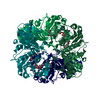
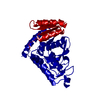
Tetrameric POLQ Helicase-like Domain Bound to Cmpd 19, a Small-Molecule ATPase Inhibitor and Drug Candidate Analog
Method: EM (single particle) / Resolution: 2.67 Å

EMDB-70813, PDB-9osy:
Tetrameric POLQ Helicase-like Domain Bound to Cmpd 36, a Small-Molecule ATPase Inhibitor and Drug Candidate Analog
Method: EM (single particle) / Resolution: 2.9 Å

Chemicals

PDB-1cer:
DETERMINANTS OF ENZYME THERMOSTABILITY OBSERVED IN THE MOLECULAR STRUCTURE OF THERMUS AQUATICUS D-GLYCERALDEHYDE-3-PHOSPHATE DEHYDROGENASE AT 2.5 ANGSTROMS RESOLUTION

PDB-1ceq:
CHLOROQUINE BINDS IN THE COFACTOR BINDING SITE OF PLASMODIUM FALCIPARUM LACTATE DEHYDROGENASE.

Source
  • homo sapiens (human)
KeywordsDNA BINDING PROTEIN / Theta-mediated end-joining DNA-dependent ATPase DNA repair Inhibitor co-complex

+
About Yorodumi Papers

-
News

-
Feb 9, 2022. New format data for meta-information of EMDB entries

New format data for meta-information of EMDB entries

  • Version 3 of the EMDB header file is now the official format.
  • The previous official version 1.9 will be removed from the archive.

Related info.:EMDB header

External links:wwPDB to switch to version 3 of the EMDB data model

-
Aug 12, 2020. Covid-19 info

Covid-19 info

URL: https://pdbj.org/emnavi/covid19.php

New page: Covid-19 featured information page in EM Navigator.

Related info.:Covid-19 info / Mar 5, 2020. Novel coronavirus structure data

+
Mar 5, 2020. Novel coronavirus structure data

Novel coronavirus structure data

Related info.:Yorodumi Speices / Aug 12, 2020. Covid-19 info

External links:COVID-19 featured content - PDBj / Molecule of the Month (242):Coronavirus Proteases

+
Jan 31, 2019. EMDB accession codes are about to change! (news from PDBe EMDB page)

EMDB accession codes are about to change! (news from PDBe EMDB page)

  • The allocation of 4 digits for EMDB accession codes will soon come to an end. Whilst these codes will remain in use, new EMDB accession codes will include an additional digit and will expand incrementally as the available range of codes is exhausted. The current 4-digit format prefixed with “EMD-” (i.e. EMD-XXXX) will advance to a 5-digit format (i.e. EMD-XXXXX), and so on. It is currently estimated that the 4-digit codes will be depleted around Spring 2019, at which point the 5-digit format will come into force.
  • The EM Navigator/Yorodumi systems omit the EMD- prefix.

Related info.:Q: What is EMD? / ID/Accession-code notation in Yorodumi/EM Navigator

External links:EMDB Accession Codes are Changing Soon! / Contact to PDBj

+
Jul 12, 2017. Major update of PDB

Major update of PDB

  • wwPDB released updated PDB data conforming to the new PDBx/mmCIF dictionary.
  • This is a major update changing the version number from 4 to 5, and with Remediation, in which all the entries are updated.
  • In this update, many items about electron microscopy experimental information are reorganized (e.g. em_software).
  • Now, EM Navigator and Yorodumi are based on the updated data.

External links:wwPDB Remediation / Enriched Model Files Conforming to OneDep Data Standards Now Available in the PDB FTP Archive

-
Yorodumi Papers

Database of articles cited by EMDB/PDB/SASBDB data

  • Database of articles cited by EMDB, PDB, and SASBDB entries
  • Using PubMed data

Related info.:EMDB / PDB / SASBDB / Yorodumi / EMN Papers / Changes in new EM Navigator and Yorodumi

Read more