[English] 日本語
Yorodumi Papers
- Database of articles cited by EMDB/PDB/SASBDB data -

+
Search query

Keywords
Structure methods
Author
Journal
IF

-
Structure paper

TitleMechanosensitive channel engineering: A study on the mixing and matching of YnaI and MscS sensor paddles and pores.
Journal, issue, pagesNat Commun, Vol. 16, Issue 1, Page 7881, Year 2025
Publish dateAug 23, 2025
AuthorsVanessa J Flegler / Akiko Rasmussen / Rainer Hedrich / Tim Rasmussen / Bettina Böttcher /
PubMed AbstractOsmotically varying environments are challenging for bacterial cells. Sudden drops in osmolytes cause an increased membrane tension and rupture the cells in the absence of protective mechanisms. One ...Osmotically varying environments are challenging for bacterial cells. Sudden drops in osmolytes cause an increased membrane tension and rupture the cells in the absence of protective mechanisms. One family of protective proteins are mechanosensitive channels of small conductance that open in response to membrane tension. Although these channels have a common architecture, they vary widely in the number of transmembrane helices, conductivity, and gating characteristics. Although there are various structures of channels in the open and closed state, the underlying common principles of the gating mechanism remain poorly understood. Here we show that YnaI opens by radial relocation of the transmembrane sensor paddles together with a shortening of the pore, which contrasts the prototypic smaller MscS. A chimera of both channels with the YnaI sensor paddles and the pore containing C-terminal part of MscS is functional and has the tension response of the paddle donor. Our research shows that elements with different structural opening mechanisms can be mixed and matched within one channel as long as they support the common area expansion on the periplasmic side.
External linksNat Commun / PubMed:40849500 / PubMed Central
MethodsEM (single particle)
Resolution2.2 - 3.6 Å
Structure data

EMDB-51813, PDB-9h2p:
YnaI in its open conformation purified in DDM showing ligand-filled pockets
Method: EM (single particle) / Resolution: 2.3 Å

EMDB-51817, PDB-9h2s:
a YnaI-MscS chimera in a closed conformation purified in DDM with additional lipids showing ligand-filled pore and pockets
Method: EM (single particle) / Resolution: 2.7 Å

EMDB-51818, PDB-9h2v:
a YnaI-MscS chimera in an open conformation purified in DDM showing ligand-filled pockets
Method: EM (single particle) / Resolution: 2.8 Å

EMDB-51897: YnaI in its open conformation, purified in DDM, C1 processed
Method: EM (single particle) / Resolution: 2.8 Å

EMDB-51898: A YnaI-MscS chimera in its closed conformation, C1 processed
Method: EM (single particle) / Resolution: 3.4 Å

EMDB-51953, PDB-9h95:
YnaI in closed conformation purified in DDM with additional lipids showing ligand-filled pockets
Method: EM (single particle) / Resolution: 2.2 Å

EMDB-51954: A YnaI-MscS chimera in its open conformation, C1 processed
Method: EM (single particle) / Resolution: 3.6 Å

Chemicals

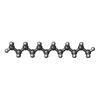
ChemComp-D12:
DODECANE

Source
  • escherichia coli (E. coli)
  • unidentified (others)
  • escherichia coli (strain k12) (bacteria)
KeywordsMEMBRANE PROTEIN / YnaI; mechanosensitive ion channel of E. coli; MscS-like / chimera; mechanosensitive ion channel; MscS-like / mechanosensitive ion channel of E. coli; MscS-like

+
About Yorodumi Papers

-
News

-
Feb 9, 2022. New format data for meta-information of EMDB entries

New format data for meta-information of EMDB entries

  • Version 3 of the EMDB header file is now the official format.
  • The previous official version 1.9 will be removed from the archive.

Related info.:EMDB header

External links:wwPDB to switch to version 3 of the EMDB data model

-
Aug 12, 2020. Covid-19 info

Covid-19 info

URL: https://pdbj.org/emnavi/covid19.php

New page: Covid-19 featured information page in EM Navigator.

Related info.:Covid-19 info / Mar 5, 2020. Novel coronavirus structure data

+
Mar 5, 2020. Novel coronavirus structure data

Novel coronavirus structure data

Related info.:Yorodumi Speices / Aug 12, 2020. Covid-19 info

External links:COVID-19 featured content - PDBj / Molecule of the Month (242):Coronavirus Proteases

+
Jan 31, 2019. EMDB accession codes are about to change! (news from PDBe EMDB page)

EMDB accession codes are about to change! (news from PDBe EMDB page)

  • The allocation of 4 digits for EMDB accession codes will soon come to an end. Whilst these codes will remain in use, new EMDB accession codes will include an additional digit and will expand incrementally as the available range of codes is exhausted. The current 4-digit format prefixed with “EMD-” (i.e. EMD-XXXX) will advance to a 5-digit format (i.e. EMD-XXXXX), and so on. It is currently estimated that the 4-digit codes will be depleted around Spring 2019, at which point the 5-digit format will come into force.
  • The EM Navigator/Yorodumi systems omit the EMD- prefix.

Related info.:Q: What is EMD? / ID/Accession-code notation in Yorodumi/EM Navigator

External links:EMDB Accession Codes are Changing Soon! / Contact to PDBj

+
Jul 12, 2017. Major update of PDB

Major update of PDB

  • wwPDB released updated PDB data conforming to the new PDBx/mmCIF dictionary.
  • This is a major update changing the version number from 4 to 5, and with Remediation, in which all the entries are updated.
  • In this update, many items about electron microscopy experimental information are reorganized (e.g. em_software).
  • Now, EM Navigator and Yorodumi are based on the updated data.

External links:wwPDB Remediation / Enriched Model Files Conforming to OneDep Data Standards Now Available in the PDB FTP Archive

-
Yorodumi Papers

Database of articles cited by EMDB/PDB/SASBDB data

  • Database of articles cited by EMDB, PDB, and SASBDB entries
  • Using PubMed data

Related info.:EMDB / PDB / SASBDB / Yorodumi / EMN Papers / Changes in new EM Navigator and Yorodumi

Read more