[English] 日本語
Yorodumi Papers
- Database of articles cited by EMDB/PDB/SASBDB data -

+
Search query

Keywords
Structure methods
Author
Journal
IF

-
Structure paper

TitleMechanistic insights into the versatile stoichiometry and biased signaling of the apelin receptor-arrestin complex.
Journal, issue, pagesNat Commun, Vol. 16, Issue 1, Page 7403, Year 2025
Publish dateAug 11, 2025
AuthorsYang Yue / Chanjuan Xu / Lijie Wu / Man Na / Kexin Xu / Xuan Chen / Yuxuan Song / Sichun Weng / Lu Xu / Fei Li / Xi Lin / Arthur Wang / Jianfeng Liu / Fei Xu /
PubMed AbstractThe apelin receptor (APJR) plays a pivotal role in regulating cardiovascular and metabolic health. Understanding the mechanisms of biased agonism at APJR is crucial for drug discovery, as stimulation ...The apelin receptor (APJR) plays a pivotal role in regulating cardiovascular and metabolic health. Understanding the mechanisms of biased agonism at APJR is crucial for drug discovery, as stimulation of the β-arrestin pathway may lead to some adverse effects. Structural analyses of APJR-Gi complexes have clarified the structural basis of receptor dimerization and activation, yet the absence of structural data on APJR-arrestin complexes has impeded a comprehensive understanding of APJR stoichiometry in the dual signaling pathways and biased agonism. Here, we present APJR-β-arrestin1 structures bound to a clinical drug analog, revealing 2:2 and 2:1 stoichiometries associated with differential β-arrestin recruitment. Through comparison of the two transducer-coupled APJR structures bound to the same ligand, we identify key residues and motifs crucial for directing biased signaling. These findings highlight APJR's versatile stoichiometry in coupling with β-arrestin and Gi proteins, establishing a framework for understanding biased agonism and guiding the development of therapeutics.
External linksNat Commun / PubMed:40790299 / PubMed Central
MethodsEM (single particle)
Resolution3.21 - 3.57 Å
Structure data

EMDB-62581, PDB-9kuv:
Mechanistic insights into the versatile stoichiometry and biased signaling of the apelin receptor-arrestin complex
Method: EM (single particle) / Resolution: 3.21 Å

EMDB-62582, PDB-9kuw:
Cryo-EM structure of dimeric APJR and two Beta-arrestins complex with small molecules
Method: EM (single particle) / Resolution: 3.49 Å

EMDB-62583, PDB-9kux:
Cryo-EM structure of dimeric APJR and one Beta-arrestin complex with small molecules
Method: EM (single particle) / Resolution: 3.57 Å

Chemicals

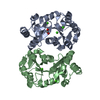
PDB-1l6r:
Crystal Structure of Thermoplasma acidophilum 0175 (APC0014)

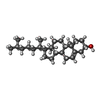
ChemComp-CLR:
CHOLESTEROL

Source
  • homo sapiens (human)
KeywordsSIGNALING PROTEIN / APJR / Beta-arrestin / GPCR

+
About Yorodumi Papers

-
News

-
Feb 9, 2022. New format data for meta-information of EMDB entries

New format data for meta-information of EMDB entries

  • Version 3 of the EMDB header file is now the official format.
  • The previous official version 1.9 will be removed from the archive.

Related info.:EMDB header

External links:wwPDB to switch to version 3 of the EMDB data model

-
Aug 12, 2020. Covid-19 info

Covid-19 info

URL: https://pdbj.org/emnavi/covid19.php

New page: Covid-19 featured information page in EM Navigator.

Related info.:Covid-19 info / Mar 5, 2020. Novel coronavirus structure data

+
Mar 5, 2020. Novel coronavirus structure data

Novel coronavirus structure data

Related info.:Yorodumi Speices / Aug 12, 2020. Covid-19 info

External links:COVID-19 featured content - PDBj / Molecule of the Month (242):Coronavirus Proteases

+
Jan 31, 2019. EMDB accession codes are about to change! (news from PDBe EMDB page)

EMDB accession codes are about to change! (news from PDBe EMDB page)

  • The allocation of 4 digits for EMDB accession codes will soon come to an end. Whilst these codes will remain in use, new EMDB accession codes will include an additional digit and will expand incrementally as the available range of codes is exhausted. The current 4-digit format prefixed with “EMD-” (i.e. EMD-XXXX) will advance to a 5-digit format (i.e. EMD-XXXXX), and so on. It is currently estimated that the 4-digit codes will be depleted around Spring 2019, at which point the 5-digit format will come into force.
  • The EM Navigator/Yorodumi systems omit the EMD- prefix.

Related info.:Q: What is EMD? / ID/Accession-code notation in Yorodumi/EM Navigator

External links:EMDB Accession Codes are Changing Soon! / Contact to PDBj

+
Jul 12, 2017. Major update of PDB

Major update of PDB

  • wwPDB released updated PDB data conforming to the new PDBx/mmCIF dictionary.
  • This is a major update changing the version number from 4 to 5, and with Remediation, in which all the entries are updated.
  • In this update, many items about electron microscopy experimental information are reorganized (e.g. em_software).
  • Now, EM Navigator and Yorodumi are based on the updated data.

External links:wwPDB Remediation / Enriched Model Files Conforming to OneDep Data Standards Now Available in the PDB FTP Archive

-
Yorodumi Papers

Database of articles cited by EMDB/PDB/SASBDB data

  • Database of articles cited by EMDB, PDB, and SASBDB entries
  • Using PubMed data

Related info.:EMDB / PDB / SASBDB / Yorodumi / EMN Papers / Changes in new EM Navigator and Yorodumi

Read more