[English] 日本語
Yorodumi Papers
- Database of articles cited by EMDB/PDB/SASBDB data -

+
Search query

Keywords
Structure methods
Author
Journal
IF

-
Structure paper

Title2-oxoglutarate:acceptor oxidoreductase-catalyzed redox cycling effectively targets coccoid forms of Helicobacter pylori.
Journal, issue, pagesNat Commun, Vol. 16, Issue 1, Page 6965, Year 2025
Publish dateJul 29, 2025
AuthorsXudong Hang / Weiqi Lan / Huang Yanqiang / Hongming Huang / Mingjing Zhang / Liping Zeng / Ting Shi / Yuefan Bai / Zhiyu Yang / Shanwei Hu / Junfan Wang / Linlin Dong / Qian Tong / Jia Jia / Shuzhuang Bi / Qianfeng Xia / Yan Gao / Hongkai Bi /
PubMed AbstractHelicobacter pylori, a globally significant pathogen, plays a central etiological role in diverse gastric pathologies ranging from chronic gastritis and peptic ulcers to gastric adenocarcinoma. ...Helicobacter pylori, a globally significant pathogen, plays a central etiological role in diverse gastric pathologies ranging from chronic gastritis and peptic ulcers to gastric adenocarcinoma. Although conventional antibiotics effectively inhibit or kill growing helical H. pylori, metabolically dormant coccoid forms of H. pylori exhibit considerable tolerance, posing a persistent and clinically significant challenge. Here, we report napabucasin (2-acetylfuro-1,4-naphthoquinone) as a redox-cycling antibiotic with potent bactericidal activity against both drug-resistant helical and coccoid forms of H. pylori. Notably, napabucasin does not induce acquired resistance in vitro and demonstrates superior efficacy compared to standard triple therapy in murine infection models. Mechanistic studies reveal that napabucasin acts through 2-oxoglutarate:acceptor oxidoreductase (OOR)-catalyzed futile redox cycling, generating bactericidal levels of reactive oxygen species (ROS). Compared to menaquinone 6, a proposed physiological electron acceptor, napabucasin exhibits enhanced oxidative capacity. Structural, biochemical, and microbiological analyses identify Leu44 and Lys46 within the OorD subunit as critical residues for napabucasin recognition and catalysis. These findings establish OOR-mediated redox cycling as a robust antimicrobial strategy that sustains endogenous ROS production to combat refractory H. pylori infections.
External linksNat Commun / PubMed:40730563 / PubMed Central
MethodsEM (single particle)
Resolution2.95 - 3.03 Å
Structure data

EMDB-39556, PDB-8ys5:
Cryo-EM structure of the Helicobacter pylori OorDABC complex in the apo-form
Method: EM (single particle) / Resolution: 2.95 Å

EMDB-39557, PDB-8ys6:
Helicobacter pylori OorDABC in complex with Napabucasin
Method: EM (single particle) / Resolution: 3.03 Å

Chemicals

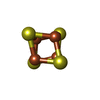
ChemComp-SF4:
IRON/SULFUR CLUSTER

ChemComp-MG:
Unknown entry

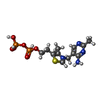
ChemComp-TPP:
THIAMINE DIPHOSPHATE

PDB-1d65:
MOLECULAR STRUCTURE OF THE B-DNA DODECAMER D(CGCAAATTTGCG)2; AN EXAMINATION OF PROPELLER TWIST AND MINOR-GROOVE WATER STRUCTURE AT 2.2 ANGSTROMS RESOLUTION

Source
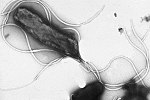
  • helicobacter pylori (bacteria)
KeywordsOXIDOREDUCTASE / Oxoglutarate Oxidoreductase / Electron Transport / Tricarboxylic Acid Cycle / Napabucasin

+
About Yorodumi Papers

-
News

-
Feb 9, 2022. New format data for meta-information of EMDB entries

New format data for meta-information of EMDB entries

  • Version 3 of the EMDB header file is now the official format.
  • The previous official version 1.9 will be removed from the archive.

Related info.:EMDB header

External links:wwPDB to switch to version 3 of the EMDB data model

-
Aug 12, 2020. Covid-19 info

Covid-19 info

URL: https://pdbj.org/emnavi/covid19.php

New page: Covid-19 featured information page in EM Navigator.

Related info.:Covid-19 info / Mar 5, 2020. Novel coronavirus structure data

+
Mar 5, 2020. Novel coronavirus structure data

Novel coronavirus structure data

Related info.:Yorodumi Speices / Aug 12, 2020. Covid-19 info

External links:COVID-19 featured content - PDBj / Molecule of the Month (242):Coronavirus Proteases

+
Jan 31, 2019. EMDB accession codes are about to change! (news from PDBe EMDB page)

EMDB accession codes are about to change! (news from PDBe EMDB page)

  • The allocation of 4 digits for EMDB accession codes will soon come to an end. Whilst these codes will remain in use, new EMDB accession codes will include an additional digit and will expand incrementally as the available range of codes is exhausted. The current 4-digit format prefixed with “EMD-” (i.e. EMD-XXXX) will advance to a 5-digit format (i.e. EMD-XXXXX), and so on. It is currently estimated that the 4-digit codes will be depleted around Spring 2019, at which point the 5-digit format will come into force.
  • The EM Navigator/Yorodumi systems omit the EMD- prefix.

Related info.:Q: What is EMD? / ID/Accession-code notation in Yorodumi/EM Navigator

External links:EMDB Accession Codes are Changing Soon! / Contact to PDBj

+
Jul 12, 2017. Major update of PDB

Major update of PDB

  • wwPDB released updated PDB data conforming to the new PDBx/mmCIF dictionary.
  • This is a major update changing the version number from 4 to 5, and with Remediation, in which all the entries are updated.
  • In this update, many items about electron microscopy experimental information are reorganized (e.g. em_software).
  • Now, EM Navigator and Yorodumi are based on the updated data.

External links:wwPDB Remediation / Enriched Model Files Conforming to OneDep Data Standards Now Available in the PDB FTP Archive

-
Yorodumi Papers

Database of articles cited by EMDB/PDB/SASBDB data

  • Database of articles cited by EMDB, PDB, and SASBDB entries
  • Using PubMed data

Related info.:EMDB / PDB / SASBDB / Yorodumi / EMN Papers / Changes in new EM Navigator and Yorodumi

Read more