[English] 日本語
Yorodumi Papers
- Database of articles cited by EMDB/PDB/SASBDB data -

+
Search query

Keywords
Structure methods
Author
Journal
IF

-
Structure paper

TitleA porin-like protein used by bacterial predators defines a wider lipid-trapping superfamily.
Journal, issue, pagesNat Commun, Vol. 16, Issue 1, Page 6213, Year 2025
Publish dateJul 5, 2025
AuthorsRebecca J Parr / Yoann G Santin / Giedrė Ratkevičiūte / Simon G Caulton / Paul Radford / Dominik Gurvič / Matthew Jenkins / Matthew T Doyle / Liam Mead / Augustinas Silale / Bert van den Berg / Timothy J Knowles / R Elizabeth Sockett / Phillip J Stansfeld / Géraldine Laloux / Andrew L Lovering /
PubMed AbstractOuter membrane proteins (OMPs) define the surface biology of Gram-negative bacteria, with roles in adhesion, transport, catalysis and signalling. Specifically, porin beta-barrels are common diffusion ...Outer membrane proteins (OMPs) define the surface biology of Gram-negative bacteria, with roles in adhesion, transport, catalysis and signalling. Specifically, porin beta-barrels are common diffusion channels, predominantly monomeric/trimeric in nature. Here we show that the major OMP of the bacterial predator Bdellovibrio bacteriovorus, PopA, differs from this architecture, forming a pentameric porin-like superstructure. Our X-ray and cryo-EM structures reveal a bowl-shape composite outer β-wall, which houses a central chamber that encloses a section of the lipid bilayer. We demonstrate that PopA, reported to insert into prey inner membrane, causes defects when directed into Escherichia coli membranes. We discover widespread PopA homologues, including likely tetramers and hexamers, that retain the lipid chamber; a similar chamber is formed by an unrelated smaller closed-barrel family, implicating this as a general feature. Our work thus defines oligomeric OMP superfamilies, whose deviation from prior structures requires us to revisit existing membrane-interaction motifs and folding models.
External linksNat Commun / PubMed:40617869 / PubMed Central
MethodsEM (single particle) / X-ray diffraction
Resolution2.8 - 2.85 Å
Structure data

EMDB-51308, PDB-9gf0:
Cryo-EM Structure of Pentameric Outer Membrane Protein A from Bdellovibrio bacteriovorus
Method: EM (single particle) / Resolution: 2.85 Å

PDB-9ga1:
Structure of Pentameric Outer Membrane Protein A from Bdellovibrio bacteriovorus
Method: X-RAY DIFFRACTION / Resolution: 2.8 Å

Chemicals

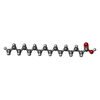
ChemComp-PLM:
PALMITIC ACID

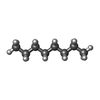
ChemComp-OCT:
N-OCTANE

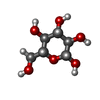
ChemComp-BGC:
beta-D-glucopyranose

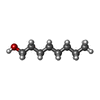
ChemComp-OC9:
OCTAN-1-OL

ChemComp-HOH:
WATER

Source
  • bdellovibrio bacteriovorus hd100 (bacteria)

KeywordsLIPID TRANSPORT / Outer Membrane Protein / Porin / Beta-barel / LIPID BINDING PROTEIN / beta-barrel

+
About Yorodumi Papers

-
News

-
Feb 9, 2022. New format data for meta-information of EMDB entries

New format data for meta-information of EMDB entries

  • Version 3 of the EMDB header file is now the official format.
  • The previous official version 1.9 will be removed from the archive.

Related info.:EMDB header

External links:wwPDB to switch to version 3 of the EMDB data model

-
Aug 12, 2020. Covid-19 info

Covid-19 info

URL: https://pdbj.org/emnavi/covid19.php

New page: Covid-19 featured information page in EM Navigator.

Related info.:Covid-19 info / Mar 5, 2020. Novel coronavirus structure data

+
Mar 5, 2020. Novel coronavirus structure data

Novel coronavirus structure data

Related info.:Yorodumi Speices / Aug 12, 2020. Covid-19 info

External links:COVID-19 featured content - PDBj / Molecule of the Month (242):Coronavirus Proteases

+
Jan 31, 2019. EMDB accession codes are about to change! (news from PDBe EMDB page)

EMDB accession codes are about to change! (news from PDBe EMDB page)

  • The allocation of 4 digits for EMDB accession codes will soon come to an end. Whilst these codes will remain in use, new EMDB accession codes will include an additional digit and will expand incrementally as the available range of codes is exhausted. The current 4-digit format prefixed with “EMD-” (i.e. EMD-XXXX) will advance to a 5-digit format (i.e. EMD-XXXXX), and so on. It is currently estimated that the 4-digit codes will be depleted around Spring 2019, at which point the 5-digit format will come into force.
  • The EM Navigator/Yorodumi systems omit the EMD- prefix.

Related info.:Q: What is EMD? / ID/Accession-code notation in Yorodumi/EM Navigator

External links:EMDB Accession Codes are Changing Soon! / Contact to PDBj

+
Jul 12, 2017. Major update of PDB

Major update of PDB

  • wwPDB released updated PDB data conforming to the new PDBx/mmCIF dictionary.
  • This is a major update changing the version number from 4 to 5, and with Remediation, in which all the entries are updated.
  • In this update, many items about electron microscopy experimental information are reorganized (e.g. em_software).
  • Now, EM Navigator and Yorodumi are based on the updated data.

External links:wwPDB Remediation / Enriched Model Files Conforming to OneDep Data Standards Now Available in the PDB FTP Archive

-
Yorodumi Papers

Database of articles cited by EMDB/PDB/SASBDB data

  • Database of articles cited by EMDB, PDB, and SASBDB entries
  • Using PubMed data

Related info.:EMDB / PDB / SASBDB / Yorodumi / EMN Papers / Changes in new EM Navigator and Yorodumi

Read more