 Movie
Movie Controller
 Structure viewers
 About Yorodumi Papers


+Search query
-Structure paper
| Title | Development of In Vitro Potency Methods to Replace In Vivo Tests for Enterovirus 71 Inactivated Vaccine (Human Diploid Cell-Based/Vero Cell-Based). |
|---|---|
| Journal, issue, pages | Vaccines (Basel), Vol. 13, Issue 4, Year 2025 |
| Publish date | Apr 13, 2025 |
 Authors Authors | Xuanxuan Zhang / Li Yi / Dan Yu / Jun Li / Xintian Li / Xing Wu / Fan Gao / Qian He / Wenhui Wang / Kaiwen Wang / Zejun Wang / Zhengling Liu / Yadong Li / Yong Zhao / Huiyi Li / Xiao Ma / Qingbing Zheng / Longfa Xu / Tong Cheng / Rui Zhu / Jing Guo / Jing Li / Qunying Mao / Zhenglun Liang /  |
| PubMed Abstract | BACKGROUND: The three commercial Enterovirus 71 (EV71) inactivated vaccines which have effectively controlled the EV71 pandemic currently rely on inherent variable in vivo potency methods for batch ...BACKGROUND: The three commercial Enterovirus 71 (EV71) inactivated vaccines which have effectively controlled the EV71 pandemic currently rely on inherent variable in vivo potency methods for batch release. To align with 3R (Replacement, Reduction, Refinement) principles and enhance quality control, this study referred to WHO guidelines and the European Pharmacopoeia to develop in vitro relative potency (IVRP) methods. METHODS: Working standards tracing to phase 3 clinical vaccines were established. Manufacture-specific IVRP methods were developed and validated per ICH Q14/Q2(R2), utilizing conformational epitope-targeting neutralizing monoclonal antibodies (MAbs). One of the MAbs (CT11F9) recognition sites was clarified with Cryo-EM. Subsequently, the performance of IVRP was assessed using varied concentrations and heat-treated vaccines. The correlation between IVRP and in vivo methods was analyzed, followed by setting IVRP specifications. RESULTS: The manufacturer-specific working standard exhibited ED50 values comparable to those of related phase 3 clinical vaccines. All IVRP methods achieved a relative bias/precision/total error ≤ 15%. The IVRP methods correlated with in vivo methods ( < 0.05, r > 0.9) can discriminate EV71 antigen concentrations ( < 0.01, r > 0.99) and indicate the stability of the vaccines. Cryo-EM was adopted to identify the epitopes recognized by CT11F9, revealing that this neutralizing antibody recognizes a conformational epitope spanning VP1-3 of the same protomer. Using 31-47 batches of commercial vaccines, IVRP specifications were proposed as 0.56-1.35, 0.58-1.40, and 0.54-1.50. CONCLUSIONS: Based on conformational epitope-targeting neutralizing MAbs, manufacturer-specific IVRP methods, which were sensitive to process variations and correlated with in vivo results, have been established. IVRP methods provide a reliable, animal-free alternative for EV71 vaccine batch release. |
 External links External links | Vaccines (Basel) / PubMed:40333322 / PubMed Central |
| Methods | EM (single particle) |
| Resolution | 3.04 Å |
| Structure data | EMDB-63694, PDB-9m7v: |
| Chemicals |  ChemComp-SPH: |
| Source |
|
 Keywords Keywords | VIRUS / ENTEROVIRUS A71 |


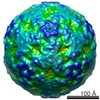 enterovirus a71
 Mus (mice)