[English] 日本語
Yorodumi Papers
- Database of articles cited by EMDB/PDB/SASBDB data -

+
Search query

Keywords
Structure methods
Author
Journal
IF

-
Structure paper

TitleLecithin:cholesterol acyltransferase binds a discontinuous binding site on adjacent apolipoprotein A-I belts in HDL.
Journal, issue, pagesJ Lipid Res, Vol. 66, Issue 5, Page 100786, Year 2025
Publish dateMar 25, 2025
AuthorsBethany Coleman / Shimpi Bedi / John H Hill / Jamie Morris / Kelly A Manthei / Rachel C Hart / Yi He / Amy S Shah / W Gray Jerome / Tomas Vaisar / Karin E Bornfeldt / Hyun Song / Jere P Segrest / Jay W Heinecke / Stephen G Aller / John J G Tesmer / W Sean Davidson /
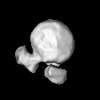
PubMed AbstractLecithin:cholesterol acyltransferase (LCAT) is a high-density lipoprotein (HDL) modifying protein that profoundly affects the composition and function of HDL subspecies. The cholesterol ...Lecithin:cholesterol acyltransferase (LCAT) is a high-density lipoprotein (HDL) modifying protein that profoundly affects the composition and function of HDL subspecies. The cholesterol esterification activity of LCAT is dramatically increased by apolipoprotein A-I (APOA1) on HDL, but the mechanism remains unclear. Using site-directed mutagenesis, cross-linking, mass spectrometry, electron microscopy, protein engineering, and molecular docking, we identified two LCAT binding sites formed by helices 4 and 6 from two antiparallel APOA1 molecules in HDL. Although the reciprocating APOA1 "belts" form two ostensibly symmetrical binding locations, LCAT can adopt distinct orientations at each site, as shown by our 9.8 Å cryoEM envelope. In one case, LCAT membrane binding domains align with the APOA1 belts and, in the other, the HDL phospholipids. By introducing disulfide bonds between the APOA1 helical domains, we demonstrated that LCAT does not require helical separation during its reaction cycle. This indicates that LCAT, anchored to APOA1 belts, accesses substrates and deposits products through interactions with the planar lipid surface. This model of the LCAT/APOA1 interaction provides insights into how LCAT and possibly other HDL-modifying factors engage the APOA1 scaffold, offering potential strategies to enhance LCAT activity in individuals with genetic defects.
External linksJ Lipid Res / PubMed:40147634 / PubMed Central
MethodsEM (single particle)
Resolution9.8 Å
Structure data

EMDB-48724, PDB-9mxz:
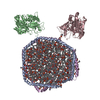
Lecithin:Cholesterol Acyltransferase Bound to Apolipoprotein A-I dimer in HDL
Method: EM (single particle) / Resolution: 9.8 Å

Chemicals

ChemComp-6PL:
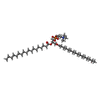
(4S,7R)-4-HYDROXY-N,N,N-TRIMETHYL-9-OXO-7-[(PALMITOYLOXY)METHYL]-3,5,8-TRIOXA-4-PHOSPHAHEXACOSAN-1-AMINIUM 4-OXIDE / phospholipid*YM

Source
  • homo sapiens (human)
KeywordsLIPID TRANSPORT / Complex / Lecithin:Cholesterol Acyltransferase / Apolipoprotein A-I / HDL

+
About Yorodumi Papers

-
News

-
Feb 9, 2022. New format data for meta-information of EMDB entries

New format data for meta-information of EMDB entries

  • Version 3 of the EMDB header file is now the official format.
  • The previous official version 1.9 will be removed from the archive.

Related info.:EMDB header

External links:wwPDB to switch to version 3 of the EMDB data model

-
Aug 12, 2020. Covid-19 info

Covid-19 info

URL: https://pdbj.org/emnavi/covid19.php

New page: Covid-19 featured information page in EM Navigator.

Related info.:Covid-19 info / Mar 5, 2020. Novel coronavirus structure data

+
Mar 5, 2020. Novel coronavirus structure data

Novel coronavirus structure data

Related info.:Yorodumi Speices / Aug 12, 2020. Covid-19 info

External links:COVID-19 featured content - PDBj / Molecule of the Month (242):Coronavirus Proteases

+
Jan 31, 2019. EMDB accession codes are about to change! (news from PDBe EMDB page)

EMDB accession codes are about to change! (news from PDBe EMDB page)

  • The allocation of 4 digits for EMDB accession codes will soon come to an end. Whilst these codes will remain in use, new EMDB accession codes will include an additional digit and will expand incrementally as the available range of codes is exhausted. The current 4-digit format prefixed with “EMD-” (i.e. EMD-XXXX) will advance to a 5-digit format (i.e. EMD-XXXXX), and so on. It is currently estimated that the 4-digit codes will be depleted around Spring 2019, at which point the 5-digit format will come into force.
  • The EM Navigator/Yorodumi systems omit the EMD- prefix.

Related info.:Q: What is EMD? / ID/Accession-code notation in Yorodumi/EM Navigator

External links:EMDB Accession Codes are Changing Soon! / Contact to PDBj

+
Jul 12, 2017. Major update of PDB

Major update of PDB

  • wwPDB released updated PDB data conforming to the new PDBx/mmCIF dictionary.
  • This is a major update changing the version number from 4 to 5, and with Remediation, in which all the entries are updated.
  • In this update, many items about electron microscopy experimental information are reorganized (e.g. em_software).
  • Now, EM Navigator and Yorodumi are based on the updated data.

External links:wwPDB Remediation / Enriched Model Files Conforming to OneDep Data Standards Now Available in the PDB FTP Archive

-
Yorodumi Papers

Database of articles cited by EMDB/PDB/SASBDB data

  • Database of articles cited by EMDB, PDB, and SASBDB entries
  • Using PubMed data

Related info.:EMDB / PDB / SASBDB / Yorodumi / EMN Papers / Changes in new EM Navigator and Yorodumi

Read more