 Movie
Movie Controller
 Structure viewers
 About Yorodumi Papers


+Search query
-Structure paper
| Title | Initiation of ERAD by the bifunctional complex of Mnl1/Htm1 mannosidase and protein disulfide isomerase. |
|---|---|
| Journal, issue, pages | Nat Struct Mol Biol, Vol. 32, Issue 6, Page 1006-1018, Year 2025 |
| Publish date | Feb 10, 2025 |
 Authors Authors | Dan Zhao / Xudong Wu / Tom A Rapoport /   |
| PubMed Abstract | Misfolded glycoproteins in the endoplasmic reticulum (ER) lumen are translocated into the cytosol and degraded by the proteasome, a conserved process called ER-associated protein degradation (ERAD). ...Misfolded glycoproteins in the endoplasmic reticulum (ER) lumen are translocated into the cytosol and degraded by the proteasome, a conserved process called ER-associated protein degradation (ERAD). In Saccharomyces cerevisiae, the glycan of these proteins is trimmed by the luminal mannosidase Mnl1 (Htm1) to generate a degradation signal. Interestingly, Mnl1 is associated with protein disulfide isomerase (Pdi1). Here we used cryo-electron microscopy, biochemical and in vivo experiments to elucidate how this complex initiates ERAD. The Mnl1-Pdi1 complex first demannosylates misfolded, globular proteins that are recognized through the C-terminal domain (CTD) of Mnl1; Pdi1 causes the CTD to ignore completely unfolded polypeptides. The disulfides of these globular proteins are then reduced by the Pdi1 component of the complex. Mnl1 blocks the canonical oxidative function of Pdi1, allowing it to function as a disulfide reductase in ERAD. The generated unfolded polypeptides can then be translocated across the membrane into the cytosol. |
 External links External links | Nat Struct Mol Biol / PubMed:39930008 / PubMed Central |
| Methods | EM (single particle) |
| Resolution | 3.0 Å |
| Structure data | EMDB-60365, PDB-8zpw: |
| Chemicals | 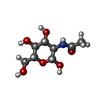 ChemComp-NAG:  ChemComp-CA: |
| Source |
|
 Keywords Keywords | PEPTIDE BINDING PROTEIN / complex / carbohydrate cleavage / peptide binding |


 saccharomyces cerevisiae (brewer's yeast)