[English] 日本語
Yorodumi Papers
- Database of articles cited by EMDB/PDB/SASBDB data -

+
Search query

Keywords
Structure methods
Author
Journal
IF

-
Structure paper

TitleReceptor binding, structure, and tissue tropism of cattle-infecting H5N1 avian influenza virus hemagglutinin.
Journal, issue, pagesCell, Vol. 188, Issue 4, Page 919-929.e9, Year 2025
Publish dateFeb 20, 2025
AuthorsHao Song / Tianjiao Hao / Pu Han / Haichen Wang / Xu Zhang / Xiaomei Li / Yuxuan Wang / Jiamin Chen / Ying Li / Xiyue Jin / Xuefeng Duan / Wei Zhang / Yuhai Bi / Ronghua Jin / Lei Sun / Ningli Wang / George F Gao /
PubMed AbstractThe ongoing circulation of highly pathogenic avian influenza (HPAI) A (H5N1) viruses, particularly clade 2.3.4.4b strains, poses a significant threat to animal and public health. Recent outbreaks in ...The ongoing circulation of highly pathogenic avian influenza (HPAI) A (H5N1) viruses, particularly clade 2.3.4.4b strains, poses a significant threat to animal and public health. Recent outbreaks in cattle highlight concerns about cross-species transmission and zoonotic spillover. Here, we found that the hemagglutinin (HA) protein from a cattle-infecting H5N1 virus has acquired slight binding to human-like α2-6-linked receptors while still exhibiting a strong preference for avian-like α2-3-linked sialic acid receptors. Immunohistochemical staining revealed HA binding to bovine pulmonary and mammary tissues, aligning with clinical observations. HA also binds effectively to human conjunctival, tracheal, and mammary tissues, indicating a risk for human transmission, notably in cases of conjunctivitis. High-resolution cryo-electron microscopy (cryo-EM) structures of this H5 HA in complex with either α2-3 or α2-6 receptors elucidate the molecular mechanisms underlying its receptor-binding properties. These findings provide critical insights into the tropism and transmission potential of this emerging pathogen.
External linksCell / PubMed:39848246
MethodsEM (single particle)
Resolution2.84 - 2.91 Å
Structure data

EMDB-61616, PDB-9jmz:
Cryo-EM structure of a human-infecting bovine influenza H5N1 hemagglutinin complexed with avian receptor analog LSTa
Method: EM (single particle) / Resolution: 2.91 Å

EMDB-61617, PDB-9jn0:
Cryo-EM structure of a human-infecting bovine influenza H5N1 hemagglutinin complexed with human receptor analog LSTc
Method: EM (single particle) / Resolution: 2.84 Å

Chemicals

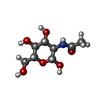
ChemComp-NAG:
2-acetamido-2-deoxy-beta-D-glucopyranose

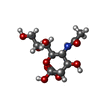
ChemComp-SIA:
N-acetyl-alpha-neuraminic acid

Source
  • influenza a virus (a/indonesia/5/2005(h5n1))

KeywordsVIRAL PROTEIN / complex

+
About Yorodumi Papers

-
News

-
Feb 9, 2022. New format data for meta-information of EMDB entries

New format data for meta-information of EMDB entries

  • Version 3 of the EMDB header file is now the official format.
  • The previous official version 1.9 will be removed from the archive.

Related info.:EMDB header

External links:wwPDB to switch to version 3 of the EMDB data model

-
Aug 12, 2020. Covid-19 info

Covid-19 info

URL: https://pdbj.org/emnavi/covid19.php

New page: Covid-19 featured information page in EM Navigator.

Related info.:Covid-19 info / Mar 5, 2020. Novel coronavirus structure data

+
Mar 5, 2020. Novel coronavirus structure data

Novel coronavirus structure data

Related info.:Yorodumi Speices / Aug 12, 2020. Covid-19 info

External links:COVID-19 featured content - PDBj / Molecule of the Month (242):Coronavirus Proteases

+
Jan 31, 2019. EMDB accession codes are about to change! (news from PDBe EMDB page)

EMDB accession codes are about to change! (news from PDBe EMDB page)

  • The allocation of 4 digits for EMDB accession codes will soon come to an end. Whilst these codes will remain in use, new EMDB accession codes will include an additional digit and will expand incrementally as the available range of codes is exhausted. The current 4-digit format prefixed with “EMD-” (i.e. EMD-XXXX) will advance to a 5-digit format (i.e. EMD-XXXXX), and so on. It is currently estimated that the 4-digit codes will be depleted around Spring 2019, at which point the 5-digit format will come into force.
  • The EM Navigator/Yorodumi systems omit the EMD- prefix.

Related info.:Q: What is EMD? / ID/Accession-code notation in Yorodumi/EM Navigator

External links:EMDB Accession Codes are Changing Soon! / Contact to PDBj

+
Jul 12, 2017. Major update of PDB

Major update of PDB

  • wwPDB released updated PDB data conforming to the new PDBx/mmCIF dictionary.
  • This is a major update changing the version number from 4 to 5, and with Remediation, in which all the entries are updated.
  • In this update, many items about electron microscopy experimental information are reorganized (e.g. em_software).
  • Now, EM Navigator and Yorodumi are based on the updated data.

External links:wwPDB Remediation / Enriched Model Files Conforming to OneDep Data Standards Now Available in the PDB FTP Archive

-
Yorodumi Papers

Database of articles cited by EMDB/PDB/SASBDB data

  • Database of articles cited by EMDB, PDB, and SASBDB entries
  • Using PubMed data

Related info.:EMDB / PDB / SASBDB / Yorodumi / EMN Papers / Changes in new EM Navigator and Yorodumi

Read more