 Movie
Movie Controller
 Structure viewers
 About Yorodumi Papers


+Search query
-Structure paper
| Title | Disulfide-Directed Multicyclic Peptides with N-Terminally Extendable α-Helices for Recognition and Activation of G Protein-Coupled Receptors. |
|---|---|
| Journal, issue, pages | J Am Chem Soc, Vol. 147, Issue 6, Page 4821-4832, Year 2025 |
| Publish date | Feb 12, 2025 |
 Authors Authors | Shihui Fan / Jie Li / Jie Zhuang / Qingtong Zhou / Yiting Mai / Bingni Lin / Ming-Wei Wang / Chuanliu Wu /  |
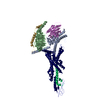
| PubMed Abstract | Many peptide hormones adopt long α-helical structures upon interacting with their cognate receptors but often exhibit flexible conformations when unbound. Strategies that can stabilize long α- ...Many peptide hormones adopt long α-helical structures upon interacting with their cognate receptors but often exhibit flexible conformations when unbound. Strategies that can stabilize long α-helices without disrupting their binding to receptors are still lacking, which hinders progress in their biological applications and drug development. Here, we present an approach that combines rational design with library screening to create and identify a unique disulfide-directed multicyclic peptide (DDMP) scaffold, which could effectively stabilize N-terminally extendable α-helices while displaying exceptional efficiency in disulfide pairing and oxidative folding. This DDMP scaffold was then utilized for stabilizing the α-helical structure of glucagon-like peptide-1 (GLP-1), resulting in a potent GLP-1 receptor (GLP-1R) agonist with a significantly improved α-helicity and proteolytic stability. By incorporating external α-helices into the DDMP scaffold, we can effectively preserve the native N-terminal α-helical structures while allowing for extensive evolution of the C-terminal disulfide-rich domain for enhancing target binding, as demonstrated by the generation of the DDMP-stabilized GLP-1 (g1:Ox). The cryo-electron microscopy structure of the g1:Ox-GLP-1R in complex with heterotrimeric G reveals the molecular basis for the potent binding between g1:Ox and GLP-1R. Specifically, the DDMP moiety establishes additional interactions with the extracellular domain of GLP-1R, which are absent in the case of GLP-1. Thus, this work offers a novel and effective approach for engineering therapeutic peptides and other peptide α-helices, ensuring that both the N- and C-terminal regions remain essential for target recognition and activation. |
 External links External links | J Am Chem Soc / PubMed:39688263 |
| Methods | EM (single particle) / NMR (solution) |
| Resolution | 2.99 Å |
| Structure data | EMDB-61077, PDB-9j1p:  PDB-9j5f:  PDB-9j5h: |
| Source |
|
 Keywords Keywords | MEMBRANE PROTEIN / g1:Ox / UNKNOWN FUNCTION / disulfide-directed multicyclic peptides / pdl1 |
 homo sapiens (human)
 rattus norvegicus (Norway rat)
 bos taurus (domestic cattle)
 lama glama (llama)