 Movie
Movie Controller
 Structure viewers
 About Yorodumi Papers


+Search query
-Structure paper
| Title | Autoinhibition of dimeric NINJ1 prevents plasma membrane rupture. |
|---|---|
| Journal, issue, pages | Nature, Vol. 637, Issue 8045, Page 446-452, Year 2025 |
| Publish date | Oct 30, 2024 |
 Authors Authors | Sergei Pourmal / Melissa E Truong / Matthew C Johnson / Ying Yang / Lijuan Zhou / Kamela Alegre / Irma B Stowe / Shalini Gupta / Phoebe A Chen / Yingnan Zhang / Alexis Rohou / Kim Newton / Nobuhiko Kayagaki / Vishva M Dixit / Ishan Deshpande /  |
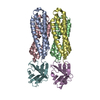
| PubMed Abstract | Lytic cell death culminates in plasma membrane rupture, which releases large intracellular molecules to augment the inflammatory response. Plasma membrane rupture is mediated by the effector membrane ...Lytic cell death culminates in plasma membrane rupture, which releases large intracellular molecules to augment the inflammatory response. Plasma membrane rupture is mediated by the effector membrane protein ninjurin-1 (NINJ1), which polymerizes and ruptures the membrane via its hydrophilic face. How NINJ1 is restrained under steady-state conditions to ensure cell survival remains unknown. Here we describe the molecular underpinnings of NINJ1 inhibition. Using cryogenic electron microscopy, we determined the structure of inactive-state mouse NINJ1 bound to the newly developed nanobody Nb538. Inactive NINJ1 forms a face-to-face homodimer by adopting a three-helix conformation with unkinked transmembrane helix 1 (TM1), in contrast to the four-helix TM1-kinked active conformation. Accordingly, endogenous NINJ1 from primary macrophages is a dimer under steady-state conditions. Inactive dimers sequester the membrane rupture-inducing hydrophilic face of NINJ1 and occlude the binding site for kinked TM1 from neighbouring activated NINJ1 molecules. Mutagenesis studies in cells show that destabilization of inactive face-to-face dimers leads to NINJ1-mediated cell death, whereas stabilization of face-to-face dimers inhibits NINJ1 activity. Moreover, destabilizing mutations prompt spontaneous TM1 kink formation, a hallmark of NINJ1 activation. Collectively, our data demonstrate that dimeric NINJ1 is autoinhibited in trans to prevent unprovoked plasma membrane rupture and cell death. |
 External links External links | Nature / PubMed:39476863 / PubMed Central |
| Methods | EM (single particle) |
| Resolution | 3.0 Å |
| Structure data | EMDB-44585, PDB-9bia: |
| Source |
|
 Keywords Keywords | MEMBRANE PROTEIN / Inactive-state / Membrane rupture / Complex |

 mus musculus (house mouse)