 Movie
Movie Controller
 Structure viewers
 About Yorodumi Papers


+Search query
-Structure paper
| Title | High-resolution yeast actin structures indicate the molecular mechanism of actin filament stiffening by cations. |
|---|---|
| Journal, issue, pages | Commun Chem, Vol. 7, Issue 1, Page 164, Year 2024 |
| Publish date | Jul 30, 2024 |
 Authors Authors | Xiao-Ping Xu / Wenxiang Cao / Mark F Swift / Nandan G Pandit / Andrew E Huehn / Charles V Sindelar / Enrique M De La Cruz / Dorit Hanein / Niels Volkmann /  |
| PubMed Abstract | Actin filament assembly and the regulation of its mechanical properties are fundamental processes essential for eukaryotic cell function. Residue E167 in vertebrate actins forms an inter-subunit salt ...Actin filament assembly and the regulation of its mechanical properties are fundamental processes essential for eukaryotic cell function. Residue E167 in vertebrate actins forms an inter-subunit salt bridge with residue K61 of the adjacent subunit. Saccharomyces cerevisiae actin filaments are more flexible than vertebrate filaments and have an alanine at this position (A167). Substitution of this alanine for a glutamic acid (A167E) confers Saccharomyces cerevisiae actin filaments with salt-dependent stiffness similar to vertebrate actins. We developed an optimized cryogenic electron microscopy workflow refining sample preparation and vitrification to obtain near-atomic resolution structures of wild-type and A167E mutant Saccharomyces cerevisiae actin filaments. The difference between these structures allowed us to pinpoint the potential binding site of a filament-associated cation that controls the stiffness of the filaments in vertebrate and A167E Saccharomyces cerevisiae actins. Through an analysis of previously published high-resolution reconstructions of vertebrate actin filaments, along with a newly determined high-resolution vertebrate actin structure in the absence of potassium, we identified a unique peak near residue 167 consistent with the binding of a magnesium ion. Our findings show how magnesium can contribute to filament stiffening by directly bridging actin subunits and allosterically affecting the orientation of the DNase-I binding loop of actin, which plays a regulatory role in modulating actin filament stiffness and interactions with regulatory proteins. |
 External links External links | Commun Chem / PubMed:39079963 / PubMed Central |
| Methods | EM (helical sym.) |
| Resolution | 2.27 Å |
| Structure data | EMDB-43763, PDB-8w36: |
| Chemicals | 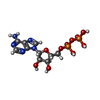 ChemComp-ADP:  ChemComp-MG: |
| Source |
|
 Keywords Keywords | STRUCTURAL PROTEIN / actin |
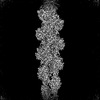


 oryctolagus cuniculus (rabbit)