 Movie
Movie Controller
 Structure viewers
 About Yorodumi Papers


+Search query
-Structure paper
| Title | Low-cooling-rate freezing in biomolecular cryo-electron microscopy for recovery of initial frames. |
|---|---|
| Journal, issue, pages | QRB Discov, Vol. 2, Page e11, Year 2021 |
| Publish date | Sep 6, 2021 |
 Authors Authors | Chunling Wu / Huigang Shi / Dongjie Zhu / Kelong Fan / Xinzheng Zhang /  |
| PubMed Abstract | When biological samples are first exposed to electrons in cryo-electron microcopy (cryo-EM), proteins exhibit a rapid 'burst' phase of beam-induced motion that cannot be corrected with software. This ...When biological samples are first exposed to electrons in cryo-electron microcopy (cryo-EM), proteins exhibit a rapid 'burst' phase of beam-induced motion that cannot be corrected with software. This lowers the quality of the initial frames, which are the least damaged by the electrons. Hence, they are commonly excluded or down-weighted during data processing, reducing the undamaged signal and the resolution in the reconstruction. By decreasing the cooling rate during sample preparation, either with a cooling-rate gradient or by increasing the freezing temperature, we show that the quality of the initial frames for various protein and virus samples can be recovered. Incorporation of the initial frames in the reconstruction increases the resolution by an amount equivalent to using ~60% more data. Moreover, these frames preserve the high-quality cryo-EM densities of radiation-sensitive residues, which is often damaged or very weak in canonical three-dimensional reconstruction. The improved freezing conditions can be easily achieved using existing devices and enhance the overall quality of cryo-EM structures. |
 External links External links | QRB Discov / PubMed:37529673 / PubMed Central |
| Methods | EM (single particle) |
| Resolution | 1.89 Å |
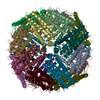
| Structure data | EMDB-31736, PDB-7v66: |
| Source |
|
 Keywords Keywords | OXIDOREDUCTASE / complex / TRANSPORT PROTEIN |
 homo sapiens (human)