[English] 日本語
Yorodumi Papers
- Database of articles cited by EMDB/PDB/SASBDB data -

+
Search query

Keywords
Structure methods
Author
Journal
IF

-
Structure paper

TitleSARS-CoV-2 spike produced in insect cells elicits high neutralization titres in non-human primates.
Journal, issue, pagesEmerg Microbes Infect, Vol. 9, Issue 1, Page 2076-2090, Year 2020
Publish dateOct 5, 2020
AuthorsTingting Li / Qingbing Zheng / Hai Yu / Dinghui Wu / Wenhui Xue / Hualong Xiong / Xiaofen Huang / Meifeng Nie / Mingxi Yue / Rui Rong / Sibo Zhang / Yuyun Zhang / Yangtao Wu / Shaojuan Wang / Zhenghui Zha / Tingting Chen / Tingting Deng / Yingbin Wang / Tianying Zhang / Yixin Chen / Quan Yuan / Qinjian Zhao / Jun Zhang / Ying Gu / Shaowei Li / Ningshao Xia /
PubMed AbstractThe current coronavirus disease 2019 (COVID-19) pandemic was the result of the rapid transmission of a highly pathogenic coronavirus, severe acute respiratory syndrome coronavirus 2 (SARS-CoV-2), for ...The current coronavirus disease 2019 (COVID-19) pandemic was the result of the rapid transmission of a highly pathogenic coronavirus, severe acute respiratory syndrome coronavirus 2 (SARS-CoV-2), for which there is no efficacious vaccine or therapeutic. Toward the development of a vaccine, here we expressed and evaluated as potential candidates four versions of the spike (S) protein using an insect cell expression system: receptor binding domain (RBD), S1 subunit, the wild-type S ectodomain (S-WT), and the prefusion trimer-stabilized form (S-2P). We showed that RBD appears as a monomer in solution, whereas S1, S-WT, and S-2P associate as homotrimers with substantial glycosylation. Cryo-electron microscopy analyses suggested that S-2P assumes an identical trimer conformation as the similarly engineered S protein expressed in 293 mammalian cells but with reduced glycosylation. Overall, the four proteins confer excellent antigenicity with convalescent COVID-19 patient sera in enzyme-linked immunosorbent assay (ELISA), yet show distinct reactivities in immunoblotting. RBD, S-WT and S-2P, but not S1, induce high neutralization titres (>3-log) in mice after a three-round immunization regimen. The high immunogenicity of S-2P could be maintained at the lowest dose (1 μg) with the inclusion of an aluminium adjuvant. Higher doses (20 μg) of S-2P can elicit high neutralization titres in non-human primates that exceed 40-times the mean titres measured in convalescent COVID-19 subjects. Our results suggest that the prefusion trimer-stabilized SARS-CoV-2 S-protein from insect cells may offer a potential candidate strategy for the development of a recombinant COVID-19 vaccine.
External linksEmerg Microbes Infect / PubMed:32897177 / PubMed Central
MethodsEM (single particle)
Resolution4.4 Å
Structure data

EMDB-30506:
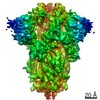
Cryo-EM structure of SARS-CoV-2 spike trimer expressed in insect cells
Method: EM (single particle) / Resolution: 4.4 Å

+
About Yorodumi Papers

-
News

-
Feb 9, 2022. New format data for meta-information of EMDB entries

New format data for meta-information of EMDB entries

  • Version 3 of the EMDB header file is now the official format.
  • The previous official version 1.9 will be removed from the archive.

Related info.:EMDB header

External links:wwPDB to switch to version 3 of the EMDB data model

-
Aug 12, 2020. Covid-19 info

Covid-19 info

URL: https://pdbj.org/emnavi/covid19.php

New page: Covid-19 featured information page in EM Navigator.

Related info.:Covid-19 info / Mar 5, 2020. Novel coronavirus structure data

+
Mar 5, 2020. Novel coronavirus structure data

Novel coronavirus structure data

Related info.:Yorodumi Speices / Aug 12, 2020. Covid-19 info

External links:COVID-19 featured content - PDBj / Molecule of the Month (242):Coronavirus Proteases

+
Jan 31, 2019. EMDB accession codes are about to change! (news from PDBe EMDB page)

EMDB accession codes are about to change! (news from PDBe EMDB page)

  • The allocation of 4 digits for EMDB accession codes will soon come to an end. Whilst these codes will remain in use, new EMDB accession codes will include an additional digit and will expand incrementally as the available range of codes is exhausted. The current 4-digit format prefixed with “EMD-” (i.e. EMD-XXXX) will advance to a 5-digit format (i.e. EMD-XXXXX), and so on. It is currently estimated that the 4-digit codes will be depleted around Spring 2019, at which point the 5-digit format will come into force.
  • The EM Navigator/Yorodumi systems omit the EMD- prefix.

Related info.:Q: What is EMD? / ID/Accession-code notation in Yorodumi/EM Navigator

External links:EMDB Accession Codes are Changing Soon! / Contact to PDBj

+
Jul 12, 2017. Major update of PDB

Major update of PDB

  • wwPDB released updated PDB data conforming to the new PDBx/mmCIF dictionary.
  • This is a major update changing the version number from 4 to 5, and with Remediation, in which all the entries are updated.
  • In this update, many items about electron microscopy experimental information are reorganized (e.g. em_software).
  • Now, EM Navigator and Yorodumi are based on the updated data.

External links:wwPDB Remediation / Enriched Model Files Conforming to OneDep Data Standards Now Available in the PDB FTP Archive

-
Yorodumi Papers

Database of articles cited by EMDB/PDB/SASBDB data

  • Database of articles cited by EMDB, PDB, and SASBDB entries
  • Using PubMed data

Related info.:EMDB / PDB / SASBDB / Yorodumi / EMN Papers / Changes in new EM Navigator and Yorodumi

Read more