Li Chen / Wen-Tao Hou / Tao Fan / Banghui Liu / Ting Pan / Yu-Hui Li / Yong-Liang Jiang / Wen Wen / Zhi-Peng Chen / Linfeng Sun / Cong-Zhao Zhou / Yuxing Chen /
PubMed Abstract
The wall teichoic acid (WTA) is a major cell wall component of Gram-positive bacteria, such as methicillin-resistant (MRSA), a common cause of fatal clinical infections in humans. Thus, the ...The wall teichoic acid (WTA) is a major cell wall component of Gram-positive bacteria, such as methicillin-resistant (MRSA), a common cause of fatal clinical infections in humans. Thus, the indispensable ABC transporter TarGH, which flips WTA from cytoplasm to extracellular space, becomes a promising target of anti-MRSA drugs. Here, we report the 3.9-Å cryo-electron microscopy (cryo-EM) structure of a 50% sequence-identical homolog of TarGH from at an ATP-free and inward-facing conformation. Structural analysis combined with activity assays enables us to clearly decode the binding site and inhibitory mechanism of the anti-MRSA inhibitor Targocil, which targets TarGH. Moreover, we propose a "crankshaft conrod" mechanism utilized by TarGH, which can be applied to similar ABC transporters that translocate a rather big substrate through relatively subtle conformational changes. These findings provide a structural basis for the rational design and optimization of antibiotics against MRSA. The wall teichoic acid (WTA) is a major component of cell wall and a pathogenic factor in methicillin-resistant (MRSA). The ABC transporter TarGH is indispensable for flipping WTA precursor from cytoplasm to the extracellular space, thus making it a promising drug target for anti-MRSA agents. The 3.9-Å cryo-EM structure of a TarGH homolog helps us to decode the binding site and inhibitory mechanism of a recently reported inhibitor, Targocil, and provides a structural platform for rational design and optimization of potential antibiotics. Moreover, we propose a "crankshaft conrod" mechanism to explain how a big substrate is translocated through subtle conformational changes of type II exporters. These findings advance our understanding of anti-MRSA drug design and ABC transporters.
EMDB-9790, PDB-6jbh: Cryo-EM structure and transport mechanism of a wall teichoic acid ABC transporter Method: EM (single particle) / Resolution: 3.94 Å
Source
alicyclobacillus herbarius (bacteria)
Keywords
TRANSPORT PROTEIN / ABC Transporter
+
About Yorodumi Papers
-
News
-
Feb 9, 2022. New format data for meta-information of EMDB entries
New format data for meta-information of EMDB entries
Version 3 of the EMDB header file is now the official format.
The previous official version 1.9 will be removed from the archive.
In the structure databanks used in Yorodumi, some data are registered as the other names, "COVID-19 virus" and "2019-nCoV". Here are the details of the virus and the list of structure data.
Jan 31, 2019. EMDB accession codes are about to change! (news from PDBe EMDB page)
EMDB accession codes are about to change! (news from PDBe EMDB page)
The allocation of 4 digits for EMDB accession codes will soon come to an end. Whilst these codes will remain in use, new EMDB accession codes will include an additional digit and will expand incrementally as the available range of codes is exhausted. The current 4-digit format prefixed with “EMD-” (i.e. EMD-XXXX) will advance to a 5-digit format (i.e. EMD-XXXXX), and so on. It is currently estimated that the 4-digit codes will be depleted around Spring 2019, at which point the 5-digit format will come into force.
The EM Navigator/Yorodumi systems omit the EMD- prefix.
Related info.:Q: What is EMD? / ID/Accession-code notation in Yorodumi/EM Navigator
 Movie
Movie Controller
 Structure viewers
 About Yorodumi Papers


 Authors
 External links
 Keywords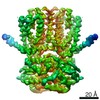

 alicyclobacillus herbarius (bacteria)