 Movie
Movie Controller
 Structure viewers
 About Yorodumi Papers


+Search query
-Structure paper
| Title | Solution structure of ectodomains of the insulin receptor family: the ectodomain of the type 1 insulin-like growth factor receptor displays asymmetry of ligand binding accompanied by limited conformational change. |
|---|---|
| Journal, issue, pages | J Mol Biol, Vol. 394, Issue 5, Page 878-892, Year 2009 |
| Publish date | Dec 18, 2009 |
 Authors Authors | Andrew E Whitten / Brian J Smith / John G Menting / Mai B Margetts / Neil M McKern / George O Lovrecz / Timothy E Adams / Kim Richards / John D Bentley / Jill Trewhella / Colin W Ward / Michael C Lawrence /  |
| PubMed Abstract | The insulin receptor (IR) and the homologous Type 1 insulin-like growth factor receptor (IGF-1R) are cell-surface tyrosine kinase receptors that effect signaling within the respective pathways of ...The insulin receptor (IR) and the homologous Type 1 insulin-like growth factor receptor (IGF-1R) are cell-surface tyrosine kinase receptors that effect signaling within the respective pathways of glucose metabolism and normal human growth. While ligand binding to these receptors is assumed to result in a structural transition within the receptor ectodomain that then effects signal transduction across the cell membrane, little is known about the molecular detail of these events. Presented here are small-angle X-ray scattering data obtained from the IR and IGF-1R ectodomains in solution. We show that, in solution, the ectodomains of IR and IGF-1R have a domain disposition that is very similar to that seen in the crystal structure of the ectodomain of IR, despite the constituent domains being in relatively sparse contact and potentially mobile. We also show that the IGF-1R ectodomain is capable of binding up to three molecules of IGF-1 in solution, with surprisingly little apparent change in relative domain disposition compared to the apo form. While the observed 3:1 ligand-binding stoichiometry appears to contradict earlier explanations of the absence of a bell-shaped dose-response curve for IGF-1R in ligand displacement assays, it is readily understood in the context of the harmonic oscillator model of the negative cooperativity of ligand binding to IGF-1R. Taken together, our findings suggest that the structural movements within these receptors upon ligand binding are small and are possibly limited to local rotation of domains. |
 External links External links | J Mol Biol / PubMed:19835884 |
| Methods | SAS (X-ray in house) |
| Structure data | 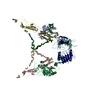 SASDHE2: 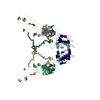 SASDHF2: |
| Source |
|
 Homo sapiens (human)