[English] 日本語
Yorodumi Papers
- Database of articles cited by EMDB/PDB/SASBDB data -

+
Search query

Keywords
Structure methods
Author
Journal
IF

-
Structure paper

TitleThree-dimensional structure of a type III glutamine synthetase by single-particle reconstruction.
Journal, issue, pagesJ Mol Biol, Vol. 361, Issue 4, Page 796-810, Year 2006
Publish dateAug 25, 2006
AuthorsJason M van Rooyen / Valerie R Abratt / B Trevor Sewell /
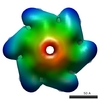
PubMed AbstractGlnN, the type III glutamine synthetase (GSIII) from the medically important, anaerobic, opportunistic pathogen Bacteroides fragilis, has 82.8 kDa subunits that share only 9% sequence identity with ...GlnN, the type III glutamine synthetase (GSIII) from the medically important, anaerobic, opportunistic pathogen Bacteroides fragilis, has 82.8 kDa subunits that share only 9% sequence identity with the type I glutamine synthetases (GSI), the only family for which a structure is known. Active GlnN was found predominantly in a single peak that eluted from a calibrated gel-filtration chromatography column at a position equaivalent to 0.86(+/-0.08) MDa. Negative-stain electron microscopy enabled the identification of double-ringed particles and single hexameric rings ("pinwheels") resulting from partial staining. A 2D average of these pinwheels showed marked similarity to the corresponding structures found in preparations of GSI, except that the arms of the subunits were 40% longer. Reconstructions from particles embedded in vitreous ice showed that GlnN has a double-ringed, dodecameric structure with a 6-fold dihedral space group (D6) symmetry and dimensions of 17.0 nm parallel with the 6-fold axis and 18.3 nm parallel with the 2-fold axes. The structures, combined with a sequence alignment based on structural principles, showed how many aspects of the structure of GSI, and most notably the alpha/beta barrel fold active site were preserved. There was evidence for the presence of this structure in the reconstructed volume, thus, identifying the indentations between the pinwheel spokes as putative active sites and suggesting conservation of the overall molecular geometry found in GSI despite their low level of global homology. Furthermore, docking of GSI into the reconstruction left sufficient plausibly located unoccupied density to account for the additional residues in GSIII, thus validating the structure.
External linksJ Mol Biol / PubMed:16879836
MethodsEM (single particle)
Resolution15.0 - 21.0 Å
Structure data

EMDB-1204:
Three-dimensional structure of a type III glutamine synthetase by single-particle reconstruction.
Method: EM (single particle) / Resolution: 15.0 Å

EMDB-1205:
Three-dimensional structure of a type III glutamine synthetase by single-particle reconstruction.
Method: EM (single particle) / Resolution: 21.0 Å

Source
  • Bacteroides fragilis (bacteria)

+
About Yorodumi Papers

-
News

-
Feb 9, 2022. New format data for meta-information of EMDB entries

New format data for meta-information of EMDB entries

  • Version 3 of the EMDB header file is now the official format.
  • The previous official version 1.9 will be removed from the archive.

Related info.:EMDB header

External links:wwPDB to switch to version 3 of the EMDB data model

-
Aug 12, 2020. Covid-19 info

Covid-19 info

URL: https://pdbj.org/emnavi/covid19.php

New page: Covid-19 featured information page in EM Navigator.

Related info.:Covid-19 info / Mar 5, 2020. Novel coronavirus structure data

+
Mar 5, 2020. Novel coronavirus structure data

Novel coronavirus structure data

Related info.:Yorodumi Speices / Aug 12, 2020. Covid-19 info

External links:COVID-19 featured content - PDBj / Molecule of the Month (242):Coronavirus Proteases

+
Jan 31, 2019. EMDB accession codes are about to change! (news from PDBe EMDB page)

EMDB accession codes are about to change! (news from PDBe EMDB page)

  • The allocation of 4 digits for EMDB accession codes will soon come to an end. Whilst these codes will remain in use, new EMDB accession codes will include an additional digit and will expand incrementally as the available range of codes is exhausted. The current 4-digit format prefixed with “EMD-” (i.e. EMD-XXXX) will advance to a 5-digit format (i.e. EMD-XXXXX), and so on. It is currently estimated that the 4-digit codes will be depleted around Spring 2019, at which point the 5-digit format will come into force.
  • The EM Navigator/Yorodumi systems omit the EMD- prefix.

Related info.:Q: What is EMD? / ID/Accession-code notation in Yorodumi/EM Navigator

External links:EMDB Accession Codes are Changing Soon! / Contact to PDBj

+
Jul 12, 2017. Major update of PDB

Major update of PDB

  • wwPDB released updated PDB data conforming to the new PDBx/mmCIF dictionary.
  • This is a major update changing the version number from 4 to 5, and with Remediation, in which all the entries are updated.
  • In this update, many items about electron microscopy experimental information are reorganized (e.g. em_software).
  • Now, EM Navigator and Yorodumi are based on the updated data.

External links:wwPDB Remediation / Enriched Model Files Conforming to OneDep Data Standards Now Available in the PDB FTP Archive

-
Yorodumi Papers

Database of articles cited by EMDB/PDB/SASBDB data

  • Database of articles cited by EMDB, PDB, and SASBDB entries
  • Using PubMed data

Related info.:EMDB / PDB / SASBDB / Yorodumi / EMN Papers / Changes in new EM Navigator and Yorodumi

Read more