Meiotic recombination / Presynaptic phase of homologous DNA pairing and strand exchange / Homologous DNA Pairing and Strand Exchange / Resolution of D-loop Structures through Holliday Junction Intermediates / HDR through Single Strand Annealing (SSA) / HDR through Homologous Recombination (HRR) / presynaptic intermediate filament cytoskeleton / response to glucoside / mitotic recombination-dependent replication fork processing / DNA recombinase assembly ...Meiotic recombination / Presynaptic phase of homologous DNA pairing and strand exchange / Homologous DNA Pairing and Strand Exchange / Resolution of D-loop Structures through Holliday Junction Intermediates / HDR through Single Strand Annealing (SSA) / HDR through Homologous Recombination (HRR) / presynaptic intermediate filament cytoskeleton / response to glucoside / mitotic recombination-dependent replication fork processing / DNA recombinase assembly / chromosome organization involved in meiotic cell cycle / telomere maintenance via telomere lengthening / double-strand break repair involved in meiotic recombination / nuclear ubiquitin ligase complex / synaptonemal complex / cellular response to cisplatin / DNA strand invasion / mitotic recombination / cellular response to hydroxyurea / cellular response to camptothecin / replication-born double-strand break repair via sister chromatid exchange / lateral element / DNA strand exchange activity / regulation of DNA damage checkpoint / telomere maintenance via recombination / reciprocal meiotic recombination / single-stranded DNA helicase activity / ATP-dependent DNA damage sensor activity / regulation of double-strand break repair via homologous recombination / cellular response to alkaloid / nuclear chromosome / replication fork processing / response to X-ray / ATP-dependent activity, acting on DNA / interstrand cross-link repair / condensed chromosome / DNA polymerase binding / telomere organization / condensed nuclear chromosome / cellular response to ionizing radiation / meiotic cell cycle / cellular response to gamma radiation / PML body / double-strand break repair via homologous recombination / 加水分解酵素; 酸無水物に作用; 酸無水物に作用・細胞または細胞小器官の運動に関与 / response to toxic substance / single-stranded DNA binding / chromosome / site of double-strand break / double-stranded DNA binding / DNA recombination / chromosome, telomeric region / response to xenobiotic stimulus / mitochondrial matrix / DNA repair / DNA damage response / chromatin binding / centrosome / chromatin / nucleolus / perinuclear region of cytoplasm / enzyme binding / protein-containing complex / mitochondrion / nucleoplasm / ATP binding / identical protein binding / nucleus / cytoplasm / cytosol 類似検索 - 分子機能
DNA recombination/repair protein Rad51 / DNA recombination and repair protein, RecA-like / DNA recombination and repair protein Rad51-like, C-terminal / Rad51 / DNA recombination and repair protein RecA, monomer-monomer interface / RecA family profile 2. / DNA recombination and repair protein RecA-like, ATP-binding domain / RecA family profile 1. / DNA repair Rad51/transcription factor NusA, alpha-helical / Helix-hairpin-helix domain ...DNA recombination/repair protein Rad51 / DNA recombination and repair protein, RecA-like / DNA recombination and repair protein Rad51-like, C-terminal / Rad51 / DNA recombination and repair protein RecA, monomer-monomer interface / RecA family profile 2. / DNA recombination and repair protein RecA-like, ATP-binding domain / RecA family profile 1. / DNA repair Rad51/transcription factor NusA, alpha-helical / Helix-hairpin-helix domain / ATPases associated with a variety of cellular activities / AAA+ ATPase domain / P-loop containing nucleoside triphosphate hydrolase 類似検索 - ドメイン・相同性
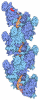
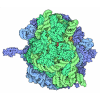
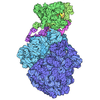
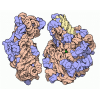
ジャーナル: Nat Commun / 年: 2025 タイトル: RAD51 D-loop structures reveal the mechanism of eukaryotic RAD51-mediated strand exchange. 著者: Shih-Chi Luo / Cheng-Han Yang / Hsin-Yi Yeh / Cheng-Wei Lin / Min-Chi Yeh / Peter Chi / Meng-Chiao Ho / 要旨: Strand exchange is a key step in homologous recombination, enabling template-based repair of DNA double-strand breaks. Eukaryotic RAD51 forms an ATP-dependent helical presynaptic filament on single- ...Strand exchange is a key step in homologous recombination, enabling template-based repair of DNA double-strand breaks. Eukaryotic RAD51 forms an ATP-dependent helical presynaptic filament on single-stranded DNA (ssDNA), which then searches for homologous double-stranded DNA (dsDNA), and catalyzes the strand exchange to form a D-loop in an ATP hydrolysis-independent manner. The molecular mechanism by which RAD51 facilitates dsDNA unwinding and pairing remains unclear. Here, we present cryo-EM structures of RAD51 mini-filaments bound to homologous dsDNA, capturing five intermediates from dsDNA recruitment to D-loop formation. These structures, together with molecular dynamics simulations, suggest a stepwise mechanism: the conserved N-terminal domain (NTD) recruits and bends the dsDNA, weakening base pairing near the exchange site. Subsequent engagement with positively-charged regions, including the loop L2 and loop Arg303-Arg306, further bends the homologous dsDNA, thereby not only positioning it closer to the strand exchange site but also inducing local base-pair opening. Additionally, the loop L2 (Met278 and Phe279) inserts between strands, and the secondary DNA binding sites (S2 sites) capture the displaced strand to prevent strand reannealing. Together, our findings provide detailed insight into a spatially coordinated mechanism of strand exchange by RAD51.
 ムービー
ムービー コントローラー


 データを開く
 基本情報
基本情報
 マップデータ
 試料
試料 キーワード
キーワード 機能・相同性情報
 Mus musculus (ハツカネズミ)
 データ登録者
 台湾, 1件
  引用
引用 構造の表示
構造の表示
 ダウンロードとリンク
 emd_64186.png
 http://ftp.pdbj.org/pub/emdb/structures/EMD-64186


 Z (Sec.)
 Y (Row.)
 X (Col.)


 試料の構成要素
 Escherichia coli (大腸菌)
 解析
解析 電子顕微鏡法
 FIELD EMISSION GUN

