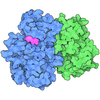
- EMDB-52204: Cryo-EM structure of CDK2-cyclin A bound to a SAMHD1 peptide -
+
Open data
ID or keywords:
Loading...
-
Basic information
Entry
Database: EMDB / ID: EMD-52204
Title
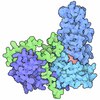
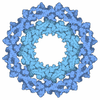
Cryo-EM structure of CDK2-cyclin A bound to a SAMHD1 peptide
Map data
Sample
Complex: CDK2-cyclin A bound to a SAMHD1 peptide
Protein or peptide: Cyclin-A2
Protein or peptide: Cyclin-dependent kinase 2
Protein or peptide: Deoxynucleoside triphosphate triphosphohydrolase SAMHD1
Keywords
Kinase / cyclin / short linear motif / cdk2 / cyclin A / CELL CYCLE
Function / homology
Function and homology information
Nucleotide catabolism / Hydrolases; Acting on ester bonds; Triphosphoric-monoester hydrolases / deoxynucleoside triphosphate hydrolase activity / dGTP binding / dATP catabolic process / deoxyribonucleotide catabolic process / tetraspanin-enriched microdomain / dGTPase activity / cyclin A2-CDK1 complex / dGTP catabolic process ...Nucleotide catabolism / Hydrolases; Acting on ester bonds; Triphosphoric-monoester hydrolases / deoxynucleoside triphosphate hydrolase activity / dGTP binding / dATP catabolic process / deoxyribonucleotide catabolic process / tetraspanin-enriched microdomain / dGTPase activity / cyclin A2-CDK1 complex / dGTP catabolic process / cell cycle G1/S phase transition / cellular response to luteinizing hormone stimulus / DNA strand resection involved in replication fork processing / G2/M DNA replication checkpoint / Transcription of E2F targets under negative control by p107 (RBL1) and p130 (RBL2) in complex with HDAC1 / cellular response to leptin stimulus / male pronucleus / female pronucleus / cellular response to cocaine / response to glucagon / cyclin-dependent protein serine/threonine kinase regulator activity / negative regulation of type I interferon-mediated signaling pathway / positive regulation of DNA biosynthetic process / regulation of innate immune response / cyclin A1-CDK2 complex / cyclin E2-CDK2 complex / cyclin E1-CDK2 complex / cellular response to insulin-like growth factor stimulus / cyclin A2-CDK2 complex / positive regulation of DNA-templated DNA replication initiation / G2 Phase / Y chromosome / cyclin-dependent protein kinase activity / regulation of heterochromatin organization / Phosphorylation of proteins involved in G1/S transition by active Cyclin E:Cdk2 complexes / positive regulation of heterochromatin formation / p53-Dependent G1 DNA Damage Response / X chromosome / PTK6 Regulates Cell Cycle / regulation of anaphase-promoting complex-dependent catabolic process / Defective binding of RB1 mutants to E2F1,(E2F2, E2F3) / centriole replication / Regulation of APC/C activators between G1/S and early anaphase / telomere maintenance in response to DNA damage / regulation of DNA replication / centrosome duplication / microtubule organizing center / G0 and Early G1 / cochlea development / Telomere Extension By Telomerase / animal organ regeneration / Activation of the pre-replicative complex / RNA nuclease activity / cyclin-dependent kinase / cyclin-dependent protein serine/threonine kinase activity / TP53 Regulates Transcription of Genes Involved in G1 Cell Cycle Arrest / Activation of ATR in response to replication stress / Regulation of MITF-M-dependent genes involved in cell cycle and proliferation / Cajal body / Cyclin E associated events during G1/S transition / somatic hypermutation of immunoglobulin genes / Cyclin A:Cdk2-associated events at S phase entry / cyclin-dependent protein kinase holoenzyme complex / Cyclin A/B1/B2 associated events during G2/M transition / Chk1/Chk2(Cds1) mediated inactivation of Cyclin B:Cdk1 complex / regulation of G2/M transition of mitotic cell cycle / cellular response to platelet-derived growth factor stimulus / condensed chromosome / mitotic G1 DNA damage checkpoint signaling / negative regulation of protein localization to chromatin / cellular response to nitric oxide / post-translational protein modification / regulation of mitotic cell cycle / cyclin binding / positive regulation of DNA replication / peptidyl-serine phosphorylation / male germ cell nucleus / meiotic cell cycle / cellular response to estradiol stimulus / potassium ion transport / Cdc20:Phospho-APC/C mediated degradation of Cyclin A / G1/S transition of mitotic cell cycle / DNA Damage/Telomere Stress Induced Senescence / double-strand break repair via homologous recombination / Meiotic recombination / CDK-mediated phosphorylation and removal of Cdc6 / G2/M transition of mitotic cell cycle / positive regulation of fibroblast proliferation / SCF(Skp2)-mediated degradation of p27/p21 / Transcriptional regulation of granulopoiesis / Orc1 removal from chromatin / Cyclin D associated events in G1 / cellular senescence / Interferon alpha/beta signaling / Regulation of TP53 Degradation / nuclear envelope / single-stranded DNA binding / site of double-strand break / Factors involved in megakaryocyte development and platelet production / Processing of DNA double-strand break ends Similarity search - Function
: / Cyclin-A, N-terminal APC/C binding region / Cyclin-A N-terminal APC/C binding region / : / HD domain profile. / Cyclin, C-terminal domain / : / Cyclins signature. / Cyclin / HD domain ...: / Cyclin-A, N-terminal APC/C binding region / Cyclin-A N-terminal APC/C binding region / : / HD domain profile. / Cyclin, C-terminal domain / : / Cyclins signature. / Cyclin / HD domain / Cyclin, C-terminal domain / Cyclin_C / HD domain / Cyclin, N-terminal / Cyclin, N-terminal domain / SAM domain (Sterile alpha motif) / Cyclin-like / domain present in cyclins, TFIIB and Retinoblastoma / Cyclin-like superfamily / SAM domain profile. / Metal dependent phosphohydrolases with conserved 'HD' motif. / HD/PDEase domain / : / Sterile alpha motif. / Sterile alpha motif domain / Sterile alpha motif/pointed domain superfamily / Serine/threonine-protein kinase, active site / Serine/Threonine protein kinases active-site signature. / Protein kinase domain / Serine/Threonine protein kinases, catalytic domain / Protein kinase, ATP binding site / Protein kinases ATP-binding region signature. / Protein kinase domain profile. / Protein kinase domain / Protein kinase-like domain superfamily Similarity search - Domain/homology
Journal: Nat Commun / Year: 2025 Title: High-throughput investigation of cyclin docking interactions reveals the complexity of motif binding determinants. Authors: Mihkel Örd / Matthew J Winters / Mythili S Subbanna / Natàlia de Martín Garrido / Victoria I Cushing / Johanna Kliche / Caroline Benz / Ylva Ivarsson / Basil J Greber / Peter M Pryciak / Norman E Davey / Abstract: Many regulatory protein-protein interactions depend on Short Linear Motifs (SLiMs). In the cell cycle, cyclin-CDKs recognize SLiMs to control substrate recruitment and phosphorylation timing. Here, ...Many regulatory protein-protein interactions depend on Short Linear Motifs (SLiMs). In the cell cycle, cyclin-CDKs recognize SLiMs to control substrate recruitment and phosphorylation timing. Here, we measure the relative binding strength of ~100,000 peptides to 11 human cyclins from five families (D, E, A, B, and F). Using a quantitative intracellular binding assay and large-scale tiled peptide screening, we identify multiple non-canonical binders unveiling a broader repertoire of cyclin docking motif types. Cryo-electron microscopy and saturation mutagenesis studies reveal distinct binding modes and sequence features governing motif recognition, binding strength, and cyclin preference. Docking motifs vary from highly selective to pan-cyclin, thereby fine-tuning the timing of CDK phosphorylation during cell cycle. Overall, these findings provide insights into the rules encoding specificity and affinity of SLiM-mediated interactions and offer a framework for understanding motif-driven protein networks across the proteome.
In the structure databanks used in Yorodumi, some data are registered as the other names, "COVID-19 virus" and "2019-nCoV". Here are the details of the virus and the list of structure data.
Jan 31, 2019. EMDB accession codes are about to change! (news from PDBe EMDB page)
EMDB accession codes are about to change! (news from PDBe EMDB page)
The allocation of 4 digits for EMDB accession codes will soon come to an end. Whilst these codes will remain in use, new EMDB accession codes will include an additional digit and will expand incrementally as the available range of codes is exhausted. The current 4-digit format prefixed with “EMD-” (i.e. EMD-XXXX) will advance to a 5-digit format (i.e. EMD-XXXXX), and so on. It is currently estimated that the 4-digit codes will be depleted around Spring 2019, at which point the 5-digit format will come into force.
The EM Navigator/Yorodumi systems omit the EMD- prefix.
Related info.:Q: What is EMD? / ID/Accession-code notation in Yorodumi/EM Navigator
Yorodumi is a browser for structure data from EMDB, PDB, SASBDB, etc.
This page is also the successor to EM Navigator detail page, and also detail information page/front-end page for Omokage search.
The word "yorodu" (or yorozu) is an old Japanese word meaning "ten thousand". "mi" (miru) is to see.
Related info.:EMDB / PDB / SASBDB / Comparison of 3 databanks / Yorodumi Search / Aug 31, 2016. New EM Navigator & Yorodumi / Yorodumi Papers / Jmol/JSmol / Function and homology information / Changes in new EM Navigator and Yorodumi
 Movie
Movie Controller


 Open data
 Basic information
 Map data
 Sample
 Keywords
 Function and homology information
 Homo sapiens (human)
 Authors
 Citation


 Structure visualization
 Downloads & links
 emd_52204.png
 http://ftp.pdbj.org/pub/emdb/structures/EMD-52204


 Z (Sec.)
 Y (Row.)
 X (Col.)


 Sample components
 Escherichia coli (E. coli)
 Processing
 Electron microscopy
 FIELD EMISSION GUN
