[English] 日本語
Yorodumi
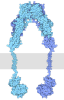
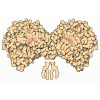
- EMDB-38404: Cryo-EM structure of human insulin receptor bound to 3 IGF-I -

+
Open data


ID or keywords:

Loading...

-
Basic information

Entry
Database: EMDB / ID: EMD-38404
TitleCryo-EM structure of human insulin receptor bound to 3 IGF-I
Map data
Sample
  • Complex: Complex of insulin receptor with 3 IGF-I
    • Protein or peptide: Isoform Short of Insulin receptor
    • Protein or peptide: Insulin-like growth factor I
KeywordsMEMBRANE PROTEIN
Function / homology
Function and homology information


glycolate metabolic process / muscle hypertrophy / negative regulation of oocyte development / insulin-like growth factor binding protein complex / insulin-like growth factor ternary complex / positive regulation of trophectodermal cell proliferation / prostate gland stromal morphogenesis / positive regulation of type B pancreatic cell proliferation / type II pneumocyte differentiation / neuronal dense core vesicle lumen ...glycolate metabolic process / muscle hypertrophy / negative regulation of oocyte development / insulin-like growth factor binding protein complex / insulin-like growth factor ternary complex / positive regulation of trophectodermal cell proliferation / prostate gland stromal morphogenesis / positive regulation of type B pancreatic cell proliferation / type II pneumocyte differentiation / neuronal dense core vesicle lumen / proteoglycan biosynthetic process / regulation of establishment or maintenance of cell polarity / chondroitin sulfate proteoglycan biosynthetic process / positive regulation of transcription regulatory region DNA binding / myotube cell development / negative regulation of neuroinflammatory response / Signaling by Type 1 Insulin-like Growth Factor 1 Receptor (IGF1R) / skeletal muscle satellite cell maintenance involved in skeletal muscle regeneration / bone mineralization involved in bone maturation / IRS-related events triggered by IGF1R / positive regulation of cerebellar granule cell precursor proliferation / positive regulation of cell growth involved in cardiac muscle cell development / lung vasculature development / negative regulation of vascular associated smooth muscle cell apoptotic process / exocytic vesicle / positive regulation of myoblast proliferation / cerebellar granule cell precursor proliferation / positive regulation of glycoprotein biosynthetic process / regulation of female gonad development / positive regulation of meiotic cell cycle / lung lobe morphogenesis / cell activation / positive regulation of myelination / insulin-like growth factor II binding / positive regulation of developmental growth / negative regulation of androgen receptor signaling pathway / transmembrane receptor protein tyrosine kinase activator activity / positive regulation of calcineurin-NFAT signaling cascade / glial cell differentiation / prostate gland growth / male sex determination / insulin receptor complex / insulin-like growth factor I binding / insulin receptor activity / mammary gland development / positive regulation of protein-containing complex disassembly / exocrine pancreas development / alphav-beta3 integrin-IGF-1-IGF1R complex / myoblast differentiation / type B pancreatic cell proliferation / cell surface receptor signaling pathway via STAT / positive regulation of insulin-like growth factor receptor signaling pathway / regulation of nitric oxide biosynthetic process / positive regulation of Ras protein signal transduction / activation of protein kinase B activity / positive regulation of activated T cell proliferation / dendritic spine maintenance / positive regulation of DNA binding / growth hormone receptor signaling pathway / insulin binding / adrenal gland development / cargo receptor activity / androgen receptor signaling pathway / positive regulation of smooth muscle cell migration / negative regulation of interleukin-1 beta production / PTB domain binding / lung alveolus development / muscle organ development / Signaling by Insulin receptor / IRS activation / branching morphogenesis of an epithelial tube / cellular response to insulin-like growth factor stimulus / prostate epithelial cord arborization involved in prostate glandular acinus morphogenesis / negative regulation of release of cytochrome c from mitochondria / positive regulation of cardiac muscle hypertrophy / neuronal cell body membrane / type I pneumocyte differentiation / positive regulation of respiratory burst / inner ear development / negative regulation of amyloid-beta formation / negative regulation of smooth muscle cell apoptotic process / amyloid-beta clearance / myoblast proliferation / regulation of embryonic development / insulin receptor substrate binding / positive regulation of receptor internalization / Synthesis, secretion, and deacylation of Ghrelin / epithelial to mesenchymal transition / epidermis development / negative regulation of tumor necrosis factor production / positive regulation of glycogen biosynthetic process / protein kinase activator activity / Signal attenuation / positive regulation of osteoblast differentiation / blood vessel remodeling / SHC-related events triggered by IGF1R / postsynaptic modulation of chemical synaptic transmission / transport across blood-brain barrier / phosphatidylinositol 3-kinase binding / heart morphogenesis
Similarity search - Function
Insulin-like growth factor I / Insulin-like growth factor / Insulin receptor, trans-membrane domain / Insulin receptor trans-membrane segment / Tyrosine-protein kinase, insulin-like receptor / Tyrosine-protein kinase, receptor class II, conserved site / Receptor tyrosine kinase class II signature. / Insulin family / Insulin-like / Insulin/IGF/Relaxin family ...Insulin-like growth factor I / Insulin-like growth factor / Insulin receptor, trans-membrane domain / Insulin receptor trans-membrane segment / Tyrosine-protein kinase, insulin-like receptor / Tyrosine-protein kinase, receptor class II, conserved site / Receptor tyrosine kinase class II signature. / Insulin family / Insulin-like / Insulin/IGF/Relaxin family / Insulin / insulin-like growth factor / relaxin family. / Insulin, conserved site / Insulin family signature. / Insulin-like superfamily / Receptor L-domain / Furin-like cysteine-rich domain / Receptor L-domain superfamily / Furin-like cysteine rich region / Receptor L domain / Furin-like repeat / Furin-like repeats / Growth factor receptor cysteine-rich domain superfamily / : / Fibronectin type 3 domain / Fibronectin type-III domain profile. / Fibronectin type III / Fibronectin type III superfamily / Tyrosine-protein kinase, catalytic domain / Tyrosine kinase, catalytic domain / Tyrosine protein kinases specific active-site signature. / Tyrosine-protein kinase, active site / Protein tyrosine and serine/threonine kinase / Serine-threonine/tyrosine-protein kinase, catalytic domain / Protein kinase, ATP binding site / Protein kinases ATP-binding region signature. / Immunoglobulin-like fold / Protein kinase domain profile. / Protein kinase domain / Protein kinase-like domain superfamily
Similarity search - Domain/homology
Insulin-like growth factor 1 / Insulin receptor
Similarity search - Component
Biological speciesHomo sapiens (human)
Methodsingle particle reconstruction / cryo EM / Resolution: 3.24 Å
AuthorsXi Z
Funding support China, 1 items
OrganizationGrant numberCountry
National Natural Science Foundation of China (NSFC) China
CitationJournal: To Be Published
Title: Cryo-EM structure of human insulin receptor bound to 3 IGF-I
Authors: Xi Z
History
DepositionDec 22, 2023-
Header (metadata) releaseDec 25, 2024-
Map releaseDec 25, 2024-
UpdateFeb 4, 2026-
Current statusFeb 4, 2026Processing site: PDBj / Status: Released

-
Structure visualization

Supplemental images

Downloads & links

-
Map

FileDownload / File: emd_38404.map.gz / Format: CCP4 / Size: 512 MB / Type: IMAGE STORED AS FLOATING POINT NUMBER (4 BYTES)
Projections & slices

Image control

Size
Brightness
Contrast
Others
AxesZ (Sec.)Y (Row.)X (Col.)
0.66 Å/pix.
x 512 pix.
= 337.92 Å
0.66 Å/pix.
x 512 pix.
= 337.92 Å
0.66 Å/pix.
x 512 pix.
= 337.92 Å

Surface

Projections

Slices (1/3)

Slices (1/2)

Slices (2/3)

Images are generated by Spider.

Voxel sizeX=Y=Z: 0.66 Å
Density
Contour LevelBy AUTHOR: 0.035
Minimum - Maximum-0.14360945 - 0.32501474
Average (Standard dev.)0.000006443138 (±0.0060289605)
SymmetrySpace group: 1
Details

EMDB XML:

Map geometry
Axis orderXYZ
Origin000
Dimensions512512512
Spacing512512512
CellA=B=C: 337.92 Å
α=β=γ: 90.0 °

-
Supplemental data

-
Mask #1

Fileemd_38404_msk_1.map
Projections & Slices
AxesZYX

Projections

Slices (1/2)
Density Histograms

-
Half map: #2

Fileemd_38404_half_map_1.map
Projections & Slices
AxesZYX

Projections

Slices (1/2)
Density Histograms

-
Half map: #1

Fileemd_38404_half_map_2.map
Projections & Slices
AxesZYX

Projections

Slices (1/2)
Density Histograms

-
Sample components

-
Entire : Complex of insulin receptor with 3 IGF-I

EntireName: Complex of insulin receptor with 3 IGF-I
Components
  • Complex: Complex of insulin receptor with 3 IGF-I
    • Protein or peptide: Isoform Short of Insulin receptor
    • Protein or peptide: Insulin-like growth factor I

-
Supramolecule #1: Complex of insulin receptor with 3 IGF-I

SupramoleculeName: Complex of insulin receptor with 3 IGF-I / type: complex / ID: 1 / Parent: 0 / Macromolecule list: all
Source (natural)Organism: Homo sapiens (human)

-
Macromolecule #1: Isoform Short of Insulin receptor

MacromoleculeName: Isoform Short of Insulin receptor / type: protein_or_peptide / ID: 1 / Number of copies: 2 / Enantiomer: LEVO
Source (natural)Organism: Homo sapiens (human)
Molecular weightTheoretical: 155.329094 KDa
Recombinant expressionOrganism: Homo sapiens (human)
SequenceString: MATGGRRGAA AAPLLVAVAA LLLGAAGHLY PGEVCPGMDI RNNLTRLHEL ENCSVIEGHL QILLMFKTRP EDFRDLSFPK LIMITDYLL LFRVYGLESL KDLFPNLTVI RGSRLFFNYA LVIFEMVHLK ELGLYNLMNI TRGSVRIEKN NELCYLATID W SRILDSVE ...String:
MATGGRRGAA AAPLLVAVAA LLLGAAGHLY PGEVCPGMDI RNNLTRLHEL ENCSVIEGHL QILLMFKTRP EDFRDLSFPK LIMITDYLL LFRVYGLESL KDLFPNLTVI RGSRLFFNYA LVIFEMVHLK ELGLYNLMNI TRGSVRIEKN NELCYLATID W SRILDSVE DNYIVLNKDD NEECGDICPG TAKGKTNCPA TVINGQFVER CWTHSHCQKV CPTICKSHGC TAEGLCCHSE CL GNCSQPD DPTKCVACRN FYLDGRCVET CPPPYYHFQD WRCVNFSFCQ DLHHKCKNSR RQGCHQYVIH NNKCIPECPS GYT MNSSNL LCTPCLGPCP KVCHLLEGEK TIDSVTSAQE LRGCTVINGS LIINIRGGNN LAAELEANLG LIEEISGYLK IRRS YALVS LSFFRKLRLI RGETLEIGNY SFYALDNQNL RQLWDWSKHN LTITQGKLFF HYNPKLCLSE IHKMEEVSGT KGRQE RNDI ALKTNGDQAS CENELLKFSY IRTSFDKILL RWEPYWPPDF RDLLGFMLFY KEAPYQNVTE FDGQDACGSN SWTVVD IDP PLRSNDPKSQ NHPGWLMRGL KPWTQYAIFV KTLVTFSDER RTYGAKSDII YVQTDATNPS VPLDPISVSN SSSQIIL KW KPPSDPNGNI THYLVFWERQ AEDSELFELD YCLKGLKLPS RTWSPPFESE DSQKHNQSEY EDSAGECCSC PKTDSQIL K ELEESSFRKT FEDYLHNVVF VPRPSRKRRS LGDVGNVTVA VPTVAAFPNT SSTSVPTSPE EHRPFEKVVN KESLVISGL RHFTGYRIEL QACNQDTPEE RCSVAAYVSA RTMPEAKADD IVGPVTHEIF ENNVVHLMWQ EPKEPNGLIV LYEVSYRRYG DEELHLCVS RKHFALERGC RLRGLSPGNY SVRIRATSLA GNGSWTEPTY FYVTDYLDVP SNIAKIIIGP LIFVFLFSVV I GSIYLFLR KRQPDGPLGP LYASSNPEYL SASDVFPCSV YVPDEWEVSR EKITLLRELG QGSFGMVYEG NARDIIKGEA ET RVAVKTV NESASLRERI EFLNEASVMK GFTCHHVVRL LGVVSKGQPT LVVMELMAHG DLKSYLRSLR PEAENNPGRP PPT LQEMIQ MAAEIADGMA YLNAKKFVHR DLAARNCMVA HDFTVKIGDF GMTRDIYETD YYRKGGKGLL PVRWMAPESL KDGV FTTSS DMWSFGVVLW EITSLAEQPY QGLSNEQVLK FVMDGGYLDQ PDNCPERVTD LMRMCWQFNP KMRPTFLEIV NLLKD DLHP SFPEVSFFHS EENKAPESEE LEMEFEDMEN VPLDRSSHCQ REEAGGRDGG SSLGFKRSYE EHIPYTHMNG GKKNGR ILT LPRSNPS

UniProtKB: Insulin receptor

-
Macromolecule #2: Insulin-like growth factor I

MacromoleculeName: Insulin-like growth factor I / type: protein_or_peptide / ID: 2 / Number of copies: 3 / Enantiomer: LEVO
Source (natural)Organism: Homo sapiens (human)
Molecular weightTheoretical: 21.88132 KDa
Recombinant expressionOrganism: Escherichia coli BL21(DE3) (bacteria)
SequenceString: MGKISSLPTQ LFKCCFCDFL KVKMHTMSSS HLFYLALCLL TFTSSATAGP ETLCGAELVD ALQFVCGDRG FYFNKPTGYG SSSRRAPQT GIVDECCFRS CDLRRLEMYC APLKPAKSAR SVRAQRHTDM PKTQKYQPPS TNKNTKSQRR KGWPKTHPGG E QKEGTEAS ...String:
MGKISSLPTQ LFKCCFCDFL KVKMHTMSSS HLFYLALCLL TFTSSATAGP ETLCGAELVD ALQFVCGDRG FYFNKPTGYG SSSRRAPQT GIVDECCFRS CDLRRLEMYC APLKPAKSAR SVRAQRHTDM PKTQKYQPPS TNKNTKSQRR KGWPKTHPGG E QKEGTEAS LQIRGKKKEQ RREIGSRNAE CRGKKGK

UniProtKB: Insulin-like growth factor 1

-
Experimental details

-
Structure determination

Methodcryo EM
Processingsingle particle reconstruction
Aggregation stateparticle

-
Sample preparation

BufferpH: 7.4
VitrificationCryogen name: ETHANE

-
Electron microscopy

MicroscopeTFS KRIOS
Image recordingFilm or detector model: GATAN K3 (6k x 4k) / Average electron dose: 50.0 e/Å2
Electron beamAcceleration voltage: 300 kV / Electron source: FIELD EMISSION GUN
Electron opticsIllumination mode: FLOOD BEAM / Imaging mode: BRIGHT FIELD / Nominal defocus max: 5.0 µm / Nominal defocus min: 1.2 µm
Experimental equipment
Model: Titan Krios / Image courtesy: FEI Company

+
Image processing

CTF correctionSoftware - Name: cryoSPARC / Type: PHASE FLIPPING AND AMPLITUDE CORRECTION
Startup modelType of model: NONE
Final reconstructionResolution.type: BY AUTHOR / Resolution: 3.24 Å / Resolution method: FSC 0.143 CUT-OFF / Software - Name: cryoSPARC / Number images used: 148388
Initial angle assignmentType: MAXIMUM LIKELIHOOD
Final angle assignmentType: MAXIMUM LIKELIHOOD

+
About Yorodumi

-
News

-
Feb 9, 2022. New format data for meta-information of EMDB entries

New format data for meta-information of EMDB entries

  • Version 3 of the EMDB header file is now the official format.
  • The previous official version 1.9 will be removed from the archive.

Related info.:EMDB header

External links:wwPDB to switch to version 3 of the EMDB data model

-
Aug 12, 2020. Covid-19 info

Covid-19 info

URL: https://pdbj.org/emnavi/covid19.php

New page: Covid-19 featured information page in EM Navigator.

Related info.:Covid-19 info / Mar 5, 2020. Novel coronavirus structure data

+
Mar 5, 2020. Novel coronavirus structure data

Novel coronavirus structure data

Related info.:Yorodumi Speices / Aug 12, 2020. Covid-19 info

External links:COVID-19 featured content - PDBj / Molecule of the Month (242):Coronavirus Proteases

+
Jan 31, 2019. EMDB accession codes are about to change! (news from PDBe EMDB page)

EMDB accession codes are about to change! (news from PDBe EMDB page)

  • The allocation of 4 digits for EMDB accession codes will soon come to an end. Whilst these codes will remain in use, new EMDB accession codes will include an additional digit and will expand incrementally as the available range of codes is exhausted. The current 4-digit format prefixed with “EMD-” (i.e. EMD-XXXX) will advance to a 5-digit format (i.e. EMD-XXXXX), and so on. It is currently estimated that the 4-digit codes will be depleted around Spring 2019, at which point the 5-digit format will come into force.
  • The EM Navigator/Yorodumi systems omit the EMD- prefix.

Related info.:Q: What is EMD? / ID/Accession-code notation in Yorodumi/EM Navigator

External links:EMDB Accession Codes are Changing Soon! / Contact to PDBj

+
Jul 12, 2017. Major update of PDB

Major update of PDB

  • wwPDB released updated PDB data conforming to the new PDBx/mmCIF dictionary.
  • This is a major update changing the version number from 4 to 5, and with Remediation, in which all the entries are updated.
  • In this update, many items about electron microscopy experimental information are reorganized (e.g. em_software).
  • Now, EM Navigator and Yorodumi are based on the updated data.

External links:wwPDB Remediation / Enriched Model Files Conforming to OneDep Data Standards Now Available in the PDB FTP Archive

-
Yorodumi

Thousand views of thousand structures

  • Yorodumi is a browser for structure data from EMDB, PDB, SASBDB, etc.
  • This page is also the successor to EM Navigator detail page, and also detail information page/front-end page for Omokage search.
  • The word "yorodu" (or yorozu) is an old Japanese word meaning "ten thousand". "mi" (miru) is to see.

Related info.:EMDB / PDB / SASBDB / Comparison of 3 databanks / Yorodumi Search / Aug 31, 2016. New EM Navigator & Yorodumi / Yorodumi Papers / Jmol/JSmol / Function and homology information / Changes in new EM Navigator and Yorodumi

Read more