






Summary for 9RLQ
| Entry DOI | 10.2210/pdb9rlq/pdb |
| Descriptor | Protein mono-ADP-ribosyltransferase PARP15, 6-[2-(2-fluorophenyl)ethoxy]-2,3-dihydrophthalazine-1,4-dione, DIMETHYL SULFOXIDE, ... (4 entities in total) |
| Functional Keywords | inhibitor, complex, adp-ribosyltransferase, transferase |
| Biological source | Homo sapiens (human) |
| Total number of polymer chains | 2 |
| Total formula weight | 46313.99 |
| Authors | Alaviuhkola, J.,Maksimainen, M.M.,Lehtio, L. (deposition date: 2025-06-17, release date: 2025-09-17) |
| Primary citation | Alaviuhkola, J.,Nizi, M.G.,Vagaggini, C.,Sarnari, C.,Lippok, B.,Maksimainen, M.M.,Bosetti, C.,Dhakar, S.S.,Manfroni, G.,Massari, S.,Dreassi, E.,Korn, P.,Tabarrini, O.,Lehtio, L. Optimization of 2,3-dihydrophthalazine-1,4-dione PARP inhibitor scaffold for nanomolar potency and specificity towards human PARP10. Eur.J.Med.Chem., 300:118111-118111, 2025 Cited by PubMed Abstract: PARP10 is a potential drug target due to its overexpression in several cancer types and its roles in DNA repair mechanisms and tumorigenesis. In this study, we performed an optimization campaign on our earlier compounds based on a 2,3-dihydrophthalazine-1,4-dione scaffold which emerged with dual PARP10 and PARP15 inhibitory activity. The specific aim was to improve the potency and selectivity towards PARP10. Minor structural modifications led to identification of compounds that maintained nanomolar IC values for PARP10 and had up to 75-fold selectivity over PARP15. The best compound 15 (6-[2-(2-fluorophenyl)ethoxy]-1,2,3,4-tetrahydrophthalazine-1,4-dione; OUL312) was also at least 18-fold over all other human enzymes of the family. Compound 15 has a good ADME profile, is able to enter cells, is not toxic, and effectively rescues human cells from PARP10 induced apoptosis at sub-micromolar concentrations. Representative compounds were co-crystallized in complex with PARP15 and PARP10 and the structures indicated that the selectivity would result from residue differences outside of the nicotinamide pocket causing subtle alterations in the environment of the fluorophenyl binding site. The established binding modes together with the functional data make the compound a useful chemical probe to study PARP10 and provide a basis for further optimization of PARP10 inhibitors. PubMed: 40914013DOI: 10.1016/j.ejmech.2025.118111 PDB entries with the same primary citation |
| Experimental method | X-RAY DIFFRACTION (1.8 Å) |
Structure validation
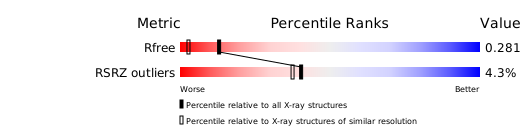
Download full validation report


