






9RFE
Human ADP-ribosylhydrolase 3 (ARH3) in complex with an inhibitor
This is a non-PDB format compatible entry.
Summary for 9RFE
| Entry DOI | 10.2210/pdb9rfe/pdb |
| Descriptor | ADP-ribosylhydrolase ARH3, MAGNESIUM ION, ACETIC ACID, ... (5 entities in total) |
| Functional Keywords | adp-ribosylation, adp-ribosylhydrolase, arh3, hydrolase |
| Biological source | Homo sapiens (human) |
| Total number of polymer chains | 2 |
| Total formula weight | 77086.80 |
| Authors | Paakkonen, J.,Lehtio, L. (deposition date: 2025-06-04, release date: 2025-09-24, Last modification date: 2025-10-29) |
| Primary citation | Parviainen, T.A.O.,Duong, M.T.H.,Paakkonen, J.,Burdova, K.,Kuttichova, B.,Hanzlikova, H.,Lehtio, L.,Heiskanen, J.P. Discovery and Structural Optimization of 2-Hydrazinopyrimidin-4-one Analogs Inhibiting Human ADP-Ribosylhydrolase ARH3. Acs Chem.Biol., 20:2438-2450, 2025 Cited by PubMed Abstract: Poly-ADP-ribosylation at sites of DNA damage, catalyzed by PARP enzymes, activates the DNA damage response, chromatin remodeling, and DNA repair. The modification is reversed by two enzymes in humans: PARG, which efficiently hydrolyzes the poly-ADP-ribose chains, and ARH3, which is the key enzyme for removing the last proximal mono-ADP-ribose from serine residues. While inhibitor development has largely focused on PARPs and PARG, no potent and selective inhibitors for ARH3 are currently available. We optimized a FRET-based competition assay for ARH3 and carried out high-throughput screening of small-molecule inhibitors. One hit compound, , with a potency of 22 μM was discovered, and through structure-activity relationship studies and synthesis, we improved its potency 10-fold to 2 μM (compound , MDOLL-0286). We demonstrate that the compound inhibits ARH3's poly-ADP-ribose hydrolytic activity on cellular substrates. Intriguingly, it does not effectively inhibit the hydrolysis of mono-ADP-ribosylation from natural protein substrates. This is despite the fact that the cocrystal structure of compound bound to ARH3 reveals its overlap with the enzyme's ADP-ribose binding site, agreeing with the competition in the FRET assay. The first experimental ARH3 inhibitor complex provides a valuable starting point for developing more potent chemical probes to study DNA damage response mechanisms in the future. PubMed: 40952342DOI: 10.1021/acschembio.5c00461 PDB entries with the same primary citation |
| Experimental method | X-RAY DIFFRACTION (1.85 Å) |
Structure validation
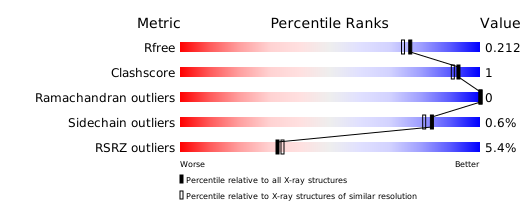
Download full validation report


