






9QT5
Structure of the 50S ribosomal subunit from the antibiotic-producing bacterium Streptomyces fradiae
Summary for 9QT5
| Entry DOI | 10.2210/pdb9qt5/pdb |
| EMDB information | 53347 |
| Descriptor | Large ribosomal subunit protein uL16, Large ribosomal subunit protein uL14, Large ribosomal subunit protein uL18, ... (30 entities in total) |
| Functional Keywords | streptomyces, ribosome, 50s, ribosome-targeting antibiotics |
| Biological source | Streptomyces fradiae ATCC 10745 = DSM 40063 More |
| Total number of polymer chains | 30 |
| Total formula weight | 1431851.76 |
| Authors | Ekemezie, C.L.,Melnikov, S.V. (deposition date: 2025-04-07, release date: 2025-05-14, Last modification date: 2025-11-26) |
| Primary citation | Ekemezie, C.L.,Chan, L.I.,Brown, C.R.,Helena-Bueno, K.,Williams, T.A.,Melnikov, S.V. Extensive natural variation in bacterial ribosomal drug-binding sites. Cell Rep, 44:115878-115878, 2025 Cited by PubMed Abstract: Ribosomes from certain bacteria possess divergent drug-binding sites compared to those of Escherichia coli, leading to natural evasion or hypersensitivity to antibiotics. However, in the absence of systematic studies, it is unknown whether this divergence is rare or common among bacterial species. Here, we address this by reconstructing the evolutionary history of drug-binding residues in bacterial ribosomes. We find that many rRNA residues that are currently viewed as bacterial-specific features of ribosomal drug-binding sites are in fact conserved only in a subset of bacteria. Conversely, species with divergent drug-binding sites are widespread in nature, arising from ancient rRNA polymorphisms at the direct ribosome-drug interface. Using a few bacterial species harboring divergent drug-binding sites, we identify their intrinsic resistance to corresponding ribosome-targeting antibiotics. Overall, we reveal the extensive lineage-specific diversity of ribosomal drug-binding sites, offering a resource for developing more targeted antibiotics and enabling personalized drug selection for specific pathogens. PubMed: 40536873DOI: 10.1016/j.celrep.2025.115878 PDB entries with the same primary citation |
| Experimental method | ELECTRON MICROSCOPY (3.13 Å) |
Structure validation
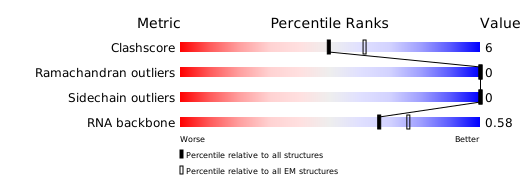
Download full validation report


