






9Q9E
Crystal structure of a TELSAM-SUMO1 fusion protein
Summary for 9Q9E
| Entry DOI | 10.2210/pdb9q9e/pdb |
| Descriptor | Transcription factor ETV6,Small ubiquitin-related modifier 1, PENTAETHYLENE GLYCOL, PHOSPHATE ION, ... (4 entities in total) |
| Functional Keywords | sumoylation, fusion protein-assisted crystallisation, telsam domain, sumo1 protein, signaling protein |
| Biological source | Homo sapiens (human) More |
| Total number of polymer chains | 3 |
| Total formula weight | 59297.01 |
| Authors | Coste, F.,Mishra, A.,Suskiewicz, M.J. (deposition date: 2025-02-26, release date: 2025-06-18, Last modification date: 2025-09-24) |
| Primary citation | Mishra, A.,Goffinont, S.,Coste, F.,Cisse, E.H.,Mance, L.,Castaing, B.,Suskiewicz, M.J. Fusion Protein-Assisted Crystallization of Human SUMO1. Proteins, 93:1767-1779, 2025 Cited by PubMed Abstract: In this study, we employed a fusion protein-assisted approach to crystallize human SUMO1, an essential covalent protein modifier that also interacts noncovalently with specific linear protein motifs called SUMO-interacting motifs (SIMs). SUMO1 has been crystallized previously as part of various complexes but never in isolation. Our strategy involved fusing a variant of a known crystallization facilitator, the TELSAM domain, upstream of the folded part of the SUMO1 protein (residues 18-97). Following a simple purification strategy, we obtained a 2.05-Å crystal structure of apo TELSAM-SUMO1, with three distinct SUMO1 chains per asymmetric unit, two of which have an accessible pocket for binding to a SIM. The crystal structure is composed of the expected left-handed helical filaments formed by TELSAM domains, with protruding SUMO1 molecules mediating connections within and between these filaments to stabilize a three-dimensional lattice. Since the TELSAM fusion does not affect the SUMO:SIM interaction, as confirmed in solution, our construct may potentially be used to structurally characterize complexes formed between SUMO and SIM-containing peptides. Neither does the TELSAM fusion interfere with the attachment of SUMO1 to substrates, potentially allowing for the creation of SUMOylated protein forms with improved crystallizability. The study represents a novel application of TELSAM-assisted crystallization to a small protein of major biological relevance. PubMed: 40406964DOI: 10.1002/prot.26838 PDB entries with the same primary citation |
| Experimental method | X-RAY DIFFRACTION (2.05 Å) |
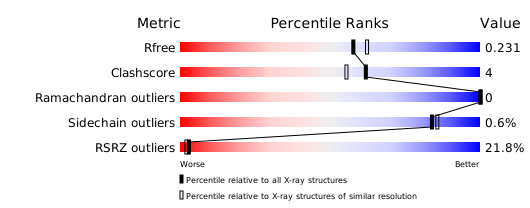
Structure validation
Download full validation report


