






9JBL
Crystal structure of amyloidogenic peptide Bz-FFAALL-NH2
This is a non-PDB format compatible entry.
Summary for 9JBL
| Entry DOI | 10.2210/pdb9jbl/pdb |
| Descriptor | Amyloidogenic peptide (1 entity in total) |
| Functional Keywords | amyloid, amyloid-reoriented enzyme catalysis, protein fibril |
| Biological source | Homo sapiens |
| Total number of polymer chains | 1 |
| Total formula weight | 782.95 |
| Authors | Sawazaki, T.,Murai, F.,Yamamoto, K.,Sasaki, D.,Sohma, Y. (deposition date: 2024-08-27, release date: 2025-04-09, Last modification date: 2025-04-16) |
| Primary citation | Sawazaki, T.,Murai, F.,Yamamoto, K.,Sasaki, D.,Sohma, Y. Amyloid-reoriented enzyme catalysis. Nat Commun, 16:3164-3164, 2025 Cited by PubMed Abstract: Enzyme catalysis is essential for molecular transformations. Here, we make use of amyloid, a fibrillar aggregate formed by stacking peptides with β-sheet, which offers unique selectivity in enzymatic reactions. Azo-stilbene derivative (ASB), the amyloid-recognition motif, is incorporated into the substrate, which allows the amyloid consisting of Bz-Phe-Phe-Ala-Ala-Leu-Leu-NH (BL7) to shield the substrates from the approaching enzyme. X-ray crystallographic analysis and structure-shielding effect relationship studies of BL7 reveal that the benzene rings present in the N-terminal benzoyl group and Phe1 side chain are particularly important for the shielding effect on the substrate. The finding results in a selective transformation system in which the reactive site close to ASB is protected by amyloid, while a site far from ASB is converted by the enzymes (trypsin, protein arginine deiminase [PAD], and Staphylococcus aureus V-8 Protease [Glu-C]). Further, the amyloid-shielded enzyme catalysis is compatible with an intact peptide, as the side chain of Tyr can be converted to the amyloid-recognizing motif. The enzymatic reactions combining amyloid provide unique selectivity for molecular transformation which may be used in diverse fields, including in synthetic chemistry. PubMed: 40175427DOI: 10.1038/s41467-025-58536-5 PDB entries with the same primary citation |
| Experimental method | X-RAY DIFFRACTION (1 Å) |
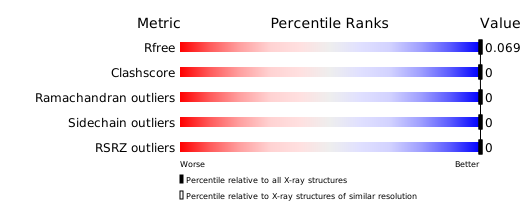
Structure validation
Download full validation report


