






9IHF
Nucleosome core particle bound by one monomer and one dimer of of DTT-reduced native myeloperoxidase
Summary for 9IHF
| Entry DOI | 10.2210/pdb9ihf/pdb |
| EMDB information | 52870 |
| Descriptor | Histone H3.2, alpha-D-mannopyranose-(1-6)-beta-D-mannopyranose-(1-4)-2-acetamido-2-deoxy-beta-D-glucopyranose-(1-4)-[alpha-L-fucopyranose-(1-6)]2-acetamido-2-deoxy-beta-D-glucopyranose, PROTOPORPHYRIN IX CONTAINING FE, ... (12 entities in total) |
| Functional Keywords | histone, acidic patch, innate immunity, nets, immune system |
| Biological source | Xenopus laevis (African clawed frog) More |
| Total number of polymer chains | 16 |
| Total formula weight | 381944.70 |
| Authors | Raisch, T.,Burn, G.L.,Tacke, S.,Winkler, M.,Prumbaum, D.,Thee, S.,Zychlinsky, A.,Raunser, S. (deposition date: 2025-02-21, release date: 2025-08-06, Last modification date: 2025-12-03) |
| Primary citation | Burn, G.L.,Raisch, T.,Tacke, S.,Winkler, M.,Prumbaum, D.,Thee, S.,Gimber, N.,Raunser, S.,Zychlinsky, A. Myeloperoxidase transforms chromatin into neutrophil extracellular traps. Nature, 647:747-756, 2025 Cited by PubMed Abstract: Neutrophils, the most abundant and biotoxic immune cells, extrude nuclear DNA into the extracellular space to maintain homeostasis. Termed neutrophil extracellular traps (NETs), these protein-modified and decondensed extracellular DNA scaffolds control infection and are involved in coagulation, autoimmunity and cancer. Here we show how myeloperoxidase (MPO), a highly expressed neutrophil protein, disassembles nucleosomes, thereby facilitating NET formation, yet also binds stably to NETs extracellularly. We describe how the oligomeric status of MPO governs both outcomes. MPO dimers interact with nucleosomal DNA using one protomer and concurrently dock into the nucleosome acidic patch with the other protomer. As a consequence, dimeric MPO displaces DNA from the core complex, culminating in nucleosome disassembly. On the other hand, MPO monomers stably interact with the nucleosome acidic patch without making concomitant DNA contacts, explaining how monomeric MPO binds to and licences NETs to confer hypohalous acid production in the extracellular space. Our data demonstrate that the binding of MPO to chromatin is governed by specific molecular interactions that transform chromatin into a non-replicative, non-encoding state that offers new biological functions in a cell-free manner. We propose that MPO is, to our knowledge, the first member of a class of proteins that convert chromatin into an immune effector. PubMed: 40963017DOI: 10.1038/s41586-025-09523-9 PDB entries with the same primary citation |
| Experimental method | ELECTRON MICROSCOPY (3.16 Å) |
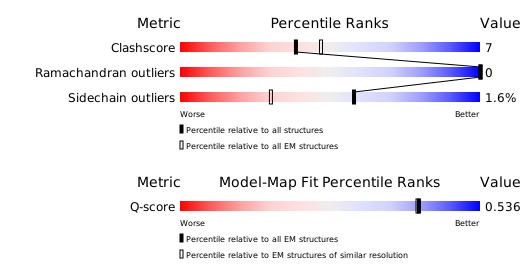
Structure validation
Download full validation report


