






9HS0
Copper-containing nitrite reductase (NirK) from Bradyrhizobium japonicum USDA110
Summary for 9HS0
| Entry DOI | 10.2210/pdb9hs0/pdb |
| Descriptor | Copper-containing nitrite reductase, COPPER (II) ION (3 entities in total) |
| Functional Keywords | copper-binding protein, reductase, nirk, oxidoreductase |
| Biological source | Bradyrhizobium diazoefficiens USDA 110 |
| Total number of polymer chains | 1 |
| Total formula weight | 39885.49 |
| Authors | |
| Primary citation | Ramirez, C.S.,Tolmie, C.,Rivas, M.G.,Gonzalez, P.J.,Murgida, D.H.,Opperman, D.J.,Brondino, C.D.,Ferroni, F.M. Structural insights into the copper-containing nitrite reductase from Bradyrhizobium japonicum USDA110 and its role in the low nitrite reductase activity of rhizobia. Arch.Biochem.Biophys., 770:110467-110467, 2025 Cited by PubMed Abstract: Bradyrhizobium japonicum USDA110 is a widely used microorganism in the formulation of bioinoculants for soybean crops, harboring a copper-containing nitrite reductase with low enzymatic activity. The activity of BjNirK at pH 6.5 was higher compared to that at pH 8.0, regardless of the presence of either physiological or artificial electron donors. Thermal shift assays reveal that the enzyme is more stable at pH 6.5 than at pH 8.0. X-ray structural data reveals that the funnel for substrate entry shows a wider cavity when compared to other class I NirK structures. Furthermore, the presence of an additional channel for proton provision is observed, in addition to the primary and secondary proton channels. The T2Cu active site can accommodate one or two water molecules, resulting in a tetra- or pentacoordinated metal site, respectively. The structural data correlates well with both optical visible and resonance Raman spectroscopies, denoting a strong blue character of the T1Cu site in both solid and solution states. Furthermore, EPR-monitored redox titration reveals that the catalytic rate is not constrained by T1Cu-T2Cu intraprotein electron transfer reaction at either pH 6.5 or pH 8.0. Additionally, bioinformatics studies indicate that the interaction between the enzyme and the electron donor is not pH dependent. These two observations suggest that the low activity of BjNirK is not caused by inefficient donor-enzyme interaction or impaired electron transfer. The present results suggest that the structural architecture and enzyme properties in rhizobia are designed to ensure low activity, a trait that is particularly advantageous for symbiosis. PubMed: 40381977DOI: 10.1016/j.abb.2025.110467 PDB entries with the same primary citation |
| Experimental method | X-RAY DIFFRACTION (1.3 Å) |
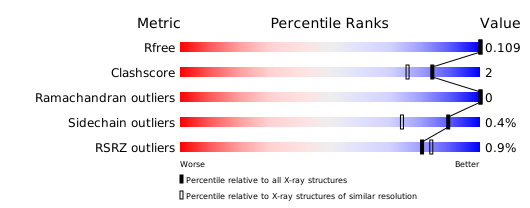
Structure validation
Download full validation report


