






9E6W
NF-kappaB RelA homo-dimer bound to a kappaB site of Cxcl2 gene
Summary for 9E6W
| Entry DOI | 10.2210/pdb9e6w/pdb |
| Descriptor | Transcription factor p65, DNA (5'-D(P*AP*CP*TP*GP*GP*GP*CP*TP*TP*TP*TP*CP*CP*AP*GP*TP*GP*A)-3'), DNA (5'-D(P*TP*CP*AP*CP*TP*GP*GP*AP*AP*AP*AP*GP*CP*CP*CP*AP*GP*T)-3'), ... (4 entities in total) |
| Functional Keywords | rela, kappab dna, promoter, transcription, dna binding protein, dna binding protein-dna complex, dna binding protein/dna |
| Biological source | Mus musculus (house mouse) More |
| Total number of polymer chains | 4 |
| Total formula weight | 76770.62 |
| Authors | Biswas, T.,Shahabi, S.,Ghosh, G. (deposition date: 2024-10-31, release date: 2025-09-17, Last modification date: 2025-10-22) |
| Primary citation | Shahabi, S.,Biswas, T.,Shen, Y.,Sanahmadi, R.,Zou, Y.,Ghosh, G. Teamwork of clustered low-affinity kappa B sites and accessory factors regulates transcriptional strength of NF-kappa B RelA dimers. Nucleic Acids Res., 53:-, 2025 Cited by PubMed Abstract: Non-consensus binding sites of transcription factors (TFs) are often observed within the regulatory elements of genes; however, their effect on transcriptional strength is unclear. Within the promoters and enhancers of NF-κB-responsive genes, we identified clusters of non-consensus κB DNA sites, many exhibiting low affinity for NF-κB in vitro. Deletion of these sites demonstrated their collective critical role in transcription. We explored how these "weak" κB sites exert their influence, especially given the typically low nuclear concentrations of NF-κB. Using proteomics approaches, we identified additional nuclear factors, including other DNA-binding TFs, that could interact with κB site-bound NF-κB RelA. ChIP-seq and RNA-seq analyses suggest that these accessory TFs, referred to as the TF-cofactors of NF-κB, facilitate dynamic recruitment of NF-κB to the clustered weak κB sites. Overall, the occupancy of NF-κB at promoters and enhancers appears to be defined by a collective contribution from all κB sites, both weak and strong, in association with specific cofactors. This congregation of multiple factors within dynamic transcriptional complexes is likely a common feature of transcriptional programs. PubMed: 41063342DOI: 10.1093/nar/gkaf846 PDB entries with the same primary citation |
| Experimental method | X-RAY DIFFRACTION (2.04 Å) |
Structure validation
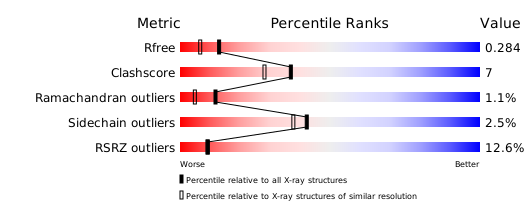
Download full validation report


