






8VJD
Human R14A Pin1 covalently bound to inhibitor 158F10 in P21 21 21 space group
This is a non-PDB format compatible entry.
Summary for 8VJD
| Entry DOI | 10.2210/pdb8vjd/pdb |
| Descriptor | Peptidyl-prolyl cis-trans isomerase NIMA-interacting 1, Inhibitor 158F10, 3,6,9,12,15,18-HEXAOXAICOSANE-1,20-DIOL, ... (5 entities in total) |
| Functional Keywords | destabilizing inhbitor, ppiase, structure-activity relationship, drug design, isomerase, isomerase-inhibitor complex, isomerase/inhibitor |
| Biological source | Homo sapiens (human) More |
| Total number of polymer chains | 4 |
| Total formula weight | 39485.50 |
| Authors | Rodriguez, I.,Blaha, G. (deposition date: 2024-01-06, release date: 2024-11-06, Last modification date: 2025-03-05) |
| Primary citation | Alboreggia, G.,Udompholkul, P.,Rodriguez, I.,Blaha, G.,Pellecchia, M. Targeted degradation of Pin1 by protein-destabilizing compounds. Proc.Natl.Acad.Sci.USA, 121:e2403330121-e2403330121, 2024 Cited by PubMed Abstract: The concept of targeted protein degradation is at the forefront of modern drug discovery, which aims to eliminate disease-causing proteins using specific molecules. In this paper, we explored the idea to design protein degraders based on the section of ligands that cause protein destabilization, hence that facilitate the cellular breakdown of the target. Our studies present covalent agents targeting Pin1, a cis-trans prolyl isomerase that plays a crucial role in tumorigenesis. Our design strategy entailed iterative optimizations of agents for potency and Pin1 destabilization in vitro. Biophysical and cellular studies suggest that the agents may act like , displacing protein-stabilizing interactions that open the structure for recognition by the proteasome degradation machinery. This approach resulted in a series of potent and effective Pin1 degraders with potential applications in target validation and in therapeutic development. We propose that our design strategy can identify molecular degraders without engineering bifunctional agents that artificially create interactions between a disease-causing protein and a ubiquitin ligase. PubMed: 39531501DOI: 10.1073/pnas.2403330121 PDB entries with the same primary citation |
| Experimental method | X-RAY DIFFRACTION (1.57 Å) |
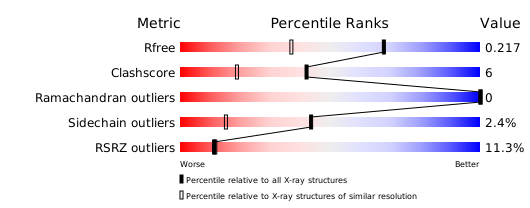
Structure validation
Download full validation report


