






3NAD
Crystal Structure of Phenolic Acid Decarboxylase from Bacillus pumilus UI-670
Summary for 3NAD
| Entry DOI | 10.2210/pdb3nad/pdb |
| Descriptor | Ferulate decarboxylase, SULFATE ION (3 entities in total) |
| Functional Keywords | beta barrel, lipocalin, biocatalysis, decarboxylase, lyase |
| Biological source | Bacillus pumilus (Bacillus mesentericus) |
| Total number of polymer chains | 2 |
| Total formula weight | 38309.19 |
| Authors | Matte, A.,Grosse, S.,Bergeron, H.,Abokitse, K.,Lau, P.C.K. (deposition date: 2010-06-01, release date: 2010-11-10, Last modification date: 2023-09-06) |
| Primary citation | Matte, A.,Grosse, S.,Bergeron, H.,Abokitse, K.,Lau, P.C. Structural analysis of Bacillus pumilus phenolic acid decarboxylase, a lipocalin-fold enzyme. Acta Crystallogr.,Sect.F, 66:1407-1414, 2010 Cited by PubMed Abstract: The decarboxylation of phenolic acids, including ferulic and p-coumaric acids, to their corresponding vinyl derivatives is of importance in the flavouring and polymer industries. Here, the crystal structure of phenolic acid decarboxylase (PAD) from Bacillus pumilus strain UI-670 is reported. The enzyme is a 161-residue polypeptide that forms dimers both in the crystal and in solution. The structure of PAD as determined by X-ray crystallography revealed a β-barrel structure and two α-helices, with a cleft formed at one edge of the barrel. The PAD structure resembles those of the lipocalin-fold proteins, which often bind hydrophobic ligands. Superposition of structurally related proteins bound to their cognate ligands shows that they and PAD bind their ligands in a conserved location within the β-barrel. Analysis of the residue-conservation pattern for PAD-related sequences mapped onto the PAD structure reveals that the conservation mainly includes residues found within the hydrophobic core of the protein, defining a common lipocalin-like fold for this enzyme family. A narrow cleft containing several conserved amino acids was observed as a structural feature and a potential ligand-binding site. PubMed: 21045284DOI: 10.1107/S174430911003246X PDB entries with the same primary citation |
| Experimental method | X-RAY DIFFRACTION (1.69 Å) |
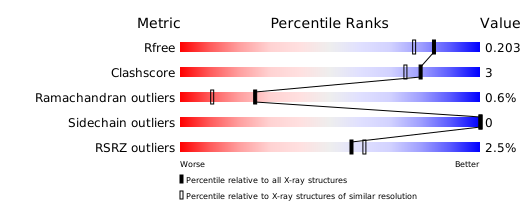
Structure validation
Download full validation report


